- Basedment
- Posts
- Russians Push Out From Pokrovsk, Iran Continues Energy War
Russians Push Out From Pokrovsk, Iran Continues Energy War
The Dobropillya front has finally moved in favour of the Russians after months of back and forth, while Iran continues it's energy war proxies show their weight!

Editor-in-Chief
March 12, 2026
THE BRIEFING
Here’s what’s happening in geopolitics today.
The Middle East dominates the headlines today, with attacks on commercial vessels in the Persian Gulf raising fears for global shipping as the Iran-U.S. confrontation spills into vital sea lanes.
Elsewhere, Ghana is gaining support for a U.N. push on slave-trade reparations, China is stepping in to calm rising tensions on the Pakistan-Afghanistan border, and Southeast Asian ministers are weighing how the Middle East crisis could ripple through energy markets and regional economies. Meanwhile, Russia is urging Washington and Israel to halt strikes on Iran.
In today’s deep dive, we look at how the battlefield around Dobropillya may finally be tilting in Moscow’s favour.
THE LAST 24 HOURS IN GEOPOLITICS
1. Six vessels attacked amid reports of Iranian drone boats, sea mines
At least six commercial vessels have been attacked in the Persian Gulf and near the Strait of Hormuz amid reports that Iranian forces are using drone boats and naval mines to target shipping. Some of the ships sustained damage from explosions or projectiles, forcing crews to abandon vessels while regional navies responded to rescue operations. The incidents mark a significant escalation in maritime threats tied to the Iran-U.S. conflict and have heightened concerns over the safety of global oil and cargo shipments passing through the strategic waterway.
read more
2. Ghana’s bid for UN resolution on slave trade reparations gains momentum
Ghana is preparing to introduce a resolution at the United Nations General Assembly that would formally recognize the transatlantic slave trade as the “gravest crime in the history of humankind” and call for reparations. The initiative, backed by the African Union and expected to gain support from Caribbean nations, reflects a broader push by African and diaspora governments to address the lasting economic and social impacts of slavery. While Ghana says momentum is building internationally, several European governments are expected to oppose the move, arguing present-day states should not be held responsible for historical injustices.
read more
3. China steps in to mediate Pakistan-Afghanistan border dispute
China has stepped in diplomatically to mediate escalating tensions between Pakistan and Afghanistan following some of the heaviest cross-border fighting in years. Chinese officials, including diplomats and envoys, have been in contact with both governments, and a message from President Xi Jinping urging restraint was conveyed to Pakistani leaders as Beijing pushed for de-escalation. While clashes and skirmishes continue along the border, Chinese mediation efforts are reported to have helped reduce the intensity of fighting and encourage renewed dialogue between the two sides.
read more
4. ASEAN ministers to discuss Middle East crisis impact
Southeast Asian officials are set to discuss the economic and security impact of the escalating Middle East crisis during upcoming meetings of ASEAN ministers. The talks are expected to focus on rising oil prices, supply disruptions, and the broader effects on trade and regional growth, as many Southeast Asian economies rely heavily on energy imports from the Middle East. The discussions come amid growing concern that prolonged instability in the region could intensify inflationary pressures and disrupt global shipping routes critical to Asian economies.
read more
5. Russia calls on Israel and US to end the Iran war
Russia has called on the United States and Israel to halt their military strikes on Iran and return to diplomatic negotiations as the conflict continues to escalate. Moscow said the attacks risk further destabilizing the Middle East and warned that civilian casualties in Iran are mounting. Russian officials also indicated they are willing to support diplomatic efforts aimed at de-escalating the war and bringing the parties back to the negotiating table.
read more
IRAN-USA CONFLICT DAY 13 - Hezbollah Strikes Back
Over the last 24 hours we’ve seen a noticeable escalation across multiple fronts, and it is increasingly clear that Hezbollah’s recovery may have been underestimated by many analysts — myself included.
Hezbollah has launched hundreds of rockets toward northern Israel, while at the same time maintaining fierce ground resistance against Israeli operations. At the operational level this suggests Hezbollah still retains a significant reserve of capability, something that many assumed had been degraded far more heavily earlier in the campaign.
But Hezbollah is not operating alone. In Iraq, Shia militias have begun engaging U.S. forces, with retaliatory drone strikes targeting American and Kurdish compounds. At sea, the situation is also deteriorating rapidly. More tankers have been struck in the Strait of Hormuz, with reports pointing to underwater drones and potentially even mines now being deployed. Even more notable was a drone strike on an oil refinery in Oman, significant given Oman’s traditional role as a mediator and its historically balanced relationship with Iran. Taken together, the concern is not necessarily the individual attacks themselves, but the possibility of a coordinated pressure campaign. If the Houthis activate more aggressively alongside Hezbollah and Iraqi militias, we could see something far more dangerous emerge: a unified regional attack structure that we haven’t really seen in previous conflicts. At the same time, while drones and rockets are clearly hitting U.S. and Israeli assets, the key question remains whether this translates into a strategic blow to power projection, or whether it remains largely disruptive — painful, but not decisive.What it is doing, however, is increasingly turning what was meant to be a precision air campaign into a regional quagmire.
For the first time in the conflict, alliance kamikaze drones have been recorded striking IRGC checkpoints and security positions inside Iran, particularly in Kurdish-dominated western regions. Combined with the ongoing bombing of Iranian military infrastructure in these areas, this suggests that at least part of the Israeli strategy still revolves around creating conditions for internal unrest or localized uprisings, or at the very least weakening the regime’s ability to control peripheral regions.
At the same time, reports indicate that elements of the Iranian leadership have relocated to Mashhad, one of the furthest major cities from current U.S. and Israeli strike zones. This geographic shift may explain why the USS Gerald R. Ford carrier group is moving toward the Red Sea and potentially the Indian Ocean. Beyond countering the Houthis, the redeployment could provide additional strike range and firepower for operations targeting eastern or northern Iran, areas that have so far been harder to reach from existing launch positions.
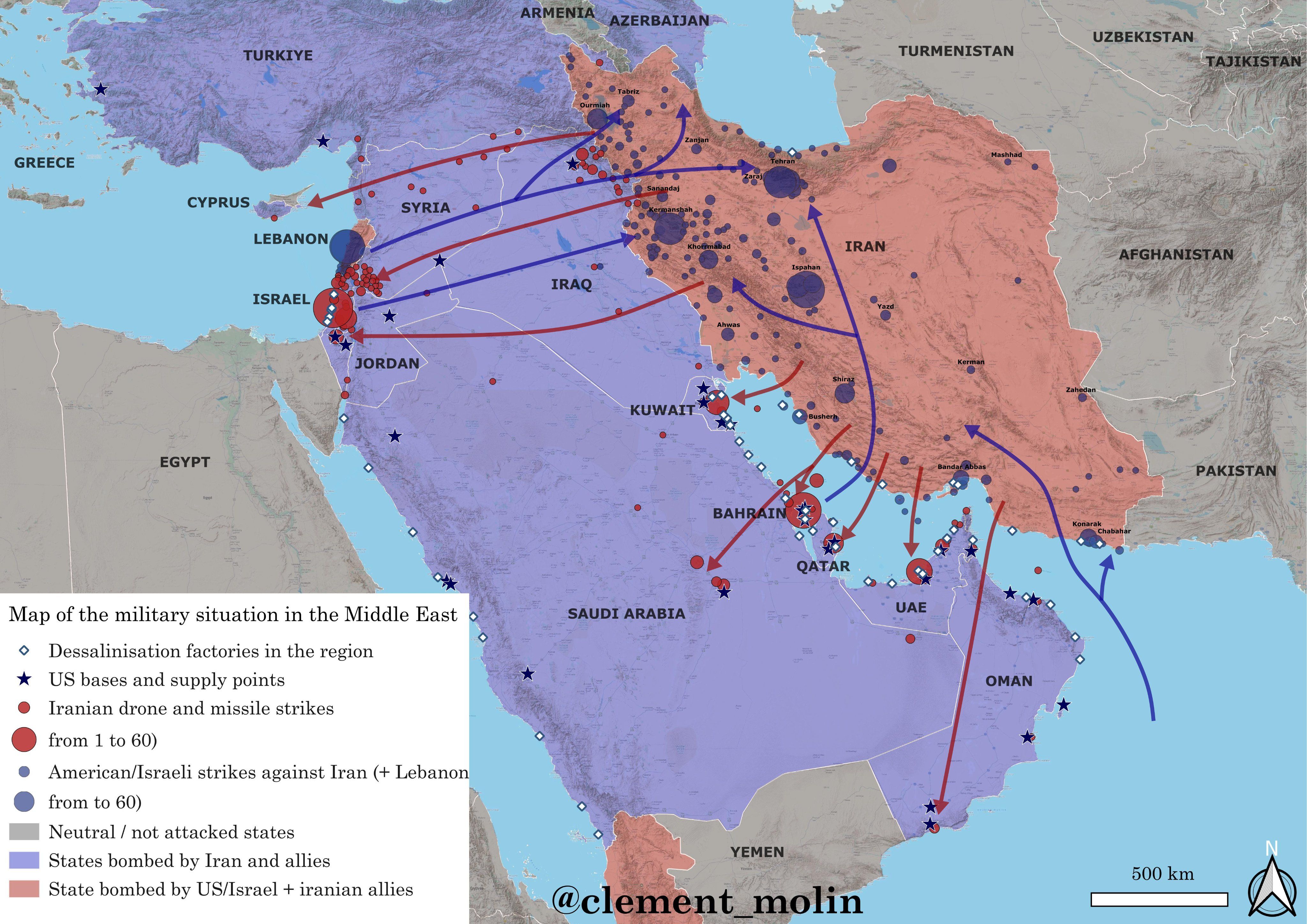
Great map made by Clement Molin check him out on X
Sources available upon request!
RUSSIA-UKRAINE: THE DOBROPILLYA FRONT
A few weeks ago I mentioned that the Dobropillya direction would likely become part of the broader Kostiantynivka effort, and the latest developments on the Pokrovsk–Udachne front seem to be pointing exactly in that direction.
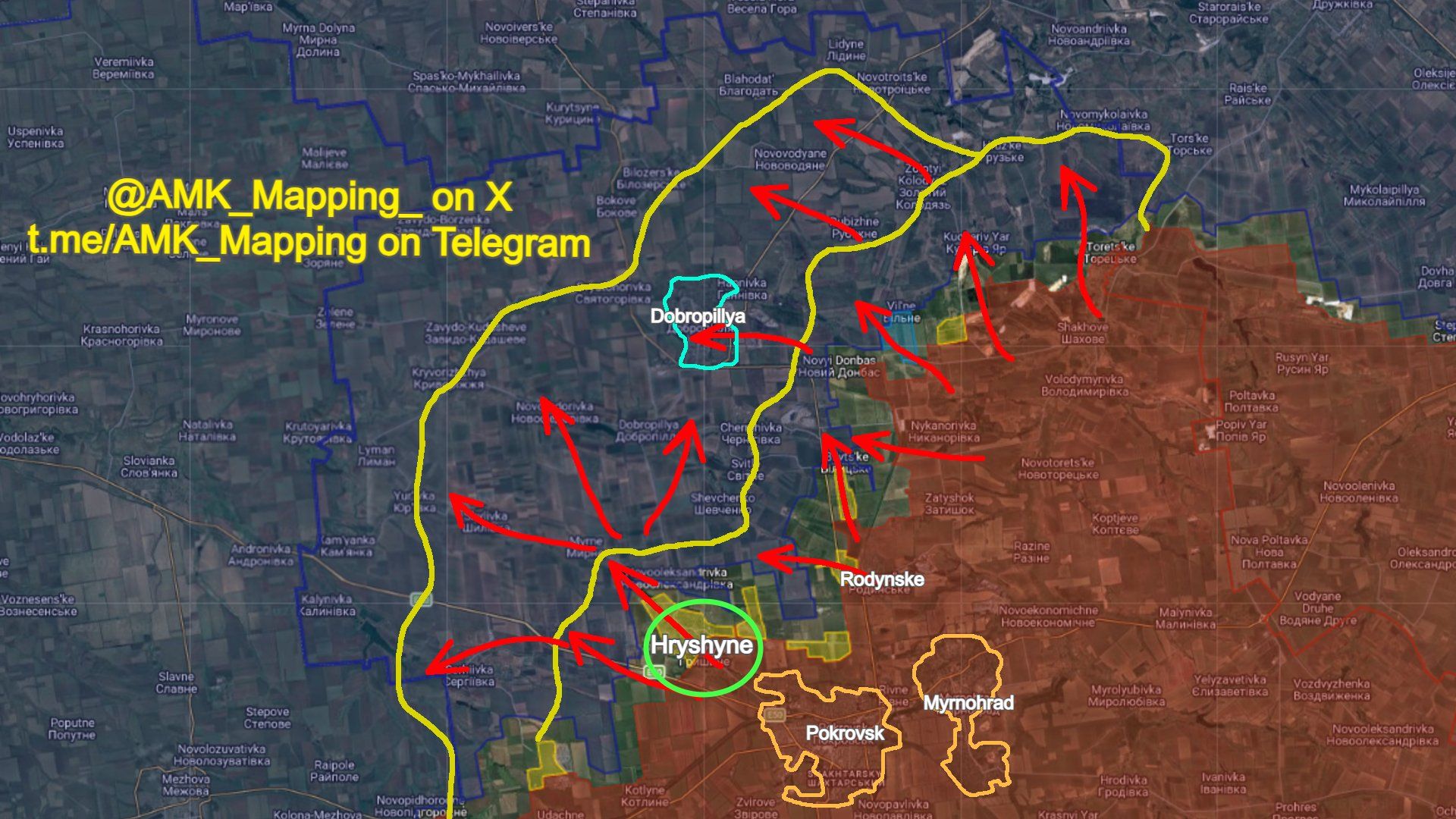
Give AMK_Mapping a follow on Telegram - great OSINT account.
Over the past five days, Russian forces have effectively captured Hryshyne (according to AMK), with clearing operations still ongoing. From there they have already expanded further west, pushing beyond Novooleksandrivka and the Tretii Yar creek toward Matyasheve, with reconnaissance and sabotage groups probing forward. At the same time, Russian units secured several positions north of the pig farms outside Pokrovsk, pushing the frontline further away from the city’s northern dacha areas.
Russian troops are expanding their buffer around Rodynske, advancing near the ruins of the Zaporizhskaya mine, and pushing north from the Zapadnaya No.1 mine landfill, now reportedly approaching the first houses of Serhiivka.
To understand why this matters, we need to zoom out slightly. Since the fall of Pokrovsk in November 2025 and Myrnohrad in January 2026, the frontline here had largely stagnated. Both sides spent months trading positions while Russia regrouped after extremely costly urban fighting. The capture of Hryshyne now changes that equation. With Rodynske already under Russian control, Moscow can begin to properly exploit the logistical infrastructure of Pokrovsk and Myrnohrad, turning the area into a staging ground for deeper operations. Like I said before, Rodynske was fiercely fought over given it sat on the major road linking Pokrovsk to Dobropillya, with its capture it has given the Russians breathing room to bloom outwards.
This is where Dobropillya becomes important. Pushing through this axis brings Russian forces deeper into central Ukraine, right onto the doorstep of the New Donbas defensive line. At the same time, it threatens to sever logistical links between Ukraine’s remaining Donetsk strongholds and the southern front, forcing supply routes further inward.
Adding to the concern for Ukraine is the fact that multiple Ukrainian units were recently pulled out of the Dobropillya sector to support counteroffensives elsewhere, particularly around Hulyaipole and Pokrovs’ke. That leaves this axis relatively exposed just as Russian forces appear to be building momentum. Compounding this further is the presence of several high-value Ukrainian formations, including Skala and other special units, concentrated around Udachne and Hryshyne. With confirmed Russian gains even with this high-value units, this could be concerning development for Ukraine.
If the Russian push continues to expand from Pokrovsk while pressure increases toward Dobropillya, this sector could soon become one of the key operational fronts of the next phase of the war.
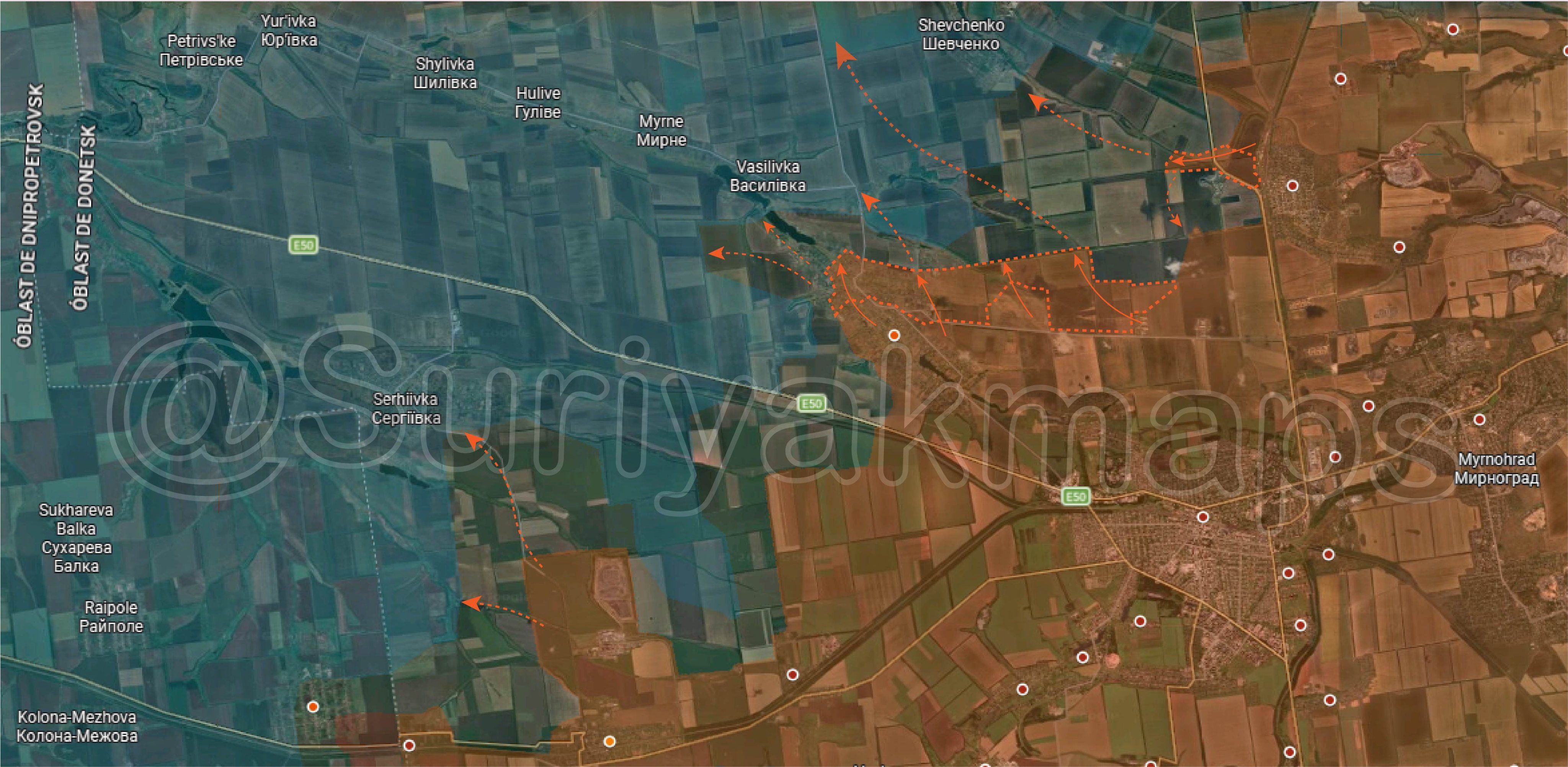
Suriyak also documenting similar gains to AMK. Suriyak is a great source for Russia-Ukraine, but should be noted he is biased toward Iran in the latest conflict.
Sources available upon request!
TWEET OF THE DAY
TODAY IN HISTORY
(March 12, 1930): Gandhi's Salt March begins
On this day in 1930, a small group of Indian citizens walked towards the sea, intending to produce salt from seawater rather than purchasing it from the British. The group, led by Mahatma Gandhi, started at Sabarmati Ashram and headed in the direction of Dandi, on the Gujarat coast. Hundreds of Indians joined along the way. Inspired by the protest, Indians broke salt laws across the country—and more than 60,000 people had been arrested by the end of the year. The Salt March would be a major force in exposing the realities of British colonization to the world, and it ultimately helped to dismantle Britain's presence in India.