- Basedment
- Posts
- Russians Regain Initiative North Of Pokrovsk As Ukraine Fumbles
Russians Regain Initiative North Of Pokrovsk As Ukraine Fumbles
Russia has regained the initiative on the Dobropillya front, today we also explore why Rodysnke is so important to both sides.

Editor-in-Chief
January 16, 2026
In partnership with

THE BRIEFING
Here’s what’s happening in geopolitics today.
From Arctic intrigue over Greenland to a new phase in Gaza’s fragile peace process, today’s top stories span diplomacy, security, and high-stakes politics.
We’re also tracking NATO troops moving north, Ukraine scrambling to keep the lights on, and Uganda heading to the polls under heavy tension and tight controls.
In today’s deep dive, Russia has regained the initiative on the Dobropillya front, we also explore why Rodysnke is so important to both sides.
MESSAGE FROM OUR PARTNER
A big 2026 starts now

Most people treat this stretch of the year as dead time. But builders like you know it’s actually prime time. And with beehiiv powering your content, world domination is truly in sight.
On beehiiv, you can launch your website in minutes with the AI Web Builder, publish a professional newsletter with ease, and even tap into huge earnings with the beehiiv Ad Network. It’s everything you need to create, grow, and monetize in one place.
In fact, we’re so hyped about what you’ll create, we’re giving you 30% off your first three months with code BIG30. So forget about taking a break. It’s time for a break-through.
THE LAST 24 HOURS IN GEOPOLITICS
1. Trump says Greenland will ‘work out’ after Denmark fails to bridge gap
Trump said he believes a resolution over Greenland will “work out,” following high-level talks in Washington with Danish and Greenlandic officials amid ongoing U.S. efforts to increase its influence over the strategically located Arctic territory. Trump reiterated that Greenland is vital to U.S. national security and defense concerns, arguing that Denmark cannot adequately protect the island from potential Russian or Chinese influence, even as Copenhagen and Nuuk maintain sovereignty and reject the notion of selling the territory. Despite these comments, significant disagreements persist between the U.S. and its NATO ally Denmark over Greenland’s future.
read more
2. US announces start of phase two of Gaza peace plan
The United States announced the start of Phase Two of its Trump-brokered Gaza peace plan, shifting focus from a ceasefire to demilitarisation, reconstruction, and the establishment of a transitional technocratic Palestinian administration called the National Committee for the Administration of Gaza (NCAG). U.S. Special Envoy Steve Witkoff said the plan calls for disarming unauthorised armed personnel and rebuilding Gaza, and warned that Hamas must comply fully with its obligations, including the return of the final deceased hostage, or face “serious consequences.”
read more
3. Germany, France, other NATO allies sending troops to Greenland amid Trump threats
Germany, France and other NATO allies are deploying troops to Greenland as tensions rise over Trump’s renewed push to control the strategically significant, mineral-rich Arctic territory. Germany announced it will send a 13-soldier reconnaissance detachment to Greenland this week at Denmark’s request to assess potential contributions to regional security, with Sweden, Norway and France also committing forces as part of a broader European security mission. The deployments come amid a diplomatic rift after talks in Washington failed to reconcile U.S. demands with Danish and Greenlandic insistence on sovereignty.
read more
4. Zelenskyy declares state of emergency in Ukraine’s energy sector
Zelenskyy has declared a state of emergency in the country’s energy sector after sustained Russian attacks on power and heating infrastructure compounded by worsening winter weather, leaving large areas without reliable electricity and heat. The emergency decree empowers authorities to establish a permanent coordination headquarters in Kyiv, streamline responses, boost electricity imports, and more flexibly manage repair and support efforts amid the crisis. Zelenskyy also indicated that the legal emergency framework could lead to adjustments in curfew rules and other measures.
read more
5. Uganda to vote in tense election clouded by succession questions
Ugandans are voting in a tense presidential election on Thursday, with long-time leader President Yoweri Museveni seeking to extend his rule into a fifth decade amid heavy security, an internet blackout, and crackdowns on opposition activity. Museveni’s main challenger is pop-star-turned-politician Bobi Wine, who has mobilized many young voters but faces repeated arrests and violent suppression, while critics worry the vote lacks transparency and civil society monitoring has been curtailed. The election is also clouded by succession questions, with anxiety over Museveni’s potential grooming of his son Muhoozi Kainerugaba.
read more
DAILY DEEP DIVE
The Russians Strike Back At Dobropillya
Russian forces have regained the initiative north of Pokrovsk, steadily expanding control in the Dobropillya axis and pushing Ukrainian units into a reactive posture. After recapturing several previously lost positions, Russian assault groups advanced northward, crossing the road toward Hryshyne at an additional point and seizing the second pig farm complex. From there, they secured adjacent treelines and pushed toward the former Zaporozhskaya Mine, linking up with diversionary reconnaissance groups that had earlier infiltrated from Rodynske.
These movements placed Ukrainian formations in southwestern Rodynske at risk of encirclement, prompting a withdrawal. As a result, Russian units reasserted control over multiple streets and shifted the focus of fighting back toward the city’s northwestern sector. Positions along the Pokrovsk–Rodynske highway, including the ruined pig farm complex, were also retaken. Net territorial gains in this phase amount to roughly 7.8 square kilometres in Russia’s favour.
Pressure continues across the wider Dobropillya–Druzhkivka front. South of Rodynske, Russian infantry established a foothold in railway windbreaks and began massing for further westward assaults, while other elements infiltrated central Rodynske and the Zaporozhskaya Mine. Fighting remains active in Zatyshok, where Russian forces are attempting to clear the last Ukrainian holdouts.
Further north, Russian troops consolidated additional clay mines, forest belts, and treelines, enabling renewed pushes toward Kucheriv Yar, Ivanivka, and western Nove Shakhove. To the northeast, advances from Shakhove yielded new positions southwest of Toretske, with heavy fighting ongoing around a major trench network and improved Russian positions near Sofiivka. These actions added another 7.55 square kilometres to Russia’s control, underscoring sustained, methodical pressure along this sector.
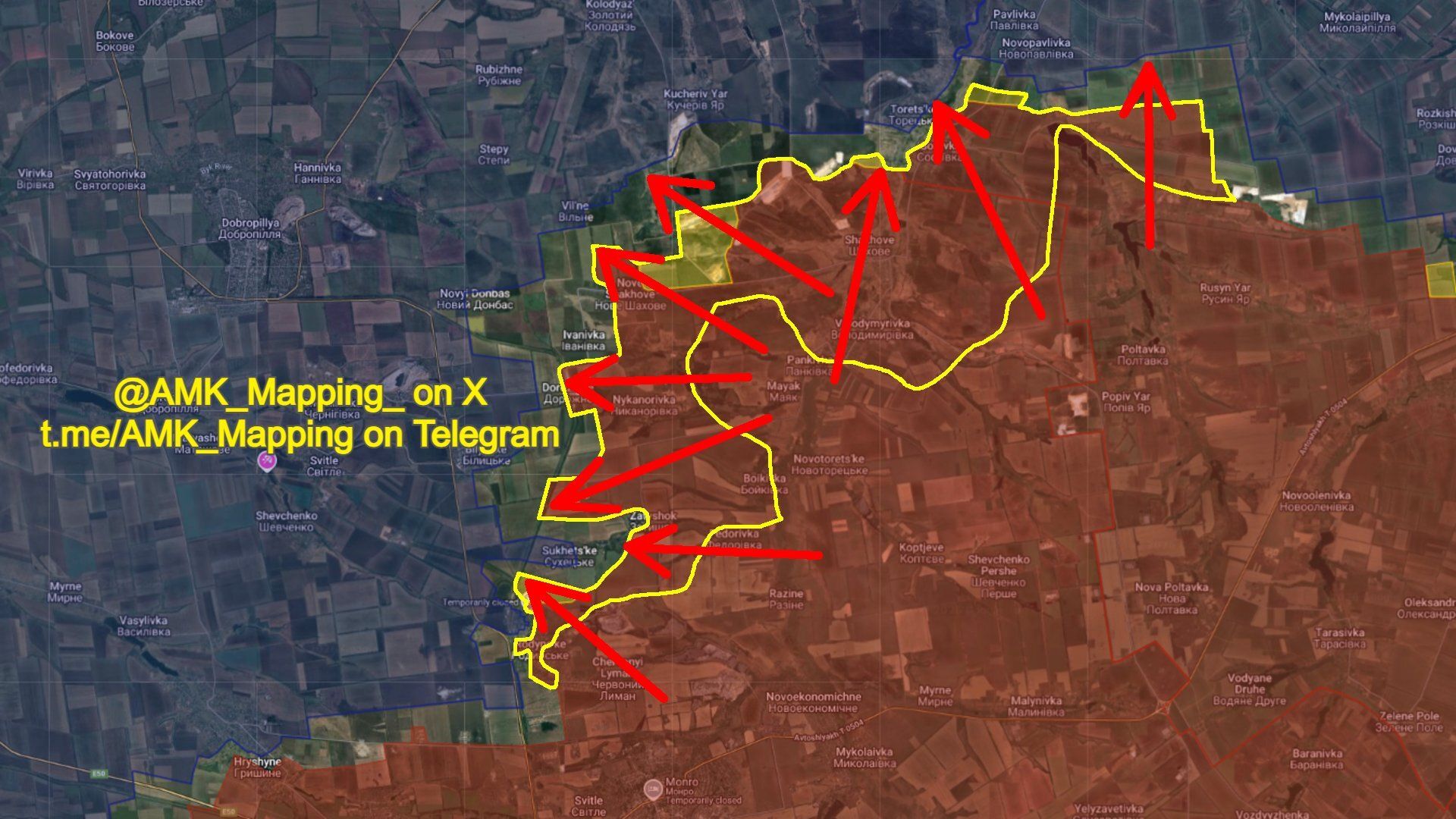
Information for the first section is referenced from AMK_Mapping.
Our Analysis:
Since July, Ukraine has regained the initiative in the Dobropillya salient after the initial Russian breakthrough was contained and pushed back. However, in recent weeks, Russia appears to have swung the momentum back in its favour, retaking several key villages on this front.
This is a highly important (if somewhat unexpected) development if Russia aims to secure the Donbas. Russian forces were able to exploit gaps in Ukrainian lines up to 12 kilometres deep, pushing forward in ones and twos into the unknown and, frankly, hoping for the best. Yes, that is effectively what happened, based on POW reports. Yet it worked. Undermanned Ukrainian fortifications allowed Russian units to slip through, with a primary objective of hunting down Ukrainian drone teams—now a key target across the entire front. These soldiers then attempted to link up with one another, forming ad hoc squads in the rear.
Once this potential became clear, Russia began feeding in reinforcements. However, the inability to commit armoured units blunted the offensive (due to a lack of pontoon available). Ukraine, recognising the danger of Russian units reaching the feared Donbas Line largely unopposed, rushed in its own reinforcements.
By November, both sides had committed mechanised assaults, resulting in heavy losses in manpower and equipment on both sides.
Why is this so important?
It comes down to the Donbas Line. In theory, Russian forces were not expected to reach it until late 2026 or beyond. These are extensive defensive works built behind Kramatorsk and Sloviansk—the first line of defence and the gateway into central Ukraine. The fact that Russian units appeared at these defences within days was deeply concerning.
If Russia can leapfrog from here and consolidate its positions, it risks undermining the entire defensive system. This would also threaten the Dobropillya–Kramatorsk highway, a vital supply route running through the heart of Ukraine-held Donetsk.
Tactically, the town of Rodynske, just north of Pokrovsk, is critical. We have written about it before, but for those unfamiliar: Rodynske is a typical Soviet-era town of four- to five-storey concrete apartment blocks, now turned into extensive, improvised bunkers. Fighting there has been fierce and fluid, with constant back-and-forth. Suriyak and AMK declared the battle finished—but as I said at the time, it was not to last.
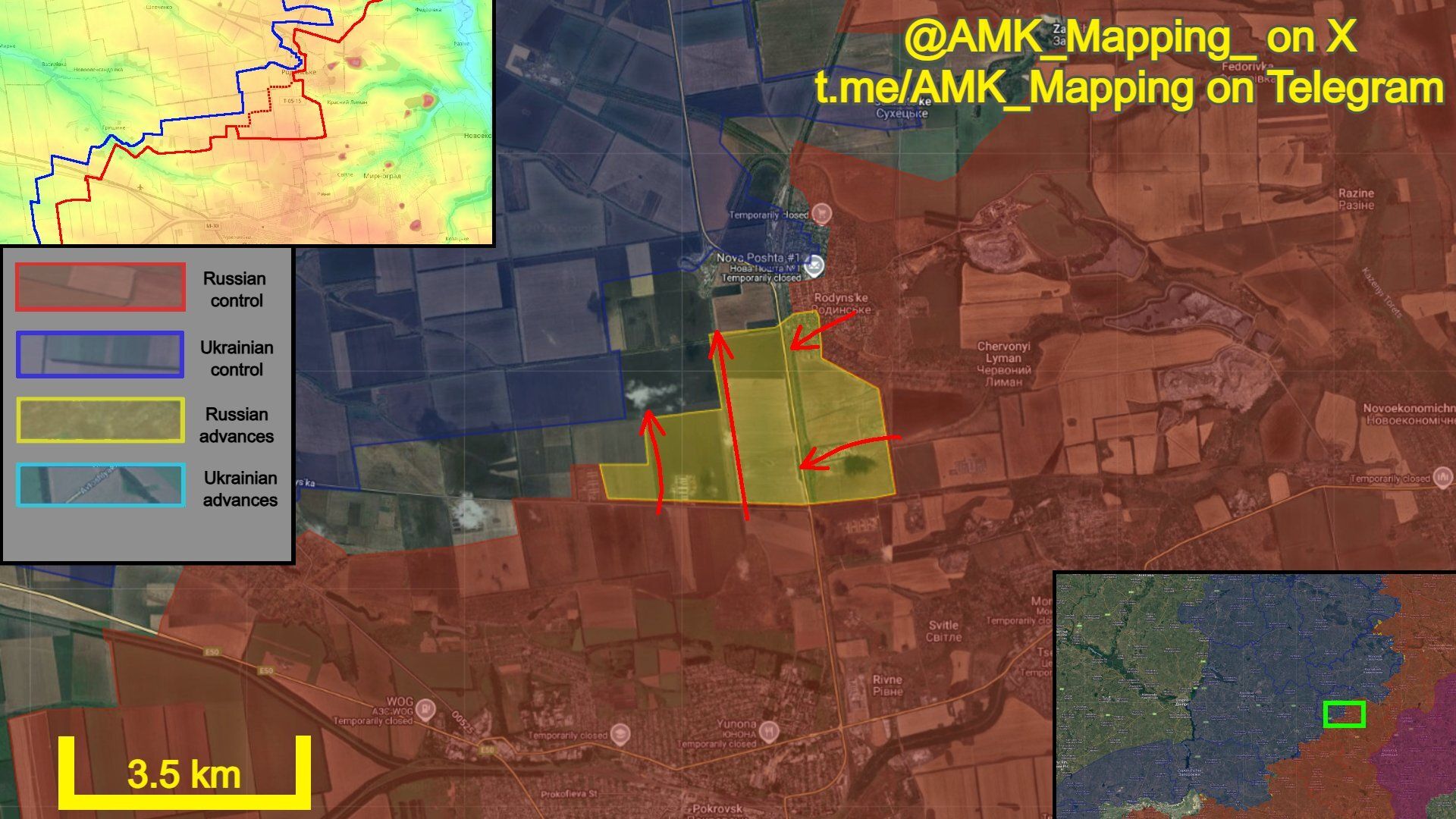
Rodynske matters because it sits directly on the main highway into Pokrovsk. Whoever controls it controls a direct supply route north toward Dobropillya. The current Dobropillya frontline, including the Shakhove sector, is constrained because behind Russian lines sits a river, crossable only by pontoon bridges. So, by taking Rodysnke, Russian units will not need to rely on pontoon crossing and such forth. It was just west of Rodynske that the Australian Abrams was destroyed, this is an important note as it’s clear that Ukraine values Rodynske otherwise it would not send in the 47th.
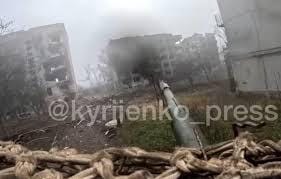
Ukrainian tank and Rodysnke - here we can see the kind of environment we are dealing with (at least west of the town).
Sources
News/Journal sources available upon request, not shown to maintain visual integrity of page.
TODAY IN HISTORY
(January 15, 2025): A ceasefire between Israel and Hamas was announced, 15 months after war between them began. It took effect four days later and held for two months before fighting began again.