- Basedment
- Posts
- Russians Stalled In Pokrovsk: Double Encirclement?
Russians Stalled In Pokrovsk: Double Encirclement?
Your daily dose of geopolitical updates and strategic analysis. Unbiased, but not unbased.

Editor-in-Chief
September 13, 2025
THE BRIEFING
Here’s what’s happening in geopolitics today.
Welcome back to your daily briefing. From Trump predicting Zohran Mamdani’s rise in New York politics to the UN’s overwhelming endorsement of a two-state solution, it’s been a day of big headlines spanning local and global arenas.
In the Middle East, regional powers are pushing for a Sudan truce while Trump meets with Qatar’s prime minister amid tensions in Doha.
In today’s deep dive, we turn to northern Pokrovsk, where Russian units are stalled and Ukrainian counterattacks are testing the limits of Moscow’s summer offensive.
THE LAST 24 HOURS IN GEOPOLITICS
1. Trump forecasts Zohran Mamdani to win NYC mayor
President Trump has predicted that Zohran Mamdani, the Democratic socialist frontrunner in New York City’s mayoral race, is likely to win in November, especially if two of his major opponents drop out. Mamdani, who defeated former governor Andrew Cuomo in the Democratic primary, is polling well against the rest of a divided opposition field including Eric Adams and Curtis Sliwa. Trump’s comments and behind-the-scenes manoeuvring to consolidate non-Mamdani candidates underscore just how high the stakes are perceived to be in this citywide race.
read more
2. Head of U.S. military’s Central Command meets Syrian leader in Damascus
Admiral Brad Cooper, head of U.S. Central Command, met Syria’s interim President Ahmad al-Sharaa in Damascus in a rare high-level meeting, joined by U.S. Envoy Thomas Barrack. They discussed expanding political and military cooperation, including integrating Syrian armed factions into the national military and bolstering efforts to counter the Islamic State. Al-Sharaa also reaffirmed Syria’s commitment to restoring stability, maintaining ties with Russia and Iran while seeking constructive engagement with the West.
read more
3. U.N. overwhelmingly endorses two-state solution declaration
The UN General Assembly on Friday overwhelmingly backed a non-binding declaration that lays out “tangible, time-bound, and irreversible steps” toward a two-state solution between Israel and the Palestinians. The declaration grew out of a July conference co-hosted by Saudi Arabia and France, and the vote finished at 142 in favour, 10 against, and 12 abstentions. While Israel and the U.S. opposed the resolution as counterproductive, the massive international support ahead of the upcoming heads-of-state meeting signals renewed global momentum for pushing a diplomatic path to peace.
read more
4. U.S., Saudi, UAE, Egypt call for Sudan truce and transition to civilian rule
The United States, Saudi Arabia, UAE, and Egypt issued a joint statement Friday calling for a three-month humanitarian truce in Sudan, followed by a permanent ceasefire and a nine-month transition to civilian rule. They argued there’s “no viable military solution” to the conflict, warning that the ongoing war is causing intolerable suffering, displacing millions and stoking famine risks. While the roadmap has broad diplomatic backing, it’s still unclear whether Sudan’s warring parties will agree to or implement the proposal.
read more
5. Trump hosts Qatari PM in New York, days after Israeli attack in Doha
Trump held a dinner with Qatari Prime Minister Sheikh Mohammed bin Abdulrahman al-Thani in New York, just days after an Israeli strike targeted Hamas leaders in Doha, seeking to steady Qatar–U.S. relations amid regional outrage. Trump publicly criticised the Israeli action as “unilateral and counterproductive,” saying it risked derailing U.S.-backed efforts to broker a ceasefire in Gaza. Qatar, meanwhile, reaffirmed its diplomatic role, insisting its mediation efforts must continue despite accusing Israel of undermining peace negotiations.
read more
DAILY DEEP DIVE
DOBROPILLYA: BACK AND FORTH
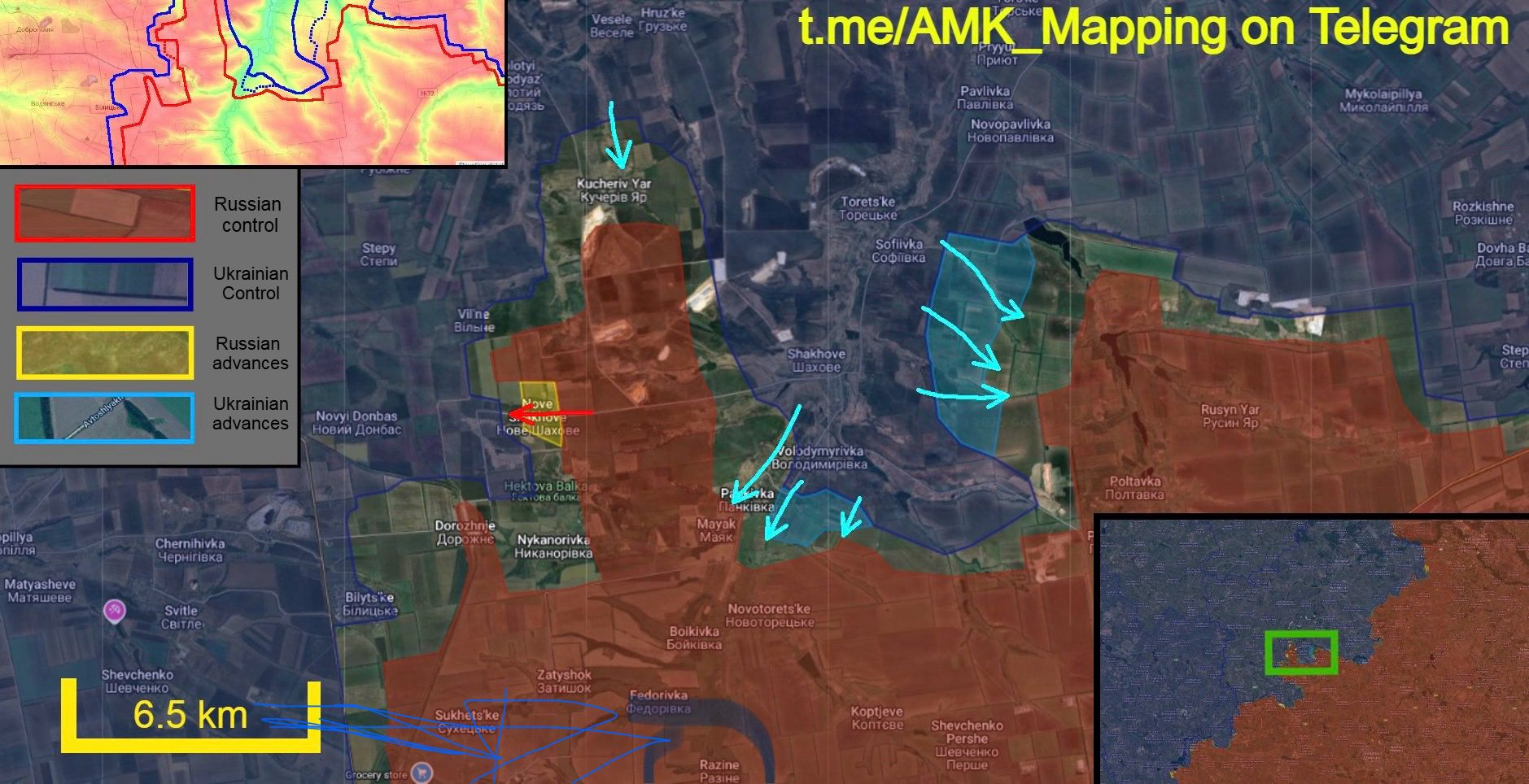
The Dobropillya axis remains one of the most fluid battlefields, with both Russian and Ukrainian forces mounting local offensives and counteroffensives over the last 48 hours. Ukrainian troops have steadily regained ground northeast of Pokrovsk, while Russian forces are attempting to stabilize and expand the salient often referred to as the “bunny ears.” The result has been a patchwork of advances and setbacks on both sides, with the line of control shifting at multiple points.
Ukrainian Movements
Ukrainian units have made progress in two principal sectors:
Northeast sector: After Russian offensive pushes around Sofiivka lost momentum, Ukrainian forces launched counterattacks moving in the direction of Poltavka and Rusyn Yar. They succeeded in clearing several treelines and gaining control along two parallel gulleys. This created a more favorable defensive line and disrupted Russian forward positions.
Southwest sector: Ukrainian formations advanced from Volodymyrivka to the south and southeast. Here, they seized control of three separate treeline systems and pushed into the northern residential blocks of Novotoretske. Fighting also continues for Pankivka, where the village remains heavily contested and effectively in the grey zone, with neither side able to establish full control.
At the same time, Ukrainian forces are working to cut the salient by striking towards the Donets River, the main lifeline for Russian logistics into the Dobropillya area. Ukrainian probes towards Razine and Mynohrad have slowed Russian momentum, and Ukrainian units have even begun striking at Razine itself in an effort to link up with their own elements positioned near Shakhove. If successful, this could create a pocket and place Russian troops inside the salient under pressure of encirclement.
Russian Movements
Russian troops have not remained passive. Despite setbacks northeast of Pokrovsk, they continue to push westward in an effort to broaden their salient.
Kucheriv Yar: Russian forces re-entered the village, securing houses on its eastern edge. Ukrainian troops simultaneously attempted to force entry from the north, leaving the settlement under active contest.
Nove Shakhove: Russian units managed to return to the eastern side of the village, consolidating positions there.
The Russian strategy is clearly aimed at strengthening the “bunny ears” formation on the map, attempting to turn the salient into a more sustainable forward base rather than a vulnerable protrusion. Reports suggest some armor has been deployed in these efforts, although confirmation remains limited.
There is also an attempt to keep pushing northeast and northwest of Shakove to encircle troops there but at the moment this has stalled.
The area has become a chessboard of treelines, gulleys, and small villages — each tactically valuable, each heavily fought over. Neither side has been able to impose operational dominance, and the battle continues to evolve through small, grinding territorial exchanges.
The situation remains fluid, but several trends are clear. Ukrainian counterattacks are increasingly effective, particularly where Russian assaults have stalled. Russian forces are heavily invested in holding the salient and appear willing to absorb casualties to maintain it.
The fight for logistics is decisive, control of routes feeding into Dobropillya from the Donets River may determine whether the salient survives or collapses.
Pokrovsk City
In Pokrovsk city it self, the situation is dynamic. Russian units made significant progress in the city centre near the railway station, but then were kicked out again. Ukrainian sources state these were DRG units, other sources have suggested assault units. Nonetheless, the whole southern sector of the city is a grey zone. Ukraine does not have the troops to defend, but Russia does not yet have the capability to sniff out resistance. Much of this resistance may be underground as we have discussed before which may be rendering FAB and drone strikes less effective. The overall situation is simply unknown, there is a considerable and unusual amount of media black out from both sides.
Sources:
Sources available on request, reduced to maintain visual integrity of page.
TWEET OF THE DAY
Interesting.
Brazil is sending its election denier to prison for 27 years. We sent ours back to the White House. Brazil already lived under military dictatorship and saw the threat clearly. We failed to protect our democracy. We need to learn from Brazil before it’s too late.
— Ed Markey (@SenMarkey)
8:52 PM • Sep 12, 2025
TODAY IN HISTORY
(September 13, 1598): Philip III crowned king of Spain and Portugal
King Philip III of Spain (Philip II of Portugal), crowned on this day in 1598, was virtuous in his private affairs but indifferent as a ruler and extravagant in his spending, exacerbating Spain's growing economic problems.