- Basedment
- Posts
- SPECIAL EDITION: TRUMP AND BIBI SPLIT?
SPECIAL EDITION: TRUMP AND BIBI SPLIT?
In today’s deep dive, we focus on the growing whispers about a rift between Bibi and Trump as the signs are there.

Editor-in-Chief
March 19, 2026
THE BRIEFING
Here’s what’s happening in geopolitics today.
Today’s headlines span funerals, missiles, and diplomatic deals, from Tehran mourning senior figures and sailors lost on the Dena, to Qatar assessing damage from Iranian strikes on its LNG hub.
Riyadh says trust with Tehran is officially gone, while Pakistan and Afghanistan call a temporary Eid ceasefire, and Washington hosts Rwanda and Congo to cool tensions along their border.
In today’s deep dive, we focus on the growing whispers about a rift between Bibi and Trump as the signs are there.
THE LAST 24 HOURS IN GEOPOLITICS
1. Funeral held for Dena ship sailors, Ali Larijani and Gholamreza Soleimani
A large funeral procession has been held in Tehran for senior Iranian figures including Ali Larijani and Gholamreza Soleimani, who were killed in recent airstrikes amid the ongoing regional conflict. Thousands gathered to mourn the officials, alongside ceremonies honouring those killed in the sinking of Iran’s Dena naval vessel, one of the country’s deadliest recent military losses.
read more
2. Qatar says Iran attack caused significant damage at Ras Laffan gas facility
Qatar said an Iranian missile attack caused significant damage at the Ras Laffan Industrial City, home to one of the world’s largest liquefied natural gas facilities and a critical hub for global LNG exports. Fires broke out at the site following the strike but were brought under control, and authorities reported no immediate casualties while assessing the impact on energy operations.
read more
3. Saudi Arabia says trust with Iran has collapsed amid attacks on Gulf states
Saudi Arabia’s Foreign Minister, Prince Faisal bin Farhan Al Saud, said that trust between Riyadh and Tehran has effectively collapsed following a series of missile and drone attacks on Gulf states. He stated that recent strikes targeting Saudi Arabia and neighbouring countries not involved in the conflict had “completely shattered” what little trust remained with Iran.
read more
4. Pakistan and Afghanistan agree to temporary Eid al-Fitr ‘pause’ in conflict
Pakistan and Afghanistan have agreed to a temporary pause in hostilities during the Eid al-Fitr holiday following weeks of escalating cross-border fighting. The truce was announced after calls from regional mediators including Saudi Arabia, Qatar, and Turkey, and is intended to briefly ease tensions after a deadly airstrike in Kabul earlier in the week. Officials on both sides said the halt is temporary and warned that military operations could resume if clashes restart.
read more
5. Rwanda, Congo agree on steps to ‘de-escalate tensions’ in Washington meeting
Rwanda and the Democratic Republic of Congo agreed on a set of coordinated steps to de-escalate tensions during talks held in Washington, as the U.S. seeks to stabilize the conflict in eastern Congo. The joint statement outlined measures including the disengagement of certain Rwandan forces from areas inside Congo and renewed efforts by Congolese authorities to address armed groups operating along the border. The discussions come amid ongoing fighting linked to the M23 rebel group and are part of broader attempts to advance a U.S.-backed peace framework between the two countries.
read more
SPECIAL EDITION: ARE WE SEEING A RIFT?
The events of last night can be described as nothing less than “concerning.” The escalation game continues to rise, with no end in sight. What we’re seeing is one actor looking to eviscerate its enemy, the enemy willing to bring the whole ship down with it, and a third actor that doesn’t seem to be holding the reins. I don’t know what is more concerning — that Israel launched high-level strikes without allegedly alerting its ally, or that it did tell them and the U.S. is playing head in the sand.
Context
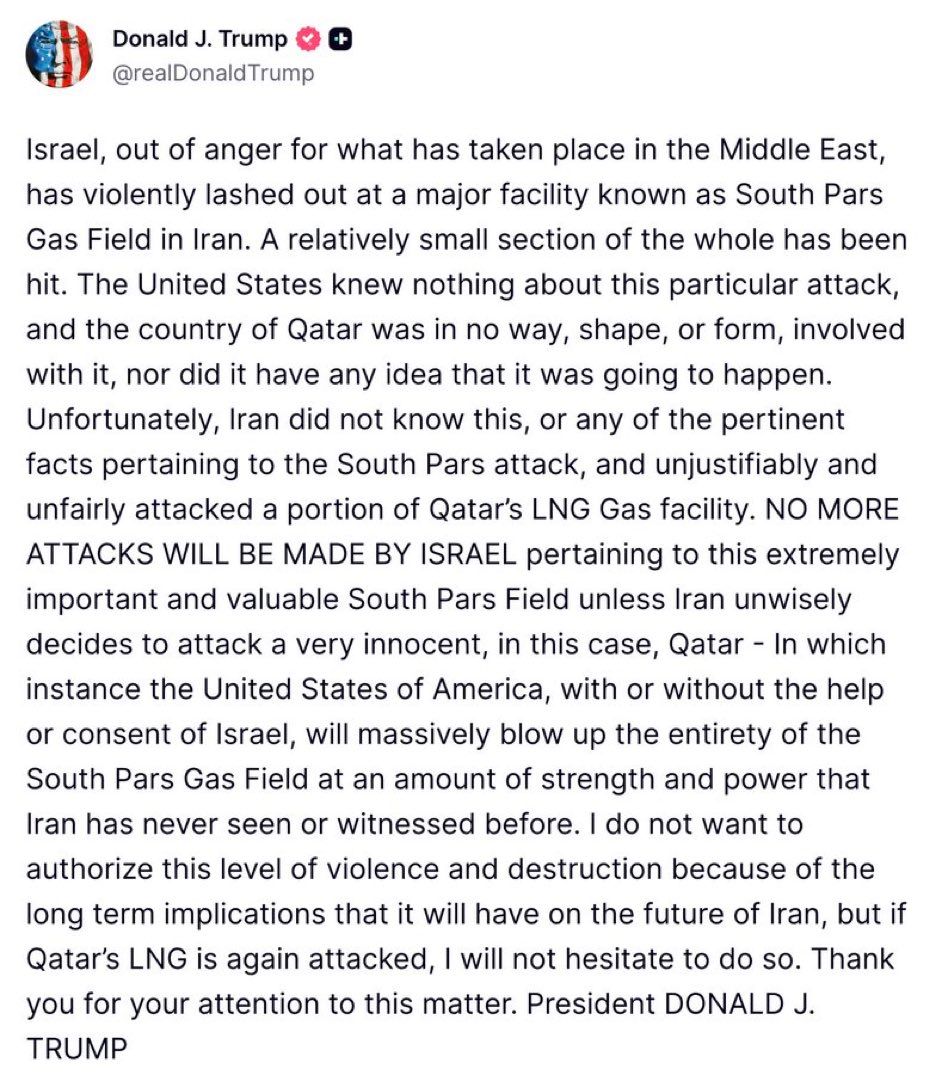
Israeli strikes on Iran’s South Pars gas field marked a major escalation in the conflict, bringing critical energy infrastructure into direct targeting for the first time. The attack triggered immediate Iranian retaliation across the Gulf, including strikes on key regional energy sites such as Qatar’s Ras Laffan LNG hub, where fires and significant damage were reported. The UAE also confirmed shutdowns at major gas facilities, describing the situation as a “dangerous escalation.” In response, Donald Trump warned that the U.S. could “massively blow up” South Pars if Iran continues attacks, while also claiming Washington had no prior knowledge of Israel’s initial strike, despite reports suggesting possible awareness. Markets reacted sharply. Oil prices rose around 6%, gas prices surged over 20%, and Asian equities declined amid growing uncertainty. With disruptions to energy flows and increased risk to the Strait of Hormuz, concerns are rising that the conflict is entering a sustained energy-focused phase.
Forced Into This?
There were a bunch of conspiracy posts about the U.S. being forced into this by Israel — the power of AIPAC is known by everyone here, so it’s not entirely out of the question. But Trump has historically been fiercely anti-Iran, and Iran is a long-standing geopolitical adversary for the U.S. What I’m trying to say is that there is a case here for the U.S. extinguishing the offensive capabilities of one of its longest rivals, especially as we enter a new world order that is clearly reshuffling. However, it seems there is more to this story. Trump likely wanted a limited strike — enough to project power and force Iran into negotiations. This was called off for a variety of reasons, soon after Netanyahu headed to Washington D.C. to likely push for strikes. Days before the attack, Netanyahu reportedly told Trump, “the moment is now or never — we know where Khamenei is.” The final piece of this theory comes from the horse’s mouth — Rubio initially suggested the U.S. joined because Israel was going to strike anyway, and Washington couldn’t risk being unprepared if Iran retaliated against U.S. bases. This narrative was later softened, but Trump has since echoed similar rhetoric. And this was likely projected early on, we wouldn’t have seen this level of military buildup as a “just in case.” This was a matter of when, not if.
Shoot For The Stars, Land On Tehran?
The administration clearly held some overly optimistic assumptions about how this conflict would unfold. Yes, the buildup suggested a multi-week operation — but based on rhetoric and insider reporting, this looked more like a contingency plan and casualty minimisation effort rather than a true regime-change campaign that was planned to last weeks. Within days, insiders at major U.S. outlets described a White House mood that was not confident, but concerned. Concerned about what? They had just dropped more munitions in 48 hours than were used in the opening phase of Operation Iraqi Freedom — yet no regime change. This is the issue. Trump himself hinted at this early on, suggesting that Iran’s future would be decided by its own people. And this is the paradox: the U.S.-Israeli alliance is winning militarily, Iran has been significantly degraded across leadership, infrastructure, and military capability, but the political objective of regime change remains unmet.
So What Next?
This is the current quagmire. The stated condition for victory appears to be regime change, yet no such change is occurring as hundreds of munitions are dropped daily and the global public feels the impact at the pump. This is likely why the administration is avoiding calling it a war. Wars tend to have clear objectives, and that reduces flexibility if things go wrong. In this sense, they’ve taken a more ambiguous approach. For the U.S., anything that can be framed as success may ultimately be presented as a victory — for example, targeted strikes on nuclear infrastructure. Ultimately, the problem is that the U.S. has found itself in a bar fight with two actors willing to escalate without regard for the wider consequences, and any fallout will be blamed on Washington both domestically and internationally.
Rough Break Up?
Whatever the case may be, the fact that Trump is saying the U.S. was unaware of the strikes is extremely telling. Regardless of what is true, there is clearly some level of separation in goals. This is not the first time we’ve seen this. Recall the earlier strikes on Iranian oil facilities (the apocalyptic scenes over Tehran with oil raining down) those were reportedly carried out by Israel, not the U.S. That may have been the first indication of a split forming. The events of the last 24 hours only reinforce this. The idea that the U.S. is simply turning a blind eye while secretly supporting escalation doesn’t fully hold up. Any operation of this scale would likely require at least some level of coordination or deconfliction with CENTCOM, given the density of U.S. assets in the region.
This leaves a narrow set of possibilities. Either Washington had prior awareness and is now creating distance for political flexibility, or Israel is acting with greater operational independence than usual, prioritising its own objectives. In this sense, Trump’s public statements may be an attempt to manage optics in a situation where alignment is no longer guaranteed. On one hand, he is trying to reassure markets and stabilise energy flows — while on the other, Israel is targeting the largest gas field on the planet. To make matters more complicated, the killing of Ali Larijani introduces another layer of divergence. Larijani was not just a senior official, but a central figure capable of linking Iran’s military, political, and diplomatic structures. He was also one of the few individuals who could have facilitated negotiations or acted as a stabilising figure in a post-conflict scenario.His removal suggests Israel may be prioritising total systemic disruption over any negotiated outcome — a strategy that does not fully align with U.S. interests. Washington has historically preferred to maintain some form of off-ramp to manage escalation and limit long-term instability. By eliminating Larijani, those options may have narrowed significantly. This raises a broader question — are both actors still working toward the same outcome, or are their definitions of victory beginning to diverge?
Conclusion
And while its known that Bibi and Trump have a long friendship, you have to ask yourself if a new Gulf War can get between a friendship? I think we all know the answer. In the most simple description: Trump needs less war — a decisive finish, if he can’t get regime change he can settle for something else. But Israel? They want the chapter finished on the decades-long conflict with their largest rival, no matter what it takes.
The current signs don’t show much of an end, Iranian missile and drone salvos have not just stabilised but rebounded upwards in the last 24 hours. This may be a statistical anomaly but after a week of stabilised launch numbers questions need to be asked. Overall, until we see movement on the major cities of Iran, we might not expect much.
It’s rough sailing ahead.
Sources available upon request
TODAY IN HISTORY
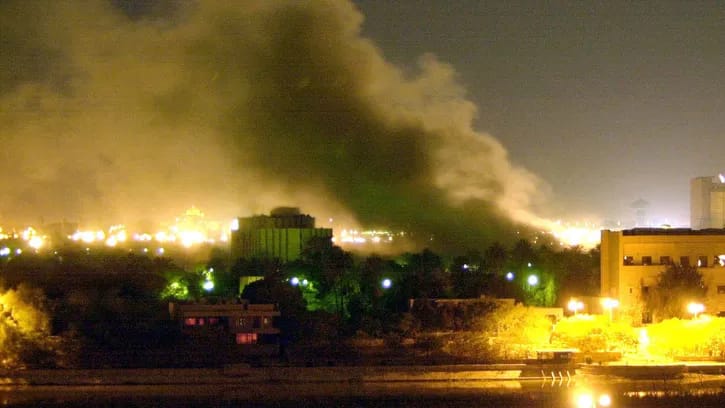
(March 19, 2003): Iraq War begins
On this day in 2003, U.S. President George W. Bush ordered air strikes on Baghdad, thus launching the Iraq War to oust dictator Saddam Hussein, who was believed (wrongly) to be manufacturing weapons of mass destruction.