- Basedment
- Posts
- Suicide Car Bombs to Drones: Evolution of Syrian Rebel Warfare
Suicide Car Bombs to Drones: Evolution of Syrian Rebel Warfare
Your daily dose of geopolitical updates and strategic analysis. Unbiased, but not unbased.

Editor-in-Chief
September 10, 2025
THE BRIEFING
Here’s what’s happening in geopolitics today.
Welcome to today’s global briefing. From Caracas to Kathmandu, political upheavals and security crises are shaping headlines, with Venezuela vowing retaliation after a deadly U.S. strike and Nepal’s prime minister stepping down amid violent protests.
France, too, faces fresh political uncertainty after yet another government collapse, while Congo reels from one of its deadliest rebel attacks in months.
In today’s deep dive, we look evolution from SVBIED’s to FPV drones in Syrian Rebel warfare.
THE LAST 24 HOURS IN GEOPOLITICS
1. Venezuela says ‘everything’s fair game’ after US Boat attack kills 11
Venezuelan Interior Minister Diosdado Cabello fired back at the U.S. military strike that killed 11 people aboard an alleged drug-smuggling vessel, warning that “everything’s fair game” going forward. Cabello accused the U.S. of staging an extrajudicial killing in international waters and said the strike signals an alarming escalation, where even non-combatant actions may become targets.
read more
2. Flotilla for Gaza says boat struck by drone in Tunisian waters
The Global Sumud Flotilla for Gaza reported that one of its boats was struck by what it claims was a drone, causing fire damage to the main deck and storage areas, though all six aboard escaped unharmed. Tunisian authorities strongly disputed the flotilla’s account, insisting an onboard fire, potentially from a lifejacket, was the culprit and that no drone was detected. The flotilla is now investigating the incident amid solidarity rallies in Tunisia, and has reaffirmed its nonviolent mission to break Gaza’s blockade, even as the conflicting narratives raise questions about accountability and maritime safety.
read more
3. France’s Macron seeks new Prime Minister after government’s collapse
French President Emmanuel Macron is seeking a new prime minister following the ousting of François Bayrou, whose government collapsed after a 364–194 no-confidence vote focused on his unpopular austerity proposals. Bayrou’s resignation marks the fifth change of prime minister since 2022 and leaves Macron navigating a deeply fragmented parliament amid growing economic pressure and public unrest. Business groups warn of dwindling investment and growing instability, while nationwide protests and looming strikes signal deepening domestic tensions.
read more
4. Nepal’s Prime Minister resigns after violent and deadly anti-corruption protests
Nepal’s Prime Minister K.P. Sharma Oli resigned on Tuesday after violent “Gen Z” protests erupted over a social media blackout and allegations of corruption, which left at least 19 dead and dozens more injured. Protesters, mainly young people, had rallied against the government’s decision to block 26 major platforms and demanded accountability, sparking fierce police responses and overnight unrest. In response, the government lifted the ban, announced compensation and medical care for victims, and pledged a full investigation, yet public anger remains high as the nation grapples with political legitimacy and freedom of expression.
read more
5. Islamic state-linked rebels kill over 50 at East Congo funeral
Militants from the Islamic State-linked Allied Democratic Forces (ADF) brutally attacked a funeral gathering in Ntoyo, eastern Congo, killing more than 50 civilians while turning a place of mourning into a scene of terror. Local officials report that about 10 attackers issued orders to congregate before unleashing the slaughter, reinforcing the ADF’s reputation for unchecked brutality in the region. The massacre underscores the escalating threat posed by ADF insurgents in North Kivu’s Lubero territory, and highlights the widening reach of IS-affiliated violence in the region.
read more
DAILY DEEP DIVE
SVBIED: The Poor Man’s Airforce
History and Role
The Syrian Civil War became the central stage for the evolution of suicide vehicle-borne improvised explosive devices (SVBIEDs), transforming them from crude insurgent tools into standardized, almost industrialized weapons of war. As early as February 2012, Jabhat al-Nusra (later Hayat Tahrir al-Sham, HTS) began using covert suicide car bombs in Damascus and other major urban centers. These early attacks targeted regime checkpoints, military bases, and government ministries, often using civilian cars with minimal modification to blend into traffic
This first phase was emblematic of insurgent strategy: the covert SVBIED. In an environment where rebels had no territorial control, the ability to infiltrate city centers undetected was key. Attacks at this time had dual aims, inflicting maximum damage on regime forces while also creating psychological terror among civilians.
By 2013–2014, as opposition forces captured significant swaths of territory, including Idlib and Aleppo countryside, SVBIEDs transitioned into a conventional battlefield weapon. HTS (then still Jabhat al-Nusra) pioneered the up-armored SVBIED, welding steel plating onto trucks and converting captured BMP-1 armored personnel carriers into mobile bombs. These designs could withstand heavy fire long enough to breach fortified positions, serving as a “poor man’s air force”, softening defenses before infantry assaults
The Islamic State (ISIS) took this innovation to its extreme, institutionalising SVBIED production with factory-like workshops. Between 2015 and 2017, ISIS claimed over 1,300 SVBIED attacks, dwarfing other groups’ output . In battles for Mosul, Ramadi, and Palmyra, waves of SVBIEDs substituted for airstrikes, breaking enemy lines and enabling rapid offensives.
By contrast, HTS maintained a more conservative doctrine, deploying fewer but larger SVBIEDs at decisive moments. During the 2015 Idlib offensive, for example, over a dozen armoured SVBIEDs (many based on BMP-1 hulls) were instrumental in expelling loyalist forces from the province in just two months.
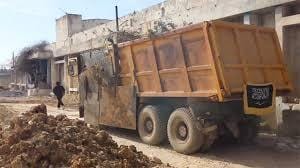
Large SVBIED
Issues
From 2016 onward, the balance shifted again. Russian airpower and regime consolidation blunted the offensive power of SVBIEDs. By the Idlib offensives of 2019–2020, HTS used SVBIEDs almost exclusively in defensive roles, attempting to slow regime advances. At least 35 SVBIEDs were deployed during this campaign, but despite tactical successes (destroying tanks or halting assaults for hours) HTS still lost 41% of its territory. This reflected the growing strategic insufficiency of SVBIEDs against superior combined-arms militaries, even as their technical sophistication increased.
While an extremely powerful device, the SVBIED had its own setbacks. Tactics were designed by armies such as the SAA and SDF, whose Soldiers who had become used to the usage of SVBIED’s, for instance when a SVBIED was spotted all firepower was concentrated on it - no matter what. A more common SAA tactic was to simply tactically retreat when a SVBIED was approaching, giving away their tactical position, which would in turn be levelled by artillery and Syrian and Russian air forces. The SVBIED was also limited to geography, they could only travel so far without being spotted and could only penetrate frontline fortifications.
The double-edged nature of the SVBIED was that, while it was highly effective on the battlefield, it carried serious public relations costs. After ISIS’s near-industrialisation of SVBIED production, footage of these attacks became a regular feature on Western news outlets, cementing their association with terrorism in the public mind. Thus when Abu Mohammad al-Jolani began to redirect HTS’s ideology toward a less openly extremist posture, seeking eventual acceptance in a post-Assad political order, SVBIED’s had to be drastically reduced.
Another challenge was the internal culture that surrounded these weapons. SVBIEDs attracted the most radical fighters, and at times there were even waiting lists for volunteers to carry out such operations. Drivers of suicide vehicles often became celebrated figures within extremist Islamist circles, their martyrdom elevating them as icons. Thus, the reduction in SVBIED usage also helped retain fighters who were more comfortable with HTS’s shift toward a less openly extremist posture. However, usage was not eliminated simply reduced like we said. There is video proof of at least one SVBIED used by HTS in the 2024 offensive that toppled Assad. Linked below:
HTS SVBIED 2024: https://x.com/HKaaman/status/1862478315979682223
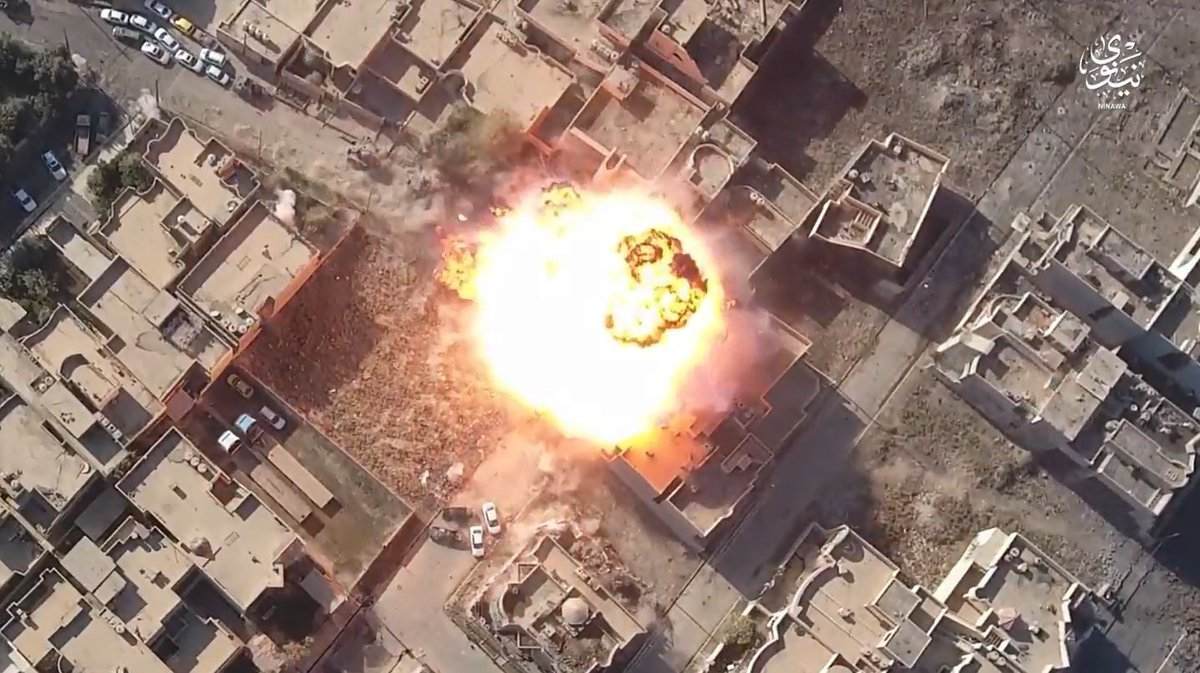
Explosion recorded
Usage of Drones
Hayat Tahrir al-Sham (HTS) systematically developed its drone force as part of a wider effort to professionalise and consolidate its military structure. From 2019 onward, HTS invested in specialised training through its Idlib military academy, where operators used classroom instruction, flight simulators, and live field exercises to prepare for combat deployment. The first notable attacks took place in 2019, targeting the Russian Hmeimim Airbase. Dedicated production teams in concealed workshops and safehouses across Idlib assembled drones from imported components, supplemented with 3D-printed parts. This decentralised infrastructure, combined with basic quality-control processes, ensured steady supply despite sanctions and airstrikes. The drones were formally integrated into HTS’s force structure through the Shaheen Brigades (Falcon Brigades), a centralised unit with responsibility for both reconnaissance and strike missions. This level of organisation, complete with command oversight, dedicated engineers, and training cadres, elevated HTS beyond improvised tinkering, making drone warfare a permanent capability.
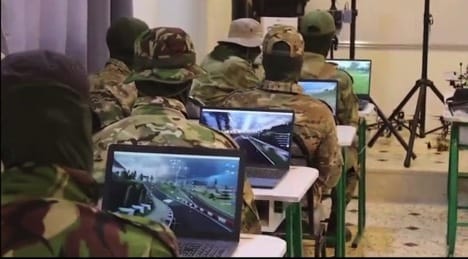
Shaheen Brigade training centre
Their usage was credited with the lighting offensive that toppled the Assad regime in a couple weeks. Operationally, HTS employed a two-tier system. Short-range FPV kamikaze drones were used to hit tanks, artillery, and personnel behind enemy lines, while long-range rocket-propelled UAVs with ranges up to 50 km targeted hardened regime sites and command centres. Reconnaissance drones supported SVBIED operations by guiding drivers in real time and confirming strike accuracy. The Shaheen Brigades also carried out high-profile assassinations, such as the killing of Brig. Gen. Uday Ghossah in Hama, disrupting command structures before the major offensive.
These were all things that SVBIED’s could only dream of achieving. The effects of this integration were both military and psychological. On the battlefield, HTS achieved a rudimentary form of airpower, multiplying its offensive and defensive options.
Sources:
sources available on request, reduced to maintain visual integrity of page.
TWEET OF THE DAY
Welcome to capitalism in 2025…
A new capitalist nightmare just dropped
— MC Squared (@mcsquared34)
9:09 PM • Sep 8, 2025
TODAY IN HISTORY
(September 9, 1976): Death of Mao
Marxist revolutionary Mao Zedong, who died this day in 1976, emerged as the undisputed Chinese Communist Party leader following the Long March (1934–35) and dominated China in the period after the communist takeover in 1949.