- Basedment
- Posts
- Tensions Rise As B-1 Bombers Fly Near Venezeula
Tensions Rise As B-1 Bombers Fly Near Venezeula
Your daily dose of geopolitical updates and strategic analysis. Unbiased, but not unbased.

Editor-in-Chief
October 24, 2025
THE BRIEFING
Here’s what’s happening in geopolitics today.
A mix of diplomacy, politics, and a bit of drama today. Trump continues to dominate headlines, first by abruptly ending trade talks with Canada and then by confirming a long-awaited meeting with Xi Jinping next week.
Meanwhile, Thailand has set a date for its next general election, Kim Jong Un is tightening military ties with Russia, and New York’s mayoral debate turned fiery as Mamdani and Cuomo clashed live on stage.
In today’s deep dive we’re providing an update as just how far tensions are rising with Venezuela and the U.S.
THE LAST 24 HOURS IN GEOPOLITICS
1. Donald Trump terminates Canada trade talks over ‘fake’ TV ad
Trump announced that the U.S. is terminating all trade negotiations with Canada after a controversial advertisement produced by Ontario was aired in the U.S. using edited audio of Ronald Reagan to criticise tariffs. Trump labelled the ad “fake” and accused it of interfering with U.S. judicial proceedings. The Ronald Reagan Presidential Foundation also condemned the advertisement for misusing and editing Reagan’s remarks without permission.
read more
2. North Korea’s Kim says military ties with Russia will ‘advance non-stop’
Kim Jong Un announced that military ties between North Korea and Russia will “advance non-stop,” in a speech commemorating North Korean soldiers who fought alongside Russian forces. He framed the alliance as forged “at the cost of precious blood” and said challenges from “domination and tyranny” would not derail their partnership.
read more
3. Thailand expects to hold election on March 29, senior Government official says
Thailand is expected to hold a general election on March 29, 2026, following discussions between the government and the Election Commission of Thailand about dissolving parliament by late January. Alongside the election, a referendum on a new constitution and votes on revoking two border-demarcation agreements with Cambodia are likely to be held on the same day, according to a senior official. The proposed timeline signals a move to transition from a minority government and resolve ongoing political uncertainty by early 2026.
read more
4. Donald Trump will meet Chinese President Xi Jinping next week
Donald Trump is set to meet Xi Jinping next week, aiming to break the ice and make progress on lingering trade and tech disputes between the world’s two largest economies. The meeting will take place against the backdrop of escalating U.S. tariffs and China’s export controls on critical minerals, with both sides keen to show global markets they can engage despite deep strategic divides.
read more
5. NYC Mayoral debate gets heated as Mamdani and Cuomo savagely clash
The final debate in the New York City mayoral race erupted into a fierce showdown when Zohran Mamdani and Andrew Cuomo traded sharp barbs over experience, policy and character. Cuomo repeatedly challenged Mamdani’s record, accusing him of being unprepared for office, while Mamdani retorted by questioning Cuomo’s motives. With early voting looming, the clash highlighted the race’s high stakes and set the stage for an intense final stretch.
read more
DAILY DEEP DIVE
TENSIONS RISE IN VENEZUELA
Does Maduro Want To Avoid War?
These were the words said by President Maduro on national TV today:
“Not war, not war. Yes peace, yes peace.
No crazy war, please, please, please.”
During the public talks with Zelensky, Trump was asked about Maduro in which he said his Venezuelan counterpart ‘doesn’t want to fuck around with the United States’ and has offered ‘everything’ to ease tensions.
If we read between the lines, Maduro may be growing increasingly anxious about a coup or civilian uprising should his military fail to respond effectively against U.S. forces. For dictators, maintaining the illusion of strength and authority is paramount, yet it is also their greatest vulnerability. The constant display of supremacy builds a glass house of power: once even slightly cracked, it can shatter entirely. For Maduro, showcasing his military to the public and framing the current tensions as a struggle against imperialism is exactly what he wants, but a war is something he would want to avoid.
U.S Sends B-1 Bombers
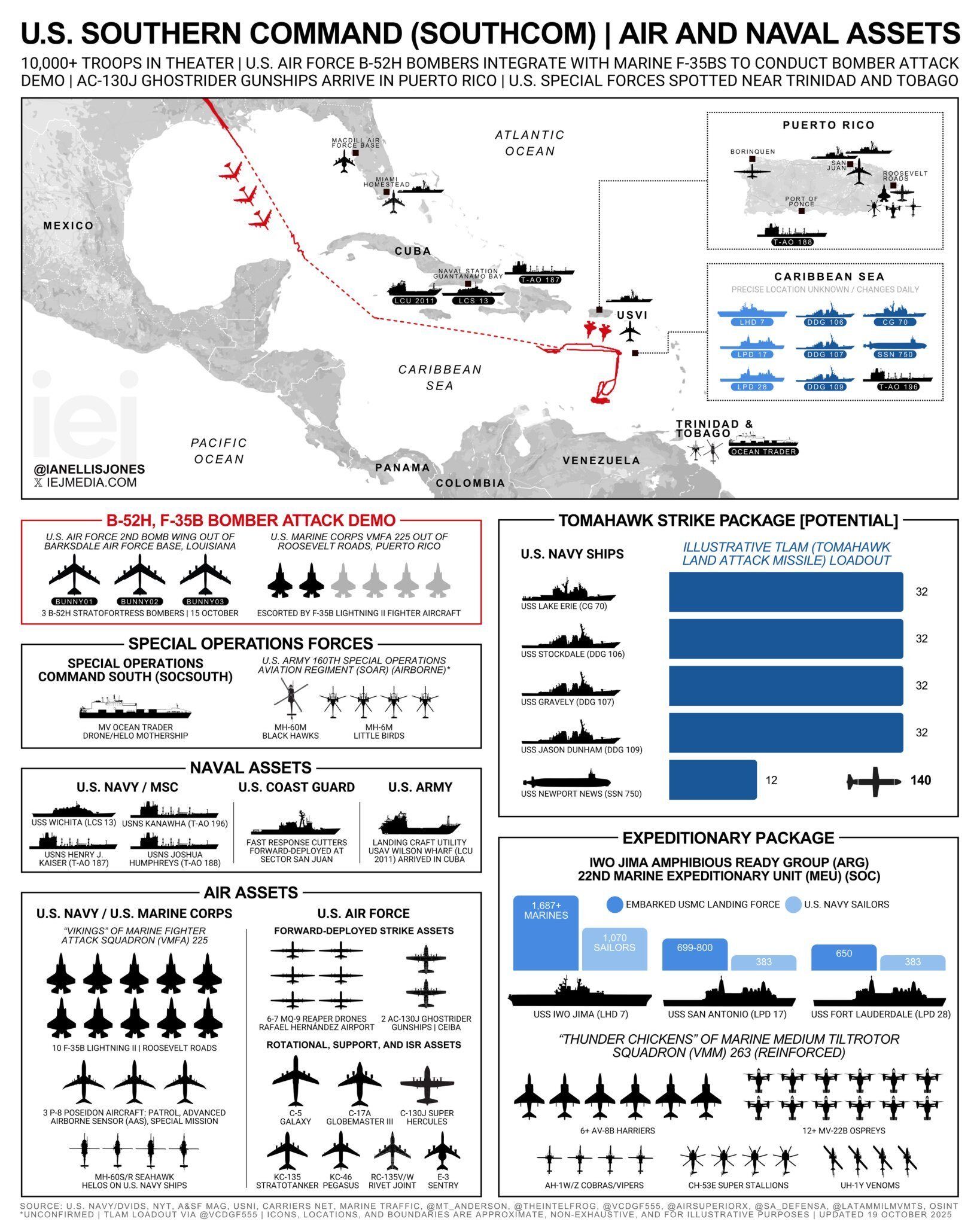
The U.S. carried out a second bomber demonstration in the Caribbean, deploying two USAF B-1B Lancer bombers to within roughly 50 miles of Venezuela’s coastline. The pair flew as close as six miles from the Los Testigos island group, which hosts a Venezuelan coast guard station. This represents the closest U.S. bomber approach to Venezuelan territory since tensions began escalating earlier this month. This is definitely a choreographed probing manoeuvre, testing potential flight paths and signalling readiness for possible future strike operations. CNN documented more than 200 military flights across the Caribbean between August 15 and October 15, involving a total of 83 different aircraft.
“No Declaration of War” Rhetoric
In the past 24 hours, Trump confirmed he may order land-based strikes against alleged drug traffickers operating from Venezuela, saying he “may go to Congress and tell them about it,” but added, “I can’t imagine they’d have any problem with it.” He clarified that he does not plan to seek a formal declaration of war, stating bluntly, “I don't think we're gonna necessarily ask for a declaration of war. I think we're just gonna kill people. Okay? We're gonna kill them. They're gonna be, like, dead.” In a notice already sent to Congress, Trump formally declared that the U.S. is engaged in a “non-international armed conflict” with drug cartels, providing legal grounds for military action without new war powers legislation. Lawmakers from both parties have since raised concerns, arguing the administration has not provided sufficient legal justification or oversight for these strikes.
In a democratic country, the ability to criticise and question power is essential. However, the “No Declaration of War” argument needs to be addressed. It’s not a particularly strong one, the last time the United States formally declared war was during World War II – every conflict since has been justified through alternative legal frameworks.
Trump “Authorises” CIA Cover Operation
President Trump confirmed that he authorised the CIA to conduct covert operations inside Venezuela, citing the Venezuelan government’s alleged role in facilitating drug trafficking and releasing prisoners into the U.S. Venezuelan President Nicolás Maduro condemned the move as a grave violation of international law and urged the internPresident Trump confirmed he authorised the CIA to conduct covert operations inside Venezuela, marking a significant escalation in U.S. engagement there. The move is being presented as a targeted effort against drug-trafficking networks and other illicit activities allegedly aided by Venezuelan officials. Maduro denounced the authorization as a blatant breach of sovereignty and international law.
CIA operations against Venezuela have likely been ongoing for years, but Trump’s decision to publicly acknowledge them serves two key purposes. First, it aims to sow panic and paranoia within Maduro’s inner circle, forcing them to question the loyalty of their own ranks. Second, it helps bolster Trump’s domestic image as a decisive leader taking action against a hostile regime by implying that U.S. engagement is far more calculated, involving complex intelligence planning rather than impulsive military strikes.
Our Analysis
Some form of U.S. strike now appears increasingly likely. The current military build-up in the Caribbean (bomber patrols, naval presence, and CIA authorisation) suggests far more than a mere show of force. Trump has never been hesitant to use limited strikes as political or strategic leverage, as seen during the Iran nuclear facility strikes earlier this year. Trump is pursuing a policy of deliberate ambiguity, one that creates both flexibility and leverage for the U.S. military. This strategy keeps multiple options open while leaving adversaries uncertain about America’s next move. As tensions rise, that uncertainty exerts psychological pressure on Maduro’s inner circle, amplifying stress and the risk of miscalculation. By maintaining an unpredictable posture, Washington maximises deterrence without committing to open conflict. While a full-scale invasion remains unlikely, a precision strike or targeted operation on Venezuelan soil seems the most probable next step.
Sources:
Sources available upon request, not shown to maintain visual integrity of page.
TWEET OF THE DAY
These are crazy times we are living in…
OnlyFans beats Apple and Nvidia to become the world’s most revenue-efficient company.
— Globe Eye News (@GlobeEyeNews)
5:49 AM • Oct 24, 2025
TODAY IN HISTORY
(October 24, 1945): United Nations established
The charter for the United Nations, the world's premier international organisation, established at the end of World War II to maintain world peace and friendly relations among nations, entered into force this day in 1945.
