- Basedment
- Posts
- The Battle of Kostiantynivka: Russians On The Outskirts
The Battle of Kostiantynivka: Russians On The Outskirts
Your daily dose of geopolitical updates and strategic analysis. Unbiased, but not unbased.

Editor-in-Chief
August 22, 2025
THE BRIEFING
Here’s what’s happening in geopolitics today.
Today’s briefing covers a wide mix of developments, from a historic arrest in Sri Lanka to shifting defence ties in the Indo-Pacific.
Energy security is again in focus after a Ukrainian strike disrupted Russian oil flows, while Netanyahu balances military pressure with renewed hostage negotiations. We also look ahead to China’s upcoming SCO summit, set to draw a heavyweight lineup of global leaders.
In our deep dive, we turn to the battlefield in eastern Ukraine with a closer look at the Battle of Kostiantynivka, with reinforcements pulling away from key fronts, cracks are starting to appear.
THE LAST 24 HOURS IN GEOPOLITICS
1. Former Sri Lankan President arrested on allegations of misusing state funds
Former Sri Lankan President Ranil Wickremesinghe was arrested Friday by the Criminal Investigation Department over allegations that he misused state funds, specifically funding a London trip to attend his wife’s graduation after an official U.S. engagement, which investigators argue was improperly treated as an official visit. This marks a historical moment as it’s the first time a former head of state has been detained on corruption charges in Sri Lanka.
read more
2. Philippines, Australia to seal new defence pact as China tensions rise
The Philippines and Australia announced on Friday that they're working toward signing a new defence agreement in 2026, aiming to deepen military cooperation. Philippine Defense Secretary Gilberto Teodoro and Australian counterpart Richard Marles said the pact will support more frequent joint exercises and the development of defence infrastructure at five key sites in the Philippines. The move builds on their joint naval drills (under the ALON exercises) and signals a shared commitment to strengthening deterrence and ensuring regional stability.
read more
3. Ukrainian attack suspends Russian oil flows to Hungary, Slovakia
Russia’s oil supplies to Hungary and Slovakia could be suspended for at least five days following a Ukrainian strike on the Unecha oil pumping station in Bryansk, prompting Hungary’s foreign minister to warn of a serious threat to its energy security. The disruptions mark the second major hit to this lifeline in recent weeks, with Kyiv intensifying attacks on Russian energy infrastructure to undercut Moscow’s war revenues. While Slovakia has since confirmed that flows have resumed at its end, Hungary’s full restoration status remains unclear, underscoring the fragility of the region’s energy reliance on Russian pipelines.
read more
4. Netanyahu said negotiations resume to end war in Gaza and free hostages
Netanyahu has ordered the immediate resumption of negotiations with Hamas to secure the release of all hostages and bring an end to the nearly two-year war, but only on terms acceptable to Israel, he emphasised. This response follows a ceasefire proposal brokered by Egypt and Qatar, which Hamas accepted, a move Israel has yet to reciprocate fully. Meanwhile, Netanyahu also reaffirmed his commitment to military operations, including plans to capture Gaza City, signalling that Israel is pursuing diplomacy and force in parallel to achieve its goals.
read more
5. China’s Xi to host Putin, UN’s Guterres at regional summit
Chinese President Xi Jinping is set to host a major gathering at the Shanghai Cooperation Organization (SCO) summit in Tianjin from August 31 to September 1, welcoming Russia’s Vladimir Putin, UN chief António Guterres, and over 20 other heads of government. The summit, focused on political and security issues, is seen as a strategic move by Beijing to cement its regional influence and align its bloc more closely amid global uncertainty.
read more
DAILY DEEP DIVE
The Battle of Kostiantynivka: Russians On The Outskirts
We Haven’t Looked at This Sector in a While
The front here has begun to shift in Russia’s favour. Russian forces have now reached the outskirts of the key city of Kostiantynivka.
The Importance of Kostiantynivka:
A quick reminder as to why Kostiantynivka matters: the terrain from Chasiv Yar to Kramatorsk sits on elevated plains. This elevation was one of the main reasons Chasiv Yar proved such a costly operation for Russia, the town sits on high ground, protected by the Siverskyi Donets–Donbas canal (effectively a moat), reinforced concrete high-rises, and dense Ukrainian defenses.
Kostiantynivka, however, is the gateway into the inner heart of the Kramatorsk–Sloviansk fortress belt. Russian forces have been unable to break through this fortified line, stretching from Lyman to Siversk, where Ukrainian positions have been hardened for years, some dating back to the Donbas War in 2014. Kostiantynivka offers a more vulnerable “underbelly” approach into the fortress belt, as its sector is not as saturated with layered defensive works.
The Pincer Movement:
As we’ve discussed previously, Russian forces have been attempting to complete a pincer maneuver stretching from Bila Hora to Predtechyne. Until this month, Russia struggled to establish a foothold in Bila Hora, advancing only in small assault groups along treelines and using motorcycle-mounted raiding units to probe and strike Ukrainian flanks. Much of this activity has been attributed to the Russian 4th Motorized Rifle Brigade.
Predtechyne’s fall was almost inevitable once Russian troops secured the higher ground at Stupochky, south of Chasiv Yar. From there, they were able to outflank Predtechyne’s fortifications. With both Predtechyne and Bila Hora now under Russian control, Ukrainian forces were forced to conduct a tactical withdrawal to prepared positions on the outskirts of Kostiantynivka, rather than risk encirclement. Ukrainian defenders nonetheless mounted a stiff resistance, delaying Russian advances for several weeks.
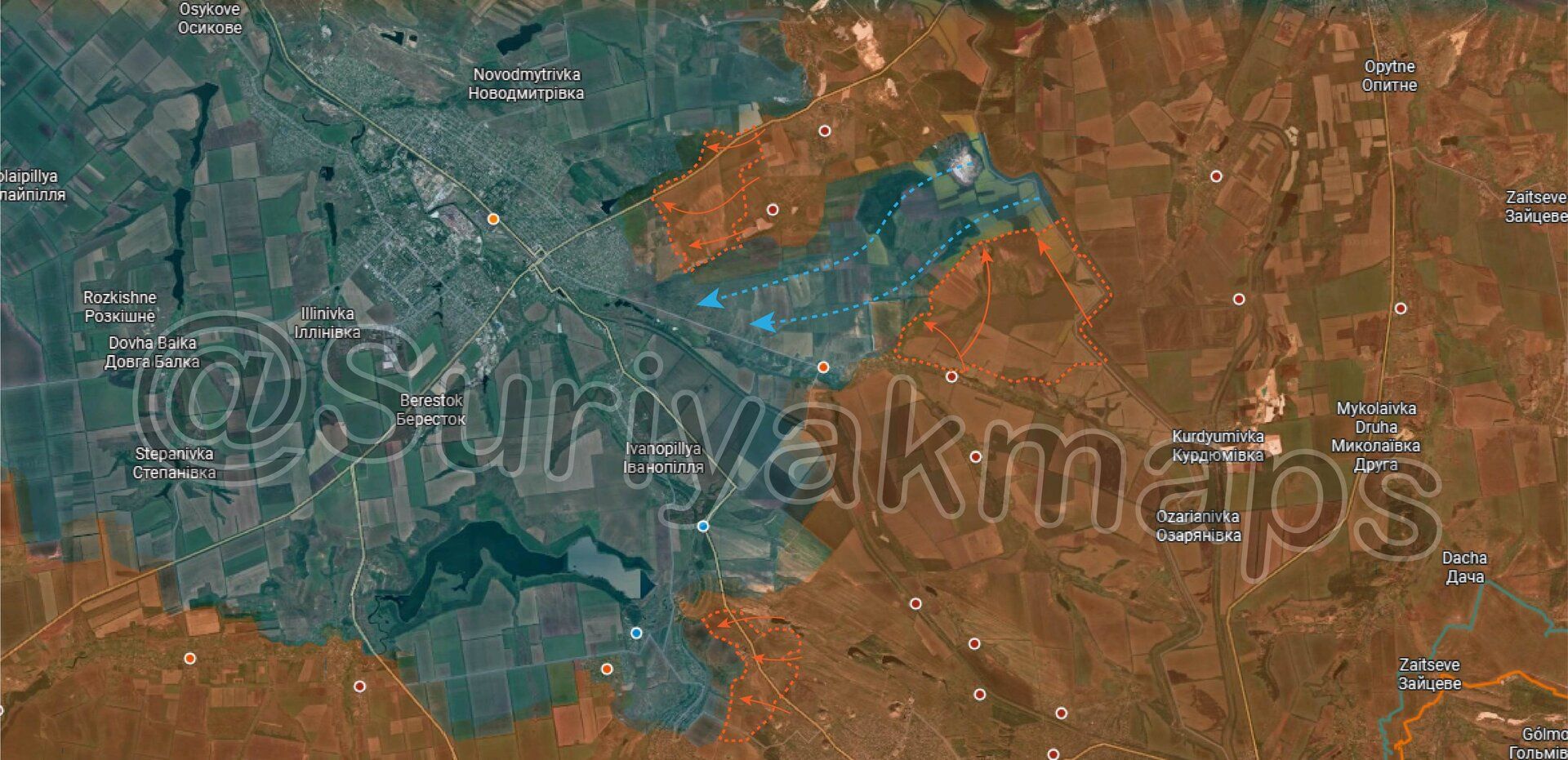
Suriyak maps showing pincer movement top of the image, and gains north of Toretsk bottom part of the image.
The Battle for Kostiantynivka
Reports suggest Russian DRG (sabotage-reconnaissance) units may already have infiltrated the outer suburbs of Kostiantynivka, although this has not been visually confirmed. The battle for the city will hinge on control of the western and southern flanks.
Russian forces currently hold positions in Rusyn Yar, a village with elevated fortifications dominating the western approach. As noted in yesterday’s analysis, Russia has been expanding its salient in this sector. If that salient widens, it will expose the open western plains of Kostiantynivka to Russian mechanized advances.
South of the city, in the Toretsk sector, Russian troops have taken full control of the Novodzerzhinskaya mine over the past nine days. From this staging area, elements of the 103rd Motorized Rifle Regiment are pushing along the Scherbynivka axis, advancing toward the northern outskirts of Scherbynivka. Which will link up to the units at the pincer movement.
Effects of Dobropillya:
Both sides are committing significant manpower to the Pokrovsk sector, but Ukraine is absorbing the heavier losses. To plug gaps across the frontline, Ukrainian command has been forced to redeploy ‘elements’ of brigades in an attempt to limit creating more gaps, especially from Sumy and Kharkiv. But the timing of these advances and in Lyman, Siversk and Kupiansk suggest the redeployments may be having an effect.
Meanwhile, Russia continues to apply its “death by a thousand cuts” approach, small tactical advances across multiple axes that accumulate into operational gains. In north Toretsk, Russian forces employed thermal-camouflaged assault teams to evade Ukrainian drone reconnaissance. These DRG-style units are achieving growing frequency of local penetrations across the frontline. Expect to see similar sabotage-style breakthroughs and sudden frontline expansions in Kupiansk, Kostiantynivka, and Pokrovsk as Russia continues to rely on infiltration tactics combined with heavy artillery and drone coverage.
Sources:
Suriyakmaps on T
ISW Updates
Deepstatemap.com
TWEET OF THE DAY
Is it just me or does this also have y’all on edge…?
AI is obviously gonna one-shot the human limbic system.
That said, I predict – counter-intuitively – that it will *increase* the birth rate!
Mark my words.
Also, we’re gonna program it that way.
— Elon Musk (@elonmusk)
12:04 PM • Aug 21, 2025
TODAY IN HISTORY
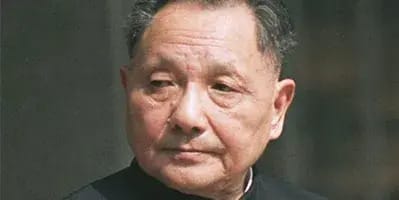
(August 22, 1904): Deng Xiaoping was born.
On this day in 1904, Deng Xiaoping was born, the Chinese leader who reshaped modern China. Breaking away from rigid Maoist orthodoxy, Deng introduced sweeping economic reforms in the late 1970s and 1980s, opening China to market principles, foreign investment, and global trade while maintaining one-party rule.
His policies, often summarized as “socialism with Chinese characteristics,” transformed China from an isolated, agrarian state into one of the world’s fastest-growing economies, laying the foundation for its rise as a global power.