- Basedment
- Posts
- The Battle Of Kupiansk Continues
The Battle Of Kupiansk Continues
Kupiansk has re-emerged as a critical test of momentum, exposing how fragile control, flawed reporting, and contested logistics can rapidly reshape the northern front.

Editor-in-Chief
December 16, 2025
In partnership with

THE BRIEFING
Here’s what’s happening in geopolitics today.
From underwater drones knocking out a Russian submarine to Washington recasting fentanyl as a weapon of mass destruction, today’s headlines span the sharp edge of modern conflict and enforcement.
We’re also tracking a deadly private jet crash in Mexico, fresh U.S. military strikes on suspected narco boats in the Pacific, and a tentative de-escalation in eastern Congo as M23 rebels agree to pull back from a key city.
In this deep dive, we break down why Kupiansk matters, how Russian overconfidence and structural weaknesses were exploited, and what this counterattack reveals about the limits of both sides’ options in an attritional war.
A MESSAGE FROM OUR PARTNER
7 Ways to Take Control of Your Legacy

Planning your estate might not sound like the most exciting thing on your to-do list, but trust us, it’s worth it. And with The Investor’s Guide to Estate Planning, preparing isn’t as daunting as it may seem.
Inside, you’ll find {straightforward advice} on tackling key documents to clearly spell out your wishes.
Plus, there’s help for having those all-important family conversations about your financial legacy to make sure everyone’s on the same page (and avoid negative future surprises).
Why leave things to chance when you can take control? Explore ways to start, review or refine your estate plan today with The Investor’s Guide to Estate Planning.
THE LAST 24 HOURS IN GEOPOLITICS
1. Ukraine hits Russian submarine with underwater drones for the first time
Ukraine’s Security Service says it used domestically developed “Sub Sea Baby” underwater drones to hit a Russian Varshavyanka-class (Kilo) submarine docked at the port of Novorossiysk, marking what Kyiv describes as the first time such drones have struck and critically damaged a submarine. According to Ukrainian officials, the explosion inflicted critical damage that effectively put the vessel out of action, and the submarine was rendered inoperable, though Moscow has not confirmed the extent of any damage.
read more
2. Trump signs executive order to classify illicit fentanyl as weapon of mass destruction
Donald Trump has signed an executive order designating illicit fentanyl and its core precursor chemicals as Weapons of Mass Destruction (WMD). Announced during a White House event on December 15, 2025, the move aims to mobilize federal resources against the fentanyl crisis, enabling enhanced sanctions, sentencing, and interagency efforts to disrupt trafficking networks. Trump described fentanyl as “closer to a chemical weapon than a narcotic,” highlighting its lethality and role in hundreds of thousands of American overdose deaths annually.
read more
3. At least 7 dead in private jet crash near Toluca airport in Central Mexico
A private jet crashed near Toluca International Airport in central Mexico on Monday while attempting an emergency landing, killing at least seven people on board, Mexican authorities said. The aircraft, which had departed from Acapulco with eight passengers and two crew members, went down in the industrial area of San Mateo Atenco, striking the metal roof of a nearby business and igniting a large fire. Local officials said the blast forced the evacuation of about 130 people from the surrounding area, and authorities have launched an investigation into the cause of the crash as first responders worked at the scene.
read more
4. U.S. Military says new strikes on 3 suspected drug boats killed 8 on board
The U.S. military said it carried out strikes on three suspected drug-smuggling boats in the eastern Pacific Ocean, resulting in the deaths of eight people across the three vessels, according to the U.S. Southern Command. The strikes took place in international waters along known narcotics trafficking routes, with the U.S. characterising the targets as operated by groups it has designated as narco-terrorist organisations, though no evidence of drug cargo has been publicly released.
read more
5. M23 rebels agree to U.S. request for withdrawal from city in DR Congo
Rwanda-backed M23 rebels have agreed to a U.S. request to withdraw their forces from the eastern Congolese city of Uvira, a strategic port town they had seized amid a broader offensive in South Kivu province. The move comes after Washington condemned the rebel capture as undermining peace efforts following a U.S.-mediated agreement between Kinshasa and Kigali, and officials described the withdrawal as a “unilateral trust-building measure” to support ongoing peace negotiations.
read more
DAILY DEEP DIVE
THE BATTLE OF KUPIANSK
Why Kupiansk Matters — and Why Some Say It Doesn’t
Since October, Ukraine’s campaign around Kupiansk has been defined by patience rather than speed. A series of small-scale counteroffensives gradually tightened the noose around Russian forces, targeting logistics rather than territory alone. Ukrainian units systematically disrupted supply routes across the Oskil River, destroying boats, pipelines, and crossing points, forcing Russian forces into a slow defensive grind.
Supporters of the “Kupiansk matters” argument see the city as a critical defensive barrier. Holding Kupiansk prevents Russia from expanding west of the Oskil in strength and denies Moscow a potential launchpad for a deep flanking manoeuvre into Kharkiv Oblast. In this view, a Russian-held Kupiansk could threaten supply lines, destabilise the Vovchansk front, and create the conditions for a broader operational encirclement.
Sceptics, however, argue Kupiansk’s strategic weight is overstated. The city lies outside Donetsk Oblast, where much of the political and military focus remains. As intense fighting continues around Siversk, Pokrovsk, Myrnohrad, and Huliaipole, critics question whether resources spent in Kupiansk could be better used elsewhere.
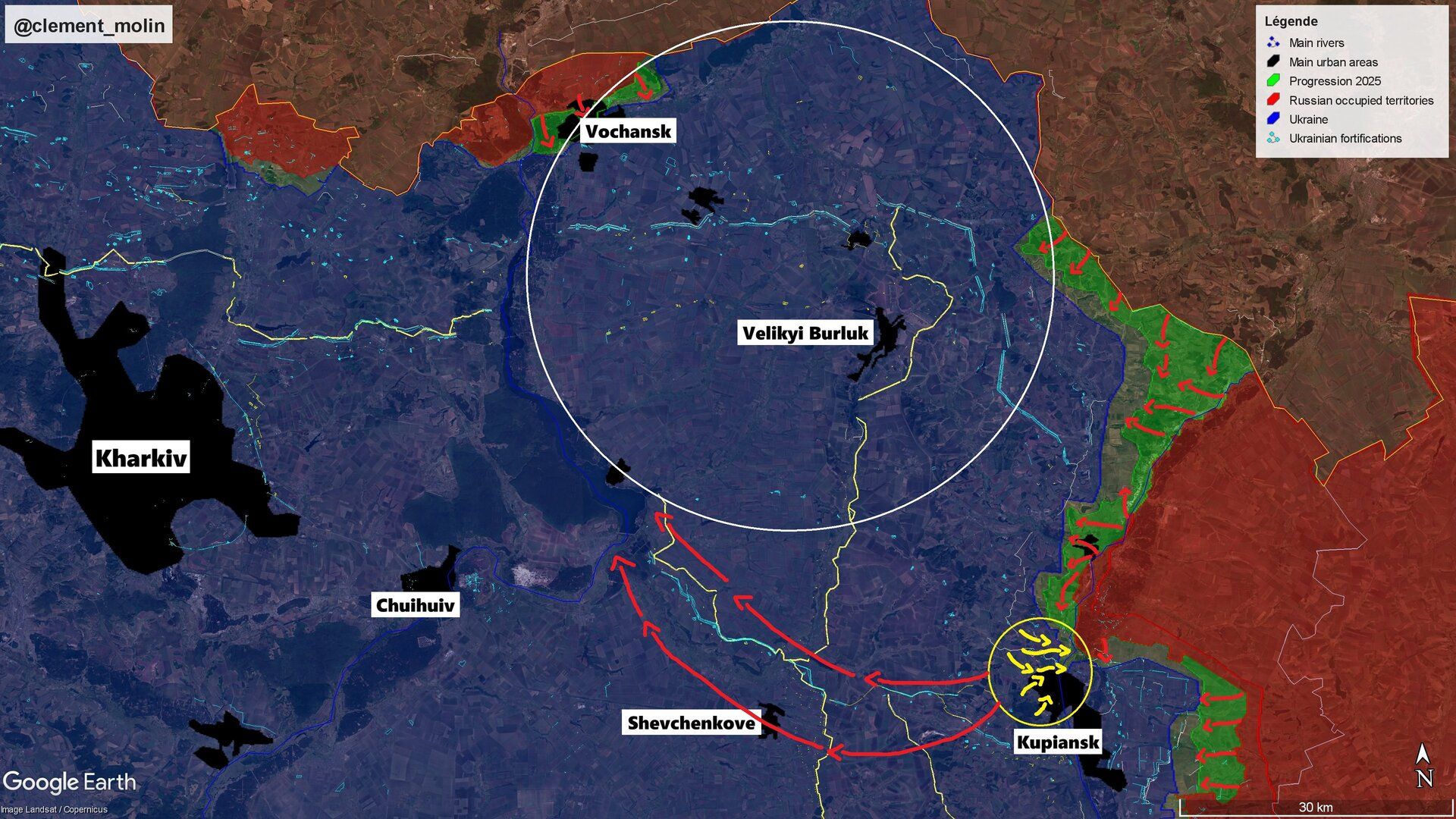
Clement Molin makes the argument why Kupiansk is important in his map above.
How Did The Russian’s Not See This?
We’ve flagged the weakness of this flank for months, particularly following Russia’s deep but uneven infiltrations across Kupiansk. The suburbs of Sobolivka and, more critically, Moskova were never properly consolidated. Russian DRG activity was frequent along the Moskova–Sobolivka axis, but as seen repeatedly throughout the war, the presence of reconnaissance or sabotage groups does not equate to durable control. Further north around Radkivka, Ukrainian forces initially achieved only limited success with their own DRG operations, constrained by harsh terrain, dense forests, and worsening weather, which pushed Kyiv toward a cautious, small-scale approach.
Russian command recognised the threat developing north of Radkivka and Kindrashivka and responded by deploying specialised drone units, including the well-known Rubikon group, turning these approaches into layered “kill zones.” Yet over time, Ukrainian forces managed to penetrate these areas. The speed and coordination of their advance ultimately blunted Russia’s numerical advantage in drones. Ukrainian sources have since praised specific tactics used to crack these kill zones, though details remain deliberately vague.
By mid-September, Russian troops had crossed the Oskil River and established control over northern suburbs situated on tactically important high ground. As Russian units began consolidating these gains, Ukrainian command moved to act. The counteroffensive was planned under Commander-in-Chief Oleksandr Syrskyi and launched on September 21, centred largely on the 2nd Corps of the National Guard of Ukraine. The objective was clear: a decisive counterattack to disrupt Russian consolidation and roll back control of Kupiansk. According to Ukrainian sources, Radkivka was retaken by October 11. Much of the credit for the operation’s execution has been attributed to the Khartiya Corps, under the command of Colonel Obolenskyi, who has overseen the campaign and is widely praised for its success.
I recommend reading the full source below on Ukrainian advances, units, preparation etc.
Read Here
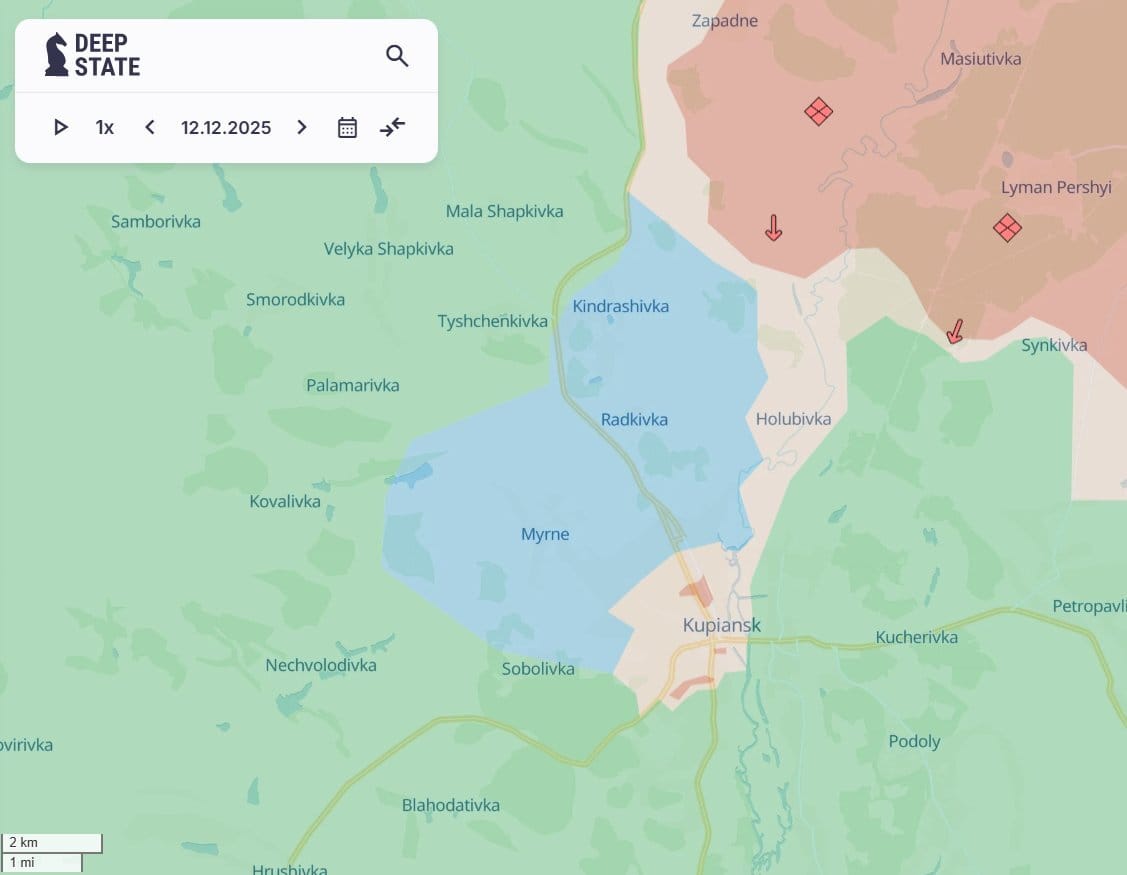
Deepstate Map (Pro-Ukrainian)
On November 20, Russian General Sergey Kuzovlev reported to Vladimir Putin that Kupiansk was fully under Russian control, and less than three weeks later, on December 9, Putin formally awarded Kuzovlev for the city’s supposed “capture.” The reality on the ground, however, suggests a familiar problem. Corruption remains a structural weakness within the Russian armed forces, and it likely played a role here. False reporting tends to move upward through the chain of command: a soldier claims a street is taken, an officer reports a sector secured, and by the time it reaches senior command, an entire city has been “captured.” This distortion is driven by career incentives, fear of punishment, and the pressure to deliver results on paper, even when control is partial or fleeting. Over time, these inaccuracies harden into official narratives, masking unresolved vulnerabilities and setting the conditions for precisely the kind of counterattacks now unfolding in Kupiansk.
What’s Next?
For now, much depends on how the situation develops on the ground. Ukraine has again demonstrated that localised, tactical counterattacks remain possible, even under difficult conditions. That said, the central question is whether this operation proves strategically worth the cost. Ukraine is fighting from the weaker side of an attritional war, meaning every counterattack carries elevated risk. Success depends not just on gains, but on timing, scale, and opportunity cost. Dobropillya is a useful comparison: the operation was executed effectively, but it arguably came at the expense of faster losses elsewhere, notably around Myrnohrad and Pokrovsk.
On the Russian side, pressure is unlikely to ease. Russian forces will continue pushing westward, aiming to link up along the Oskil River and stabilise a defensive line securing key crossings, high ground, and supply routes. However, if Moscow fails to counterattack and regain the initiative, plans for the northern sector will face significant delays. The situation is compounded by the loss of the pipeline and northern access routes. With the Oskil River deep, swampy, and difficult to traverse, Russian forces are increasingly constrained, turning logistics and manoeuvre into a growing liability rather than an advantage.
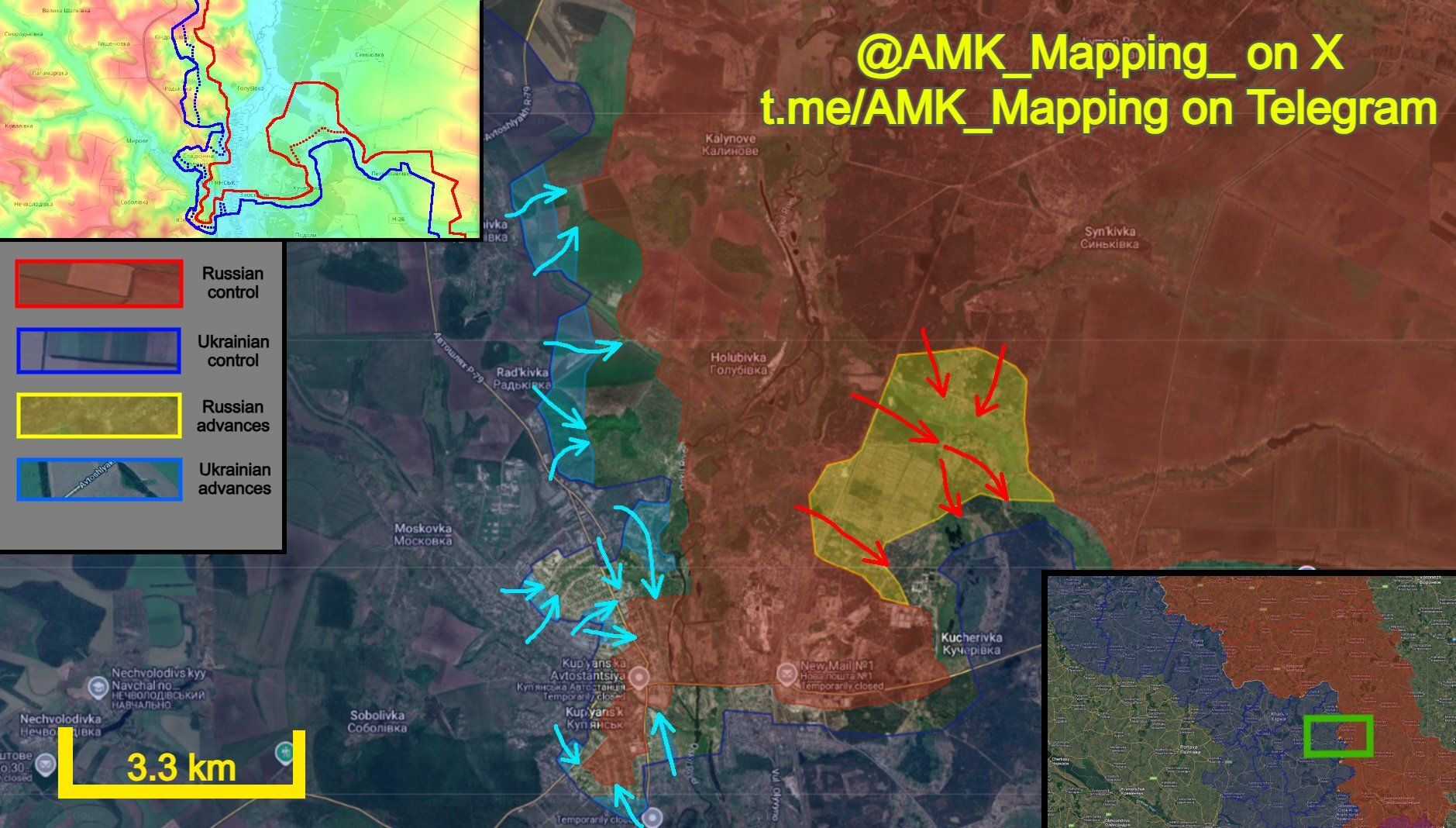
Last 24 hours in according to AMK (More Neutral)
Sources:
News/Journal sources available upon request, not shown to maintain visual integrity of page.
TWEET OF THE DAY
TODAY IN HISTORY
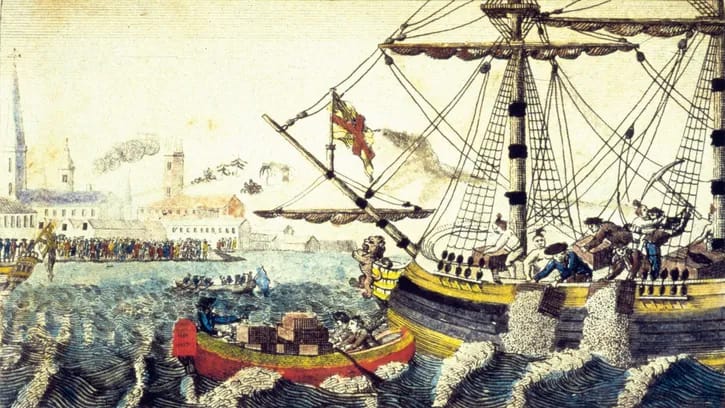
(December 16, 1773): The Boston Tea Party
On this day in 1773, a group of men dressed in Mohawk headdresses and cheered by a crowd of thousands threw tea belonging to the British East India Company into Boston Harbor. Britain's punitive response to the Boston Tea Party, which was a protest against taxes, helped push American colonists closer to war.