- Basedment
- Posts
- The Bizarre New Ukraine Peace Plan
The Bizarre New Ukraine Peace Plan
Your daily dose of geopolitical updates and strategic analysis. Unbiased, but not unbased.

Editor-in-Chief
November 20, 2025
THE BRIEFING
Here’s what’s happening in geopolitics today.
Washington is cracking open the Epstein files, Moscow is again pounding western Ukraine, and Sudan is cautiously welcoming fresh diplomacy from the U.S. and Saudi Arabia.
Meanwhile, climate diplomacy took a surprise turn with Turkey landing COP31 and Australia steering the negotiations, just as Beijing slammed Tokyo for remarks it says crossed a red line on Taiwan.
And in today’s deep dive, we’re breaking down the meaning and timeline of this newly proposed and bizarre 28-point Trump Peace Plan.
THE LAST 24 HOURS IN GEOPOLITICS
1. Trump signs bill to release Justice Department’s Epstein files
Trump has today signed legislation directing the Department of Justice to release unclassified files from its investigation of Jeffrey Epstein to include: internal communications, investigative records, and his 2019 death in custody. While Trump had previously opposed the measure, he reversed course amid bipartisan pressure, and the law mandates transparency within 30 days while still allowing redactions for active investigations, classified material or victim privacy. Congressional support was overwhelming: the House voted 427–1 and the Senate passed it by unanimous consent.
read more
2. Death toll from Russia’s overnight attack on Ternopil rises to 25
A massive Russian drone and missile strike on the western Ukrainian city of Ternopil killed 25 people, including three children, and injured at least 73 others, according to Ukraine’s Interior Ministry. The attack hit two nine-storey residential buildings, severely damaging their upper floors and sparking large fires. Rescue efforts are ongoing, with over 160 emergency personnel on the ground, while Ukraine has condemned the strike as a brutal assault on civilians.
read more
3. Sudan welcomes U.S. and Saudi mediation efforts to end civil war
Sudan’s Transitional Sovereignty Council has publicly praised new mediation efforts by the United States and Saudi Arabia aimed at ending the brutal civil war with the Rapid Support Forces (RSF). In a statement on X, the council affirmed its willingness to engage “seriously” with Washington and Riyadh to bring about “just and equitable peace.” Meanwhile, both the U.S. and Saudi Arabia have pushed a broader peace roadmap calling for a three-month humanitarian truce followed by a permanent ceasefire and political transition.
read more
4. Turkey set to host COP31 climate summit, Australia to lead government talks
Turkey has been awarded the hosting rights for COP31, which is now set to take place in Antalya in November 2026, following a compromise with Australia. Under the deal, Australia’s Climate Minister Chris Bowen will lead the government negotiations, giving Canberra significant influence over the summit’s substance, even though the event will not be held on Australian soil.
read more
5. China says trade cooperation with Japan ‘severely damaged’ by Taiwan comments
China’s foreign ministry has accused Japan of “severely damaging” bilateral trade cooperation after Prime Minister Sanae Takaichi made remarks suggesting Japan could militarily respond if China attacked Taiwan. Beijing said the comments undermined the political foundation of China-Japan relations and violated the one-China principle. "Prime Minister Takaichi's openly erroneous remarks concerning Taiwan have fundamentally undermined the political foundation of China-Japan relations and severely damaged bilateral economic and trade exchanges," He Yongqian, a ministry spokesperson told a regular news conference.
read more
DAILY DEEP DIVE
This Is Better Than Any Reality TV…
It’s not often that a deal like this smells as fishy as it does. There are far too many moving pieces, all being denied, rejected, altered, or ignored at the same time. Many have little confidence in this peace plan, and it’s not hard to see why. It’s almost as if someone handed Witkoff the ball and said, “just run with it”. We will put a disclaimer here now, that all early reporting was based off leaked sources.
What’s the Drama About?
Yesterday, sources at Axios revealed that the Trump administration and Russian officials had drafted a new Ukraine peace proposal. At the time, sources stressed this was still in a framework stage rather than a concrete document to be presented to either side. It has since been referred to as the “28-point peace proposal”. But the early details were incredibly vague, with most of the initial information coming from Washington “sources”.
The controversy stems from the concessions buried within the plan. The proposal appears entirely skewed in Russia’s favour. Ukraine could be required to cede the remaining parts of the Donbas, while Crimea and the broader Donbas would be fully recognised internationally as Russian territory. Militarily, Ukraine would need to cut its armed forces by half and abandon key long-range weapons, given that U.S. systems would be significantly reduced. Kyiv would also need to reduce its army by more than half, with no peacekeeping force in the country and no NATO prospects whatsoever. Then, to muddy the situation further, the Donbas would become a fully demilitarised zone with no Russian troop presence — even in areas Russia currently controls. And in return? Ukraine would receive extremely vague U.S. security guarantees.
U.S. Thinking and Ukrainian Response
Kyiv officials have dismissed the proposal as nothing more than a list of long-standing maximalist Kremlin demands, unchanged and completely unacceptable. Umerov — Ukraine’s defence minister — was authorised to travel to Ankara to meet U.S. envoy Witkoff, and according to “sources”, Umerov’s comments were apparently considered during the framework discussions. Ukrainian officials, however, say he only received an oral briefing and did not agree to any terms. The alleged U.S. logic behind all this is that Ukraine is likely to lose the Donbas, and possibly more, the longer the war drags on. Therefore, in their view, it is in Ukraine’s interest to take a deal now.
The Timeline
One of the main architects behind the draft proposal is Kirill Dmitriev, the Kremlin-linked head of Russia’s sovereign wealth fund and a long-time Putin insider. Dmitriev travelled to Washington in late October, shortly after the U.S. hit Rosneft and Lukoil with major sanctions and scrapped a planned Trump–Putin meeting in Budapest amid rising frustration in the White House. Tensions peaked during a heated call between the countries’ senior diplomats. That exchange convinced Washington that Moscow had no real intention of negotiating. Witkoff, who reportedly recently met Ukraine’s national security chief Rustem Umerov in Miami to walk through the 28-point framework.
On November 19th Witkoff was meant to attend a trilateral meeting with Zelensky and the Turkish foreign minister in Ankara to advance the proposal, but it collapsed after Zelensky reportedly said he would not agree to such terms and instead floated an EU-crafted alternative that officials claimed “Russia would never accept”. However, Zelensky publicly denies this account, saying the meeting was postponed only to include European partners — and that he rejected nothing of the sort. The cancellation of the meeting was already making waves in the geopolitical space, but it was Axios who had revealed to us why – the 28 peace point plan. Once the story was leaked, no major Russian or US official would confirm the peace plan. On November 20th, Rubio jumped on X with a vague, half-formed statement that was quickly ridiculed by the internet.

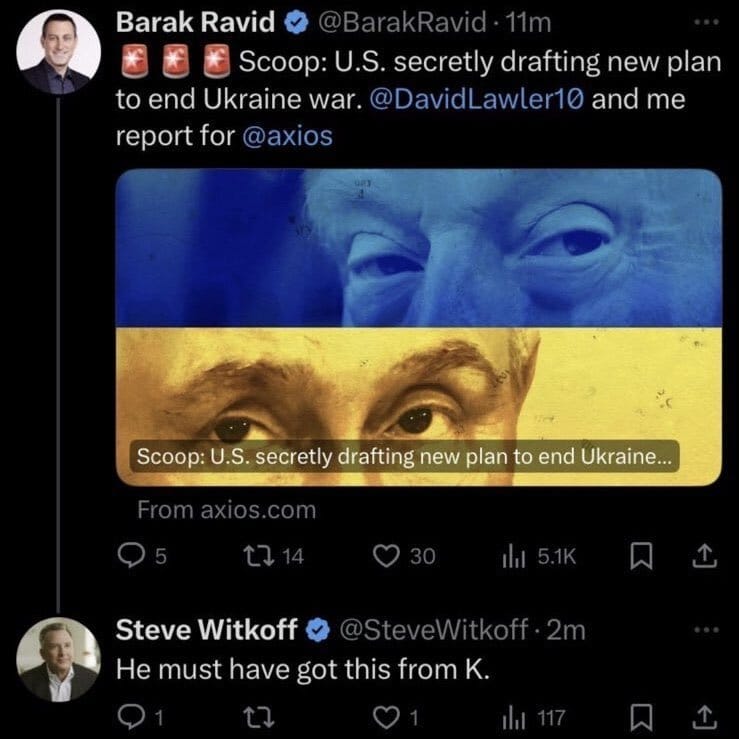
To make matters even more bizarre, Witkoff (apparently thinking he was replying to a private DM) commented publicly under a post, hinting that the Axios leak supposedly came from someone with the euphemism “K.” Is K referring to Kiril or Kellogg? Just today, Keith Kellogg, the U.S. President’s special envoy to Ukraine and previously Russia, plans to resign in January 2026, citing workload issues and frustration that the administration refuses to acknowledge Russia is stalling peace talks. Kellogg has frequently clashed with fellow envoy Steve Witkoff. Kiril could have also leaked this to create division and confusion amongst Western allies.
Other Considerations
Siversk is under serious threat, Kupiansk heavily favours Russia, Pokrovsk and Myrnohrad are tightening, and the southern front is in freefall. The Epstein saga suggests Russia may be trying to leverage whatever relationship it has with Trump, fearing Republicans could lose influence and wanting to use him while they can. And to top it all off, this comes just days after one of the biggest Ukrainian corruption scandals in years was unearthed — a scandal that has hit Zelensky’s image hard at the worst possible moment.
European leaders have also argued, not unfairly, that this is just another Russian tactic to appear as though it’s pursuing peace. And if Moscow leaked this deliberately, it’s already doing exactly what it was designed to do.
PART 1 Of 2
This is a highly fluid and fast-moving story, and our aim today was simply to lay out the foundations of the absurdity surrounding this entire debacle before diving into the analytical side tomorrow. By then, we’ll likely have more clarity — and more information to work with.
Sources:
News/Journal sources available upon request, not shown to maintain visual integrity of page.
TODAY IN HISTORY
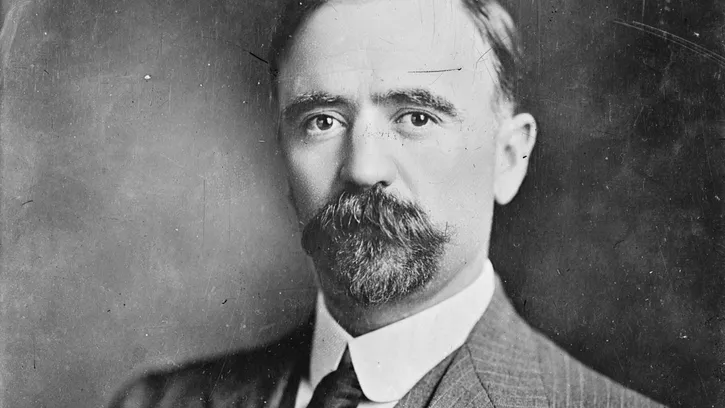
(November 20, 1910): Mexican Revolution launched by Francisco Madero
On this day in 1910, Francisco Madero launched a failed revolt that sparked the Mexican Revolution by inspiring hope in such leaders as Pancho Villa and Emiliano Zapata, who then mobilized their armies against the government of Porfirio Díaz, the president of Mexico.