- Basedment
- Posts
- The Bloody remnants of Boko Haram
The Bloody remnants of Boko Haram
Your daily dose of geopolitical updates and strategic analysis. Unbiased, but not unbased.

Editor-in-Chief
August 05, 2025
THE BRIEFING
Here’s what’s happening in geopolitics today.
Today’s top stories span from new defence cooperation in the Indo-Pacific to economic and political pushback in the Middle East and South Asia.
Australia has tapped Japan to build a new fleet of warships, while Israel adjusts its aid strategy in Gaza and India pushes back on Western criticism of its Russian oil ties. Meanwhile, Lebanon has opened sensitive talks on Hezbollah’s arms, and Ukrainian drones have again struck deep inside Russian territory.
Today we we examine The Islamic State’s most successful African affiliate: ISWAP. It’s operations, structure, rise and decline.
THE LAST 24 HOURS IN GEOPOLITICS
1. Japan wins $10B deal to build three Aussie warships
Australia has awarded a A$10 billion (USD 6.5 billion) contract to Japan’s Mitsubishi Heavy Industries for 11 Mogami‑class frigates, beating Germany’s ThyssenKrupp MEKO A‑200 proposal in a hard-fought defence procurement competition. As part of the SEA 3000 general purpose frigate programme, the first three ships will be built in Japan and the remaining eight at Austal’s shipyard in Western Australia under a joint production model. With cutting-edge stealth design, vertical launch missile cells, and advanced sensors, the Mogami frigates are being framed as a key symbol of growing Japan–Australia strategic alignment and accelerated Indo-Pacific naval capability delivery.
read more
2. Israel claims to allow ‘gradual entry of goods’ to Gaza’s private sector
Israel has announced a new cabinet-approved mechanism to allow gradual and controlled entry of goods into Gaza through private local merchants, aimed at supplementing humanitarian aid while reducing reliance on UN agencies. The move is operated by COGAT and intended to expand access to essentials like food, baby supplies, and hygiene items as famine concerns mount. This comes amid UN warnings of a “worst-case scenario” famine unfolding in Gaza, with humanitarian agencies reporting shortages and mass starvation across the region.
read more
3. India hits back at Trump’s threat over Russian oil purchases
India has pushed back hard at U.S. and EU criticism, calling it unfair to single out New Delhi for purchasing Russian oil, even as Western powers continue extensive trade with Moscow themselves. The Indian Foreign Ministry called the targeting “unjustified” and accused the U.S. and EU of double standards, pointing out their own imports of Russian energy, chemicals, and industrial goods. Facing looming tariff threats and trade penalties, India defended its decision as a matter of affordability and energy security, arguing it’s a necessity rather than a political choice.
read more
4. Lebanon’s cabinet meets to discuss Hezbollah’s arms after US pressure
Lebanese Cabinet ministers met on August 5 to formally address Hezbollah’s weapons arsenal, marking the first time the issue has entered the official government agenda. The session followed mounting U.S. pressure: Washington has insisted Beirut publicly commit to disarmament before resuming negotiations to halt Israeli airstrikes and troop presence in the south. While Hezbollah has publicly rejected disarmament as serving Israeli interests, some Lebanese officials are pushing for compromises, emphasising defence reform under state control rather than outright disbandment.
read more
5. Ukraine drone attack sparks fire in Russian resort city
Overnight Ukrainian drone strikes hit Russia’s Rostov region, sparking fires at a railway station and knocking out a power line, according to acting Governor Yury Slyusar. The attack killed one person in a car caught in the blast zone and disrupted local train service as fire crews worked to contain the damage. The incident illustrates Ukraine’s increasingly aggressive strategy of targeting transport and infrastructure deep behind Russian lines as the war continues.
read more
DAILY DEEP DIVE
ISWAP: CONFLICT, VIOLENCE AND DECLINE
BOKO HARAM: SPLIT IN TWO
The group commonly known as Boko Haram initially emerged in the late 2000s under the leadership of Mohammed Yusuf and was later led by Abubakar Shekau. After internal fractures in 2016, two key splinters emerged: Jama’tu Ahlis Sunna Lidda’awati wal-Jihad (JAS) and Islamic State West Africa Province (ISWAP), recognised by ISIS. JAS retained Shekau’s (its original leader) violent, predatory model; ISWAP adopted a more bureaucratic, structured approach aligned with ISIS doctrine.
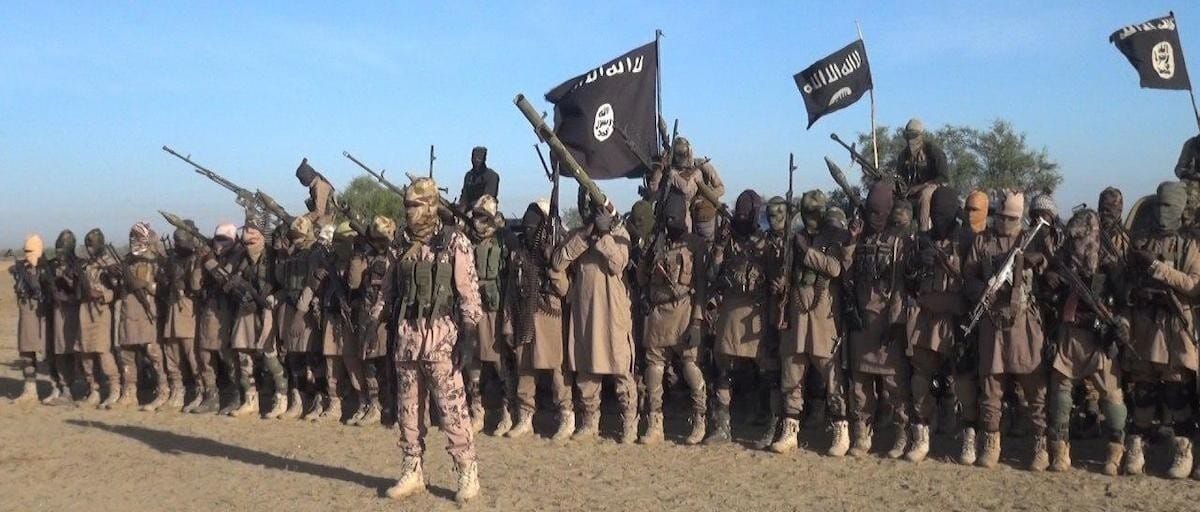
ISWAP members in propaganda video
ISWAP OVERVIEW
ISWAP controls a large area of North Eastern Nigeria, with a varying presence in Niger, Cameroon, and Chad (albeit heavily declined). It also operates through its subgroup in the Greater Sahara (ISGS). ISWAP aims at establishing a global caliphate in alignment with ISIS’ ideology and, therefore, is an extremist Islamist group. It generates revenue through abductions and raids, arms trafficking, taxation, and business ventures. It also provides social services to communities under its control. Structurally, ISWAP is a hybrid of spider and starfish models, controlling territory with decentralised cells, while maintaining some limited self-sufficient institutions. Abu Musab al-Barnawi was the confirmed leader until he was killed in October 2021.
The current political context is now centred around a resurgent JAS, which has taken over ISWAP’s previous strongholds in the Lake Chad islands. ISWAP, while still operational, is focused on consolidating control in central and western Borno and eastern Yobe after suffering internal defections and leadership crises. The rivalry between both factions is rooted in their differing treatment of civilians and organisational governance, inflicting greater damage on each other than state militaries have in recent years. JAS believes that any civilian is fair plunder, including muslims, and are generally more violent. While ISWAP has taken a more ‘liberal’ approach in the eyes of Islamic extremism. Opting for less violent methods of control, such as taxation, for its muslim civilians.
OPERATIONS
Terrorist strategies include mass murder and kidnappings of civilian and military targets to seize territory, fund operations, and inflict terror (CNR, 2022; ANS, 2023). These come in the form of car bombings, organised attacks, and kidnappings. Pre-2022, ISWAP had primarily focussed on a “heart and mind” approach, targeting military objectives, in contrast to JAS. Since then, violence has escalated, particularly outside ISWAP's core territory. The Lake Chad Basin contributed 14% of Islamist activity in 2023, reflecting a near doubling in extremist events since 2019. Reports show that ISWAP has contributed to a greater number of civilian fatalities than Boko Haram despite committing fewer attacks, indicating a more effective and calculated terrorist strategy. Notable attacks include the abduction of 110 schoolgirls, the killing of 100 Nigerian soldiers, the seizure of Borno towns, and the attempted assassination of the Nigerian president.
STATE BUILDING
ISWAP’s operations are supported by a controlled economy and strict regulation of trade, but its coercive grip is weakening. The group’s ability to extract taxes and maintain legitimacy has declined following its loss of the Lake Chad region. Though it continues to provide services in parts of Borno and Yobe, internal tensions, leadership disputes, and resource constraints have eroded its authority. Defections and battlefield setbacks have exposed vulnerabilities in ISWAP’s governance model, once perceived as sustainable.
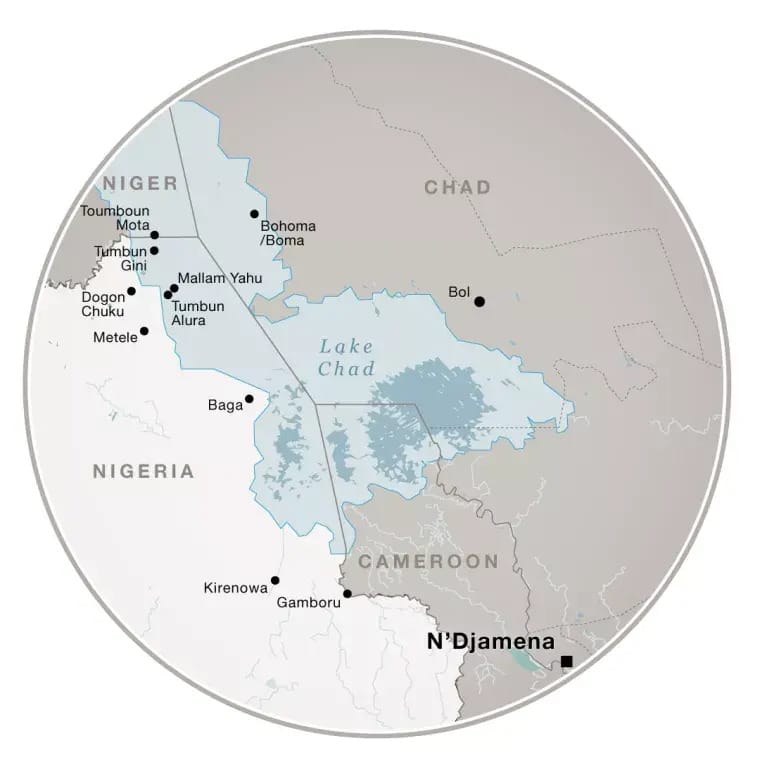
Much of the foucs is centred around the borders surrounding Lake Chad
ISIS IDEOLOGICAL ALIGNMENT
ISWAP’s ideological alignment with ISIS informs its strategic posture. While traditionally avoiding indiscriminate violence against civilians, ISWAP has increasingly adopted coercive tactics in response to internal dissent and territorial loss. Its previous strength in controlling Lake Chad has been undercut by JAS's resurgence. ISWAP now faces financial disruption, declining legitimacy, and internal fragmentation. State actors across the region remain overstretched, and ECOWAS coordination has been weakened due to regional instability. Without renewed governance, defection support, and military coordination, ISWAP remains a persistent threat with a weakened but dangerous presence.
Sources:
References available upon request. A full citation list has been omitted to preserve the visual integrity of the page.
TWEET OF THE DAY
The fact I had to ask Grok whether this is real is crazy…
TODAY IN HISTORY
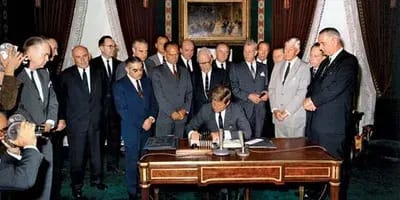
(August 5, 1963): The United States, the Soviet Union, and the United Kingdom signed the Nuclear Test-Ban Treaty in Moscow. The treaty prohibited nuclear weapons tests in the atmosphere, outer space, and under water, aiming to curb radioactive fallout and ease Cold War tensions. Although it did not ban underground testing, it marked a critical step toward future arms control agreements and signaled a rare moment of cooperation between rival superpowers.