- Basedment
- Posts
- The China Victory Parade: Who Is Attending?
The China Victory Parade: Who Is Attending?
Your daily dose of geopolitical updates and strategic analysis. Unbiased, but not unbased.

Editor-in-Chief
August 30, 2025
THE BRIEFING
Here’s what’s happening in geopolitics today.
Today’s briefing brings together stories ranging from shifting U.S. political dynamics to fresh tensions across Europe and Asia.
From Donald Trump’s decision to strip Kamala Harris of Secret Service protection to Israel’s recovery of another hostage from Gaza, the headlines underscore how security, diplomacy, and leadership are shaping events worldwide. We also look at mounting unrest in Indonesia and renewed calls from Europe to tighten sanctions on Russia.
And in our deep dive, we explore who will be attending China’s 80th “Victory Day” parade and why this matters in geopolitics.
THE LAST 24 HOURS IN GEOPOLITICS
1. Trump revokes Kamala Harris’ Secret Service protection
Trump has directed that Secret Service protection for former Vice President Kamala Harris be terminated effective September 1, ending the extra year of coverage previously approved by President Biden beyond the six-month post-tenure norm. The move means Harris will lose not only a 24/7 security detail but also threat monitoring, just as she prepares to launch a 15-city book tour for her memoir 107 Days. Her team expressed gratitude to the Secret Service for their service, while criticism mounted amid concerns that the timing could jeopardise her safety.
read more
2. Israel recovers body of hostage Ilan Weiss from Gaza
Israel has recovered the body of former hostage Ilan Weiss from the Gaza Strip, according to the Prime Minister’s office, along with the remains of a second individual whose identity has not yet been released. Weiss, 55, had been kidnapped during the deadly October 7, 2023 Hamas attack on Kibbutz Be'eri. His wife and daughter were later freed in a prisoner swap, while now 49 hostages are reported to remain in Gaza, with only around 20 believed to be alive.
read more
3. Macron calls Putin an ‘ogre at our doorstep’
Russia slammed French President Emmanuel Macron on Friday after he referred to Vladimir Putin as “an ogre at our gates,” with the Russian Foreign Ministry calling the remark "indecent" and unbecoming of a head of state, media reported. Spokesperson Maria Zakharova criticised the comment as a “low-grade insult,” arguing it crossed the line of diplomatic decorum.
read more
4. Tensions soar across Indonesia as protests against police erupt
Hundreds of Indonesians took to the streets across Jakarta on Friday after a delivery rider, Affan Kurniawan, was tragically run over during student-led protests by an armoured police vehicle, an incident that swiftly became a symbol of excessive force and ignited public outrage and fresh calls for police reform. The driver was not involved in the protests and his death prompted widespread condemnation, including an official apology from Indonesia’s president and the arrest of seven officers involved in the crash. s demonstrations spread and the economy wavered, the episode emerged as a significant test for President Prabowo Subianto’s year-old administration, which is now grappling with escalating dissent over austerity and governance.
read more
5. Merz and Macron push for secondary sanctions on Russian backers
German Chancellor Friedrich Merz and French President Emmanuel Macron jointly called for secondary sanctions targeting Russia’s energy, financial, and oil sectors aimed at striking deeper at the Kremlin’s war machinery. The coordinated push underscores growing frustration with Moscow's refusal to accept ceasefire proposals, especially as U.S. efforts at peace settle into uncertainty. Their united front reflects European resolve to maintain pressure on Russia even as diplomatic paths encounter turbulence.
read more
DAILY DEEP DIVE
CHINA VICTORY PARADE: WHO IS ATTENDING?
They say you are the average of your five closest friends. In geopolitics, the same logic applies. China is holding the September 3rd parade to mark the 80th anniversary of Japan’s surrender in World War II, commemorating its role in the “War of Resistance Against Japanese Aggression” and the broader Allied victory. China’s gathering of 26 foreign leaders at its V-Day commemorations shows exactly which alliances it values most in 2025. On top of that, there will be former heads of state and other government officials from different nations - but today we focus on the 26 foreign leaders.
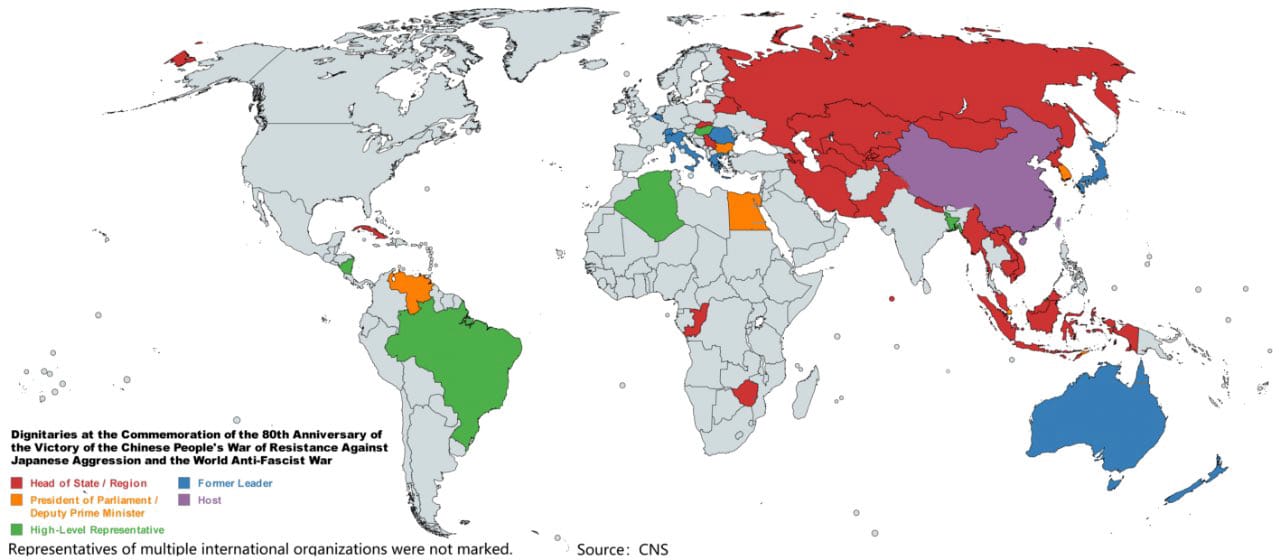
Please note this map highlights ROC (Taiwan) as part of the PRC, image source has a bias, but it allows us to show who is attending.
Central Asia
All five Central Asian presidents will attend (Kazakhstan, Kyrgyzstan, Tajikistan, Uzbekistan, Turkmenistan). The region is central to China’s Belt and Road Initiative, bringing major economic benefits, while also serving as a buffer for Beijing’s border security concerns in Xinjiang, where unrest and militant flows through Afghanistan and Central Asia have been an issue. More importantly, China is steadily pulling these states out of Russia’s traditional sphere of influence. Despite the rhetoric, Russian-Chinese ties are far from seamless, with the Ukraine war draining Moscow, Putin has been forced to lean on Beijing for support, a dependency framed publicly as ‘cooperation.’
Middle East
The simultaneous presence of Armenia and Azerbaijan in Beijing, so soon after their joint summit with Trump in Washington, highlights how both states are carefully balancing between Western overtures and deepening ties with China. For Beijing, hosting both leaders alongside Iran’s president signals that the South Caucasus corridor, a key route for trade and energy linking Europe, Asia, and the Middle East, is firmly within its strategic orbit. Iran’s attendance carries added symbolic weight: it comes in the aftermath of the Iran–Israel conflict and just weeks after the EU reimposed “snapback” sanctions on Tehran.
Europe
Only three European leaders will attend the parade: Slovakia’s Prime Minister Robert Fico, Serbia’s President Aleksandar Vučić (both known for warmer ties with Russia and China than most of Europe) and Belarus’ Alexander Lukashenko. In previous years, leaders from the Czech Republic, Bosnia, and Montenegro also attended, but their absence now reflects a closer alignment with the West. Hungary and Bulgaria will send high level dignitaries as well.
Africa
Africa’s presence at the 2025 parade is limited to just two leaders (Congo’s Denis Sassou Nguesso and Zimbabwe’s Emmerson Mnangagwa) a sharp drop from 2015, when Egypt, South Africa, Ethiopia, Sudan, and the DRC were represented. Egypt will still send a senior dignitary, but the broader decline reflects optics: many states prefer not to be seen endorsing a military show amid intensifying U.S.–China rivalry. Still, China remains deeply entrenched in Africa through FOCAC and bilateral economic ties, allowing leaders to skip the parade without weakening their broader engagement with Beijing.
South East Asia
Leaders from Indonesia, Malaysia, Cambodia, Laos, Vietnam, and Myanmar will attend, one of the strongest regional showings. For Indonesia and Malaysia, it’s about keeping Beijing close while balancing U.S. ties, while Cambodia, Laos, and Myanmar remain China’s most dependable partners. The turnout underscores Southeast Asia’s centrality to China’s neighbourhood diplomacy.
The Americas
Latin America’s presence is limited, with Cuba’s President Miguel Díaz-Canel the only head of state attending. Brazil and Venezuela will send senior representatives rather than their leaders, a step down from 2015 when Venezuela’s president appeared in Beijing. Maduro faces bigger problems at home, including the U.S. Navy at his doorstep, while Brazil (keen to maintain ties with China) is also wary of provoking Trump, especially after recent tensions involving Bolsonaro and renewed threats to BRICS.
Notable Visits: Putin and Kim
Two of the most significant attendees in Beijing are Vladimir Putin and Kim Jong Un. Putin’s visit, described by his own spokesperson as “unprecedented,” comes at a time when Russia is heavily dependent on China due to the economic and military strain of the Ukraine war. His presence underscores Moscow’s pivot eastward, and it allows Beijing to visually cement its role as Russia’s indispensable partner.
Kim’s attendance is just as striking, it marks the first time North Korea’s leader has joined a multilateral diplomatic event, after years of limiting his travel to bilateral summits. His presence opens the door for a potential trilateral encounter with Xi and Putin, signalling the possibility of deeper alignment among China, Russia, and North Korea. Iran should also be considered in this anti-western axis. It also lets Beijing showcase its continued leverage over Pyongyang, even as Russia has recently courted Kim more aggressively.
Equally telling is who will not be in Beijing
Australia and Oceania: No leaders from this region are attending, which reflects less a diplomatic breakdown than China’s current priority on its immediate neighbourhood.
India: Despite being a BRICS partner, India is absent at the head-of-state level. However, Modi will be attending the SCO summit shortly after - but not before he meets with the Prime Minister of Japan for trade talks.
Japan: Tokyo not only declined to attend but reportedly urged other states to skip the parade. Historical disputes over Japan’s wartime role, combined with current tensions over Taiwan and the East China Sea, make Japan’s absence both expected and symbolic.
Philippines: The Philippines stands an outlier on the map, one of the few SEA / Pacific nations to not attend. They have had the most animosity towards the Chinese expansion in the South China Sea.
Sources:
Sources available upon request, included separately to not disrupt the style of the page.
TODAY IN HISTORY
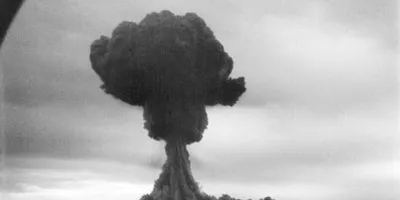
(August 29, 1949): The Soviet Union tested its first atomic bomb (known in the West as Joe-1); it was a direct copy of the Fat Man bomb used by the U.S. military on Nagasaki during World War II.