- Basedment
- Posts
- The Complicated Civil War In Myanmar, Melania Denies Epstein Connection
The Complicated Civil War In Myanmar, Melania Denies Epstein Connection
Today we break down the Myanmar civil war — a complex mix of ethnic, cultural, and political conflict.

Editor-in-Chief
April 10, 2026
THE BRIEFING
Here’s what’s happening in geopolitics today.
A day of diplomacy, with plenty on the line: Taiwan’s opposition leader meets Xi in a rare high-level encounter, while Keir Starmer works the Gulf to keep a fragile US-Iran ceasefire intact and Pakistan prepares to host potentially pivotal talks between Washington and Tehran.
Elsewhere, Ukraine is expanding its security footprint into the Gulf, and Melania Trump has stepped forward with a rare public denial amid renewed scrutiny around Epstein.
Today we break down the Myanmar civil war — a complex mix of ethnic, cultural, and political conflict.
SUPPORT OUR PODCAST!
You guys asked for it, we delivered it! New podcast based off your questions.
In the podcast we discussed: The F-15E crash and rescue, Iranian capabilities, Russia and Ukraine, Fall of the Roman Republic
Watch and listen here
THE LAST 24 HOURS IN GEOPOLITICS
1. Taiwan opposition leader meets Xi Jinping in Beijing
Taiwan’s opposition leader Cheng Li-wun has met Chinese President Xi Jinping in Beijing, marking the first such high-level encounter between the two sides in more than a decade. During the meeting, both sides emphasised the need to maintain peace and stability across the Taiwan Strait, with Cheng calling for dialogue to “avoid war” amid rising tensions. The visit has sparked political debate in Taiwan, with critics warning it could signal closer alignment with Beijing, while supporters argue engagement is necessary to reduce the risk of conflict.
read more
2. UK PM Keir Starmer visits Gulf to shore up ‘fragile’ US-Iran ceasefire
UK Prime Minister Keir Starmer has travelled to the Gulf to meet regional leaders in an effort to reinforce the recently agreed two-week ceasefire between the United States and Iran. During the visit, he is holding talks with partners including Saudi Arabia, the UAE and Qatar, focusing on sustaining the truce, reopening the Strait of Hormuz and pushing for a longer-term diplomatic resolution. Starmer has warned the ceasefire remains “fragile,” stressing that continued coordination and concrete actions will be required to prevent a return to conflict.
read more
3. Melania Trump denies any connection with Jeffrey Epstein in rare public address
U.S. First Lady Melania Trump has publicly denied any connection to convicted sex offender Jeffrey Epstein in a rare address from the White House. She said she was never friends with Epstein or Ghislaine Maxwell, was not involved in his crimes, and rejected claims that Epstein introduced her to Donald Trump, describing such allegations as “lies.” The statement comes amid renewed scrutiny of Epstein’s network and was accompanied by a call for congressional hearings to allow victims to testify publicly under oath.
read more
4. Ukraine in talks with Oman, Kuwait, Bahrain on security cooperation, Zelenskyy says
Ukrainian President Volodymyr Zelenskyy said Kyiv is in ongoing talks with Oman, Kuwait and Bahrain to expand security cooperation as part of a broader push into the Gulf. The discussions focus on sharing Ukraine’s battlefield expertise while also exploring energy and defence collaboration. The outreach builds on existing agreements with other Gulf states and reflects Ukraine’s growing role as a provider of security know-how amid overlapping regional conflicts.
read more
5. Islamabad prepares to host historic negotiations between Iran and the US
Pakistan is preparing to host what officials describe as historic negotiations between the United States and Iran in Islamabad, following a fragile two-week ceasefire brokered through Pakistani mediation. High-level delegations from both sides, including U.S. representatives led by Vice President JD Vance and senior Iranian officials, are expected to attend talks aimed at securing a longer-term agreement. Security has been tightened across the capital ahead of the meetings, with the outcome seen as highly uncertain given ongoing tensions, including continued fighting in Lebanon.
read more
GLOBAL CONFLICT TRACKER
Myanmar Civil War
One of the more complicated conflicts to wrap your head around if you haven’t been following for a while. Equally hard to find good sources which can make data acquisition difficult, especially for more ‘live’ updates. A lot of competing and mixing interests in this one from a political standpoint but what can be certain is that the civilian population has suffered immensely ever since the nations independence in 1948.
Context
Myanmar's civil war began following the military coup on 1 February 2021. The military, known as the Tatmadaw, seized power from the elected government of Aung San Suu Kyi, triggering mass protests and armed resistance. In response, the exiled National Unity Government (NUG) and major ethnic armed organisations called for a democratic federal state, and their armed wing — the People's Defence Force (PDF) — declared a "defensive war" against the junta.
The conflict has gone badly for the military. Four years on, the junta controls only about 21% of the country's territory, while rebel forces and ethnic armies hold around 42%. The military's troop numbers have fallen dramatically, from roughly 300,000 soldiers in 2021 to about 130,000. A major comparison between rebel groups and the Junta is that these groups have much higher morale and purpose than that of the Junta.
The human toll has been severe. Nearly 5.2 million people have been displaced, and the UN reports widespread violations including airstrikes deliberately targeting civilians, hospitals, and schools. Myanmar's economy has lost nearly $100 billion since the coup.
Fractious Alliance
While anti-junta forces share the common goal of ousting the military junta, the opposition is a fragmented patchwork of ethnic armies, pro-democracy fighters, and local militias — each with their own agendas, territorial ambitions, and long-standing grievances with one another.
The National Unity Government (NUG), set up as the umbrella political body for the resistance, has largely failed to bring everyone under one roof. Many ethnic armed groups see it as too closely tied to Aung San Suu Kyi's NLD party, which they previously accused of siding with the military against minorities. Individual groups are also split internally, for example the Chin resistance, fractured into two rival factions that have clashed violently with each other.
Some groups have stayed neutral altogether, while others have quietly aligned with the junta. China has made things worse by cutting weapon supplies to rebel groups along its border and pressuring certain factions (like the MNDAA) to withdraw from key areas they had captured. Analysts warn the military has historically exploited these divisions, and could do so again. Unity is widely seen as the key to victory, but achieving it remains one of the revolution's biggest unsolved problems.
Political Reshuffling
In late 2025, the junta held elections widely condemned as a sham. The vote was held in only 263 of 330 townships, excluded displaced populations and minorities, and the main opposition party was barred from participating.
And as of March 2026 Myanmar's military has a new commander-in-chief. General Ye Win Oo, a 60-year-old former spymaster, was appointed to lead the Tatmadaw on March 30, 2026. Making him the first intelligence chief to rise to the top military post.
His selection is widely attributed to one thing: loyalty. Ye Win Oo has been a close confidant of outgoing commander Min Aung Hlaing for decades, with ties dating back to when he served under him in Yangon. He also personally led the troops that arrested Aung San Suu Kyi during the 2021 coup.
The appointment is seen as Min Aung Hlaing ensuring he retains influence behind the scenes, as he transitions to become Myanmar's president following the widely condemned sham elections held in late 2025. Analysts describe Ye Win Oo as a loyalist installed to keep the military firmly under Min Aung Hlaing's control, even as he steps out of uniform.
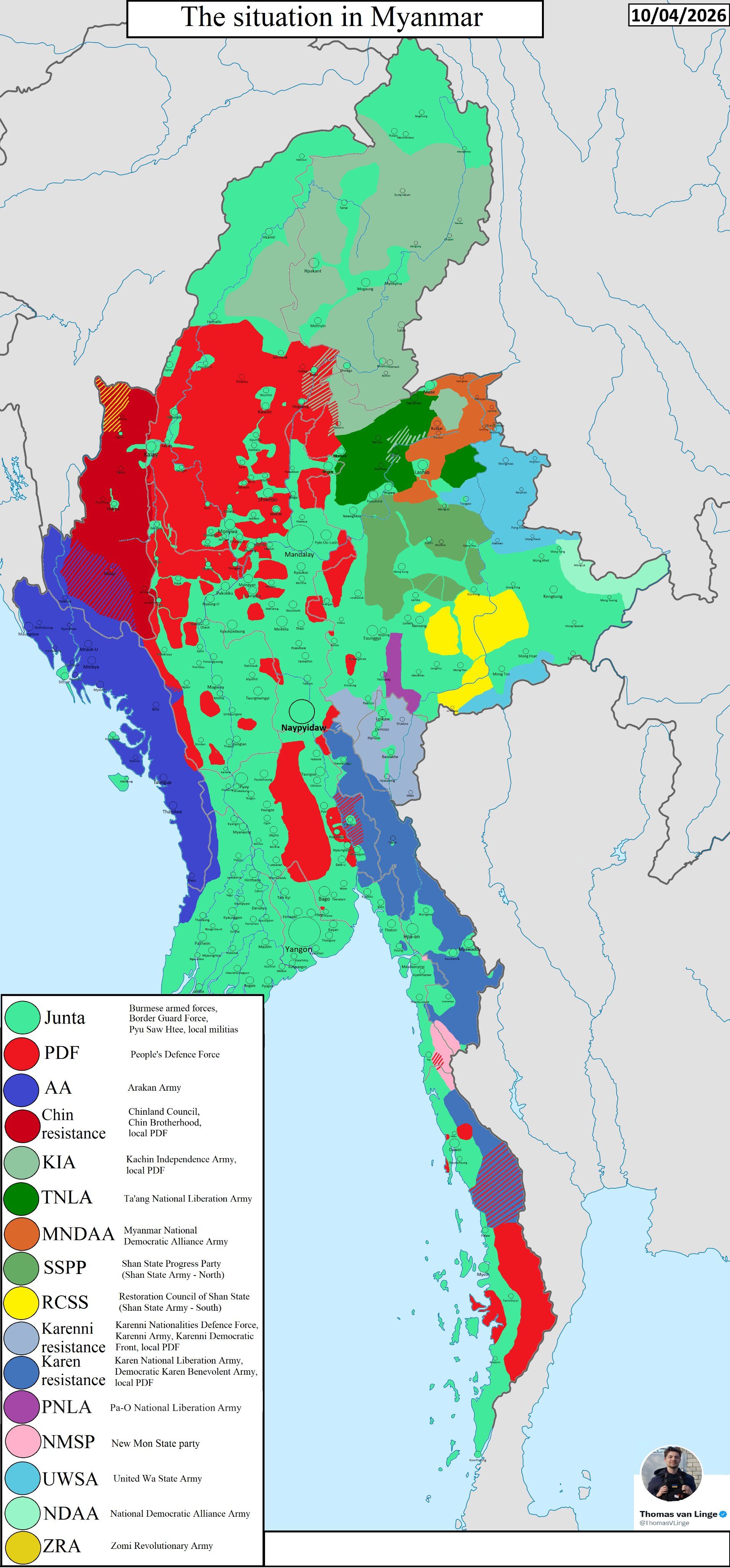
Thomas van Linge via X as map source and good source for this conflict overall.
Sources available upon request
TODAY IN HISTORY
(April 10, 1972): The development, production, and stockpiling of biological weapons were outlawed by the Biological Weapons Convention, signed by more than 150 countries.
