- Basedment
- Posts
- The Donroe Doctrine Is Being Tested - Everything You Need To Know
The Donroe Doctrine Is Being Tested - Everything You Need To Know
Today we turn to North America as the Donroe Doctrine has it’s first major pushback. We analyse the China-Canada partnership as well as the looming trade war between Europe and the U.S.

Editor-in-Chief
January 19, 2026
THE BRIEFING
Here’s what’s happening in geopolitics today.
From US fighter jets repositioning amid Iran tensions to a tragic high-speed rail disaster in Spain, today’s headlines span hard security and human tragedy.
We’re also tracking fresh diplomacy in the Pacific, domestic unrest concerns inside the United States, and a high-stakes impeachment challenge in the Philippines.
In today’s deep dive, we turn to North America as the Donroe Doctrine has it’s first major pushback.
A WORD FROM OUR SPONSOR
Last Time the Market Was This Expensive, Investors Waited 14 Years to Break Even

In 1999, the S&P 500 peaked. Then it took 14 years to gradually recover by 2013.
Today? Goldman Sachs sounds crazy forecasting 3% returns for 2024 to 2034.
But we’re currently seeing the highest price for the S&P 500 compared to earnings since the dot-com boom.
So, maybe that’s why they’re not alone; Vanguard projects about 5%.
In fact, now just about everything seems priced near all time highs. Equities, gold, crypto, etc.
But billionaires have long diversified a slice of their portfolios with one asset class that is poised to rebound.
It’s post war and contemporary art.
Sounds crazy, but over 70,000 investors have followed suit since 2019—with Masterworks.
You can invest in shares of artworks featuring Banksy, Basquiat, Picasso, and more.
24 exits later, results speak for themselves: net annualized returns like 14.6%, 17.6%, and 17.8%.*
My subscribers can skip the waitlist.
*Investing involves risk. Past performance is not indicative of future returns. Important Reg A disclosures: masterworks.com/cd.
THE LAST 24 HOURS IN GEOPOLITICS
1. US boosts presence in Middle East as Iran strikes remain a possibility
Twelve U.S. Air Force F-15E Strike Eagles from the 48th Fighter Wing took off earlier today from RAF Lakenheath in the UK en route to Muwaffaq Salti Air Base in Jordan, with one aircraft diverting to Chania International Airport in Crete. The deployment was supported by multiple KC-135T aerial refuelling tankers and C-17A Globemaster III transport aircraft, as the U.S. increases its military posture in the Middle East amid rising tensions with Iran.
read more
2. High-speed train crash in Southern Spain leaves at least 21 dead
At least 21 people were killed and dozens more injured on Sunday evening after two high-speed trains derailed and collided near Adamuz in Córdoba province, southern Spain, officials said. One train travelling from Málaga to Madrid jumped onto the opposite track and struck an oncoming service from Madrid to Huelva, sending both off the rails and prompting a large-scale emergency response. Spanish authorities have suspended rail services between Madrid and Andalucía as investigators work to determine the cause of the collision, which occurred on a recently renovated straight section of track.
read more
3. New Zealand and Kiribati sign statement of partnership agreement
New Zealand and Kiribati signed a new Statement of Partnership in Tarawa on Monday, formalising enhanced cooperation across political, economic and social areas after several months of high-level dialogue. The agreement, signed by New Zealand’s Foreign Minister Winston Peters and Kiribati’s Vice President Dr Teuea Toatu, underscores shared priorities including health initiatives, labour mobility and security cooperation within the Pacific region. The pact reaffirms a long-standing relationship between the two Pacific nations and expands commitments such as support for non-communicable disease prevention, maternal and child health, increased participation in seasonal worker programmes, and enhanced water security funding.
read more
4. Pentagon readies 1,500 soldiers to possibly deploy to Minnesota, officials say
The U.S. Pentagon has placed about 1,500 active-duty soldiers from the Army’s 11th Airborne Division on “prepare-to-deploy” orders for a potential mission to Minnesota, according to U.S. defence officials. The troops could be sent if Trump invokes the rarely used Insurrection Act to support federal authorities amid widespread protests linked to a federal immigration enforcement operation. No formal deployment has yet been ordered, and officials emphasised that the standby status reflects strategic planning rather than an imminent movement, while state leaders including Minnesota’s governor have pushed back against the idea of active-duty troops being sent into the state.
read more
5. Lawyer files impeachment complaint against Philippine President Marcos
A lawyer has formally filed an impeachment complaint against Philippine President Ferdinand “Bongbong” Marcos Jr. with the House of Representatives, marking the first such complaint lodged during his administration. The complaint, submitted by attorney Andre De Jesus and endorsed by Pusong Pinoy Party-list Rep. Jett Nisay, accuses Marcos of culpable violation of the Constitution, graft and corruption, and betrayal of public trust, with one central allegation focusing on his role in permitting the arrest and transfer of former President Rodrigo Duterte to the International Criminal Court in The Hague.
read more
DAILY DEEP DIVE
The Donroe Doctrine’s First Big Test, Can It Last?
The Donroe Doctrine
The “Donroe Doctrine,” as Trump has coined it—a revived Monroe Doctrine—rests on an old understanding of power. Unlike the 19th or even mid-20th century, influence today is no longer just exercised primarily through naval dominance or territorial control. Economic leverage, regulatory power, supply chains, and political alignment also shape spheres of influence.
In this context, Canada aligning itself with China (even in a limited, controlled way) becomes a strategic irritant for Washington. Combined with the EU’s increasing willingness to assert itself, the administration’s hemispheric assumptions are being quietly but firmly tested.
Nuuk’s Westward Shift at Risk
What many don’t know is that in recent years Nuuk has pursued a calculated westward pivot toward the US and Canada—seeking direct trade routes, infrastructure links, and reduced reliance on Denmark’s €600m annual block grant. This shift also has to do with breaking old colonial links to Copenhagen fo better prospects as the traditional fishing continues to decline. This strategy is tied to Greenland’s mineral wealth, increasingly important for green technologies and defence supply chains as Western states seek alternatives to China.
However, Trump’s coercive rhetoric risks backfiring. Rather than accelerating westward alignment, it strengthens arguments within Nuuk for hedging through deeper EU and Nordic ties. The result may be diversification, not dependency.
The EU Pushes Back
Trump has sharply escalated tensions by threatening tariffs on eight European countries over Greenland, starting at 10% and rising to 25% by June. European leaders responded with emergency talks, with Emmanuel Macron urging use of the EU’s anti-coercion instrument, the “trade bazooka.” This could restrict US market access or revive €93bn in retaliatory tariffs.
Economists warn this standoff could damage growth on both sides, freeze investment, and further undermine US credibility. Greenland risks becoming less a security asset and more a flashpoint in a fragmented global order.
The Presence of China
Despite widespread perception, Chinese investment in Arctic mining remains limited and is declining in Canada and Greenland due to political resistance, environmental constraints, and poor project economics without sustained state support. Historically, Chinese firms held only a small share of Arctic mineral licences.
Their withdrawal creates openings for Western control, though capital shortages and local opposition remain obstacles. In contrast, Chinese investment is expanding in Russia, reinforcing a bifurcated global minerals market similar to existing oil and gas divides.
The recent Canada–China strategic partnership has limited relevance for Nuuk. It does not materially alter Greenland’s mineral or infrastructure calculus. Chinese interest functions primarily as leverage, useful for extracting Western funding, not as a preferred long-term partner.
Our Analysis
Trump has historically been sceptical of multilateralism, both with state and non-state actors. He is far more inclined toward bilateral, state-to-state deals. On a personal level, Trump appears to have little faith in the European multilateral system as it currently exists. By all accounts, with the United States already embedded in NATO, the use of Greenland for security purposes is already possible without annexing it. This certainly wasn’t an issue throughout the Cold War. So the question remains: what has actually changed that the U.S. wants to completely control Greenland?
JD Vance’s Munich speech offers a clear answer. The speech outlines a recalibration of how the Trump administration views Europe: less as a dependent partner to be managed, and more as a bloc expected to assume responsibility for its own political, social, and security outcomes. Washington increasingly frames Europe’s primary threat not as Russia or China, but as internal erosion—censorship, judicial overreach, and elite insulation from voters. Free speech, electoral legitimacy, and migration control are cast as prerequisites for meaningful security cooperation. One could argue there are ulterior motives from US technocrats opposed to EU regulation, but that is beside the point. This administration sees Europe as a liability, weakened from within. For the administration, allowing Greenland to be defended by the “old men of Europe” is simply too much of a security threat when viewed through a strategic military lens.
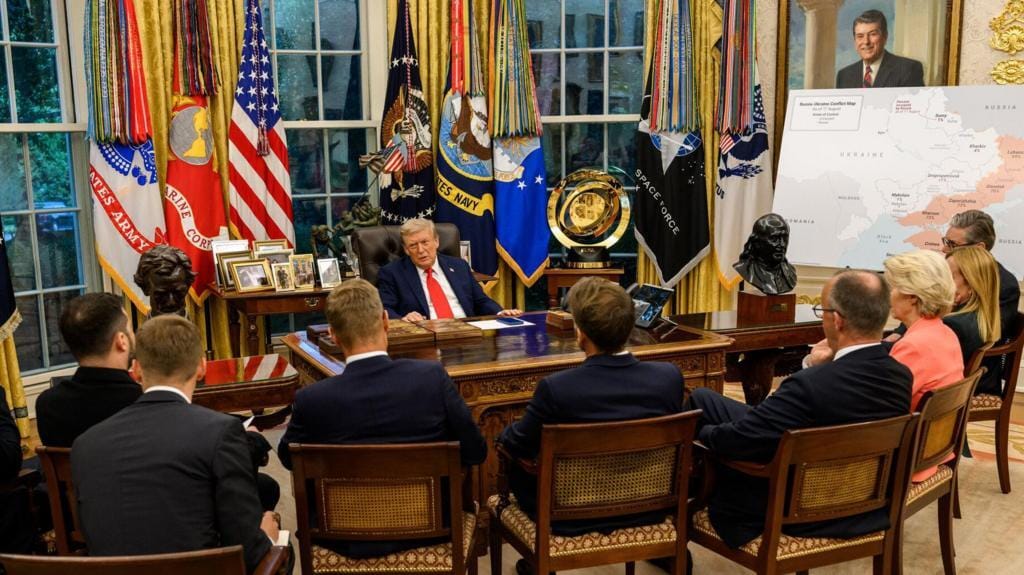
I believe this historic photo summarises how Trump views the European states.
Reading the National Security Strategy and listening to Trump and his inner circle reveals a strong strain of survivalist realism. As I argued in the previous Greenland Deep Dive, this administration appears to believe it is facing existential decline. The response is a grand vision of revival: big projects, big plans, and decisive geopolitical moves. There is an almost mythological belief that the Monroe Doctrine can be revived, battleships recommissioned, and Greenland “secured,” as if power still functions as it did in the mid-20th century. This reflects strategic nostalgia—reviving familiar frameworks without fully accounting for a geopolitical environment that no longer responds to them.
I’m not saying this new America First vision will fail, but it resembles a friend reviving an old fashion trend and being surprised when no one joins in. The real question is whether Trump anticipated this level of pushback. Given his apparent lack of regard for most European leaders, perhaps he did not.
Trump’s muted response to the Canada–China deal surprised many. From Washington’s perspective, the agreement stays well within US red lines. It allows just 49,000 Chinese EVs into Canada—roughly 3% of annual sales—and lowers, rather than removes, Chinese tariffs on canola. Crucially, it does not threaten US auto dominance or North American supply chains ahead of the USMCA review.
For Prime Minister Mark Carney, the deal is a deliberate test of boundaries. Canada signals diversification away from US overreliance without provoking retaliation, carefully avoiding sectors Washington views as strategic. Analysts suggest it may even serve as a low-risk reference point as Trump explores his own détente with Xi Jinping. More importantly, Trump has little incentive to fight a two-front rhetorical war in the Western Hemisphere. Keeping relations stable with Canada—at least for now—while confronting the EU and reshaping the Greenland file makes strategic sense.
At a deeper level, the Canada deal is a reminder that this is no longer the 19th century. Smaller states retain agency and can shift trajectory when pressured. That reality may be the real shock to the more Donroe-maximalist instincts within the administration.
In short, the US is trying to reassert 20th-century power in a 21st-century system and discovering resistance comes not from enemies, but from partners who no longer behave like dependents.
Sources
News/Journal sources available upon request, not shown to maintain visual integrity of page.
TODAY IN HISTORY
(January 19, 1977): U.S. President Gerald Ford pardoned Iva Toguri D'Aquino (Tokyo Rose), a Japanese-American broadcaster from Japan to U.S. troops during World War II, who, after the war, was convicted of treason and served six years in a U.S. prison; mitigating information later raised questions about her guilt.