- Basedment
- Posts
- The Future of Syria? It's Complicated.
The Future of Syria? It's Complicated.
Your daily dose of geopolitical updates and strategic analysis. Unbiased, but not unbased.

Editor-in-Chief
September 24, 2025
THE BRIEFING
Here’s what’s happening in geopolitics today.
From Trump’s executive order designating Antifa as a domestic terrorist group to France formally recognising Palestinian statehood, the headlines are shaping up to be both controversial and consequential.
We’re also seeing Jimmy Kimmel return to air after his suspension, Putin offering a one-year extension to the New START nuclear treaty, and Trump planning talks with leaders from Muslim-majority countries on the situation in Gaza.
With all eyes on Al-Sharaa (Jolani) in New York, we analyse the current state of Syria and its future geopolitical and economic trajectory.
THE LAST 24 HOURS IN GEOPOLITICS
1. Trump signs order designating Antifa as domestic terrorist group
Trump has signed an executive order officially designating Antifa as a domestic terrorist organisation, calling the movement “a sick, dangerous, radical left disaster". The order directs all federal agencies to investigate, disrupt, and dismantle individuals or groups associated with Antifa, and to look into those funding the group. Legal experts and civil liberties advocates are raising serious concerns, because U.S. law does not currently provide for designating domestic movements or ideologies as terrorist organisations, and Antifa is loosely organised with no central leadership.
read more
2. France among six more countries to formally recognise Palestinian statehood
France has become one of six more countries to formally recognise the State of Palestine during a high-level UN meeting, signalling growing international support for a two-state solution amid mounting frustration with the violence in Gaza. Israeli leaders condemned the move, calling it unjust and arguing that recognition without progress on peace or security risks undermining dialogue. Meanwhile, Palestinian leaders welcomed the recognition, saying it boosts their diplomatic legitimacy and could help pressure Israel and its allies to engage more substantively.
read more
3. Jimmy Kimmel to go back on air after suspension following Charlie Kirk comments
ABC has announced that Jimmy Kimmel Live! will return to air on Tuesday following an indefinite suspension over controversial remarks Jimmy Kimmel made regarding the murder of conservative activist Charlie Kirk. The network says it reached the decision after “thoughtful conversations” with Kimmel and determined that his comments were “ill-timed and thus insensitive.” However, some ABC affiliates say they will not air the returning show, demanding apologies and other conditions before doing so.
read more
4. Putin offers Trump one-year extension to nuclear weapons treaty
Russian President Vladimir Putin on Monday offered to voluntarily maintain the limits on deployed strategic nuclear weapons set in the 2010 New START accord after it expires in February if the U.S. agreed to do the same.
read more
5. Trump to meet officials from Muslim-majority countries to discuss Gaza
Trump will meet leaders and officials from multiple Muslim-majority countries on Tuesday and discuss the situation in Gaza, which has been under a mounting assault from Israel. White House Press Secretary Karoline Leavitt told reporters on Monday that Trump will hold a multilateral meeting with Saudi Arabia, the UAE, Qatar, Egypt, Jordan, Turkey, Indonesia and Pakistan.
read more
DAILY DEEP DIVE
WHERE IS SYRIA NOW AND WHATS NEXT?
Political Transition
Syria is undergoing its first real transition since the fall of Bashar al-Assad in December 2024. Al-Sharaa has set October 5 as the date for parliamentary elections—the first since Assad’s removal. The structure is designed with one-third of seats appointed by the presidency and the rest filled through local committees. This offers stability in the short term but risks concentrating power and excluding parts of the population if not coupled with credible oversight. Security challenges remain, with unrest in Suwayda, continued Kurdish influence in Hasakah and Raqqa, and ongoing Israeli airstrikes that underscore Syria’s fragile sovereignty.
Al-Sharaa has also used platforms like the Concordia Summit to call on the United States to formally drop sanctions. Although Washington has eased measures, the Caesar Act is still law and continues to limit Syria’s access to international finance and trade.
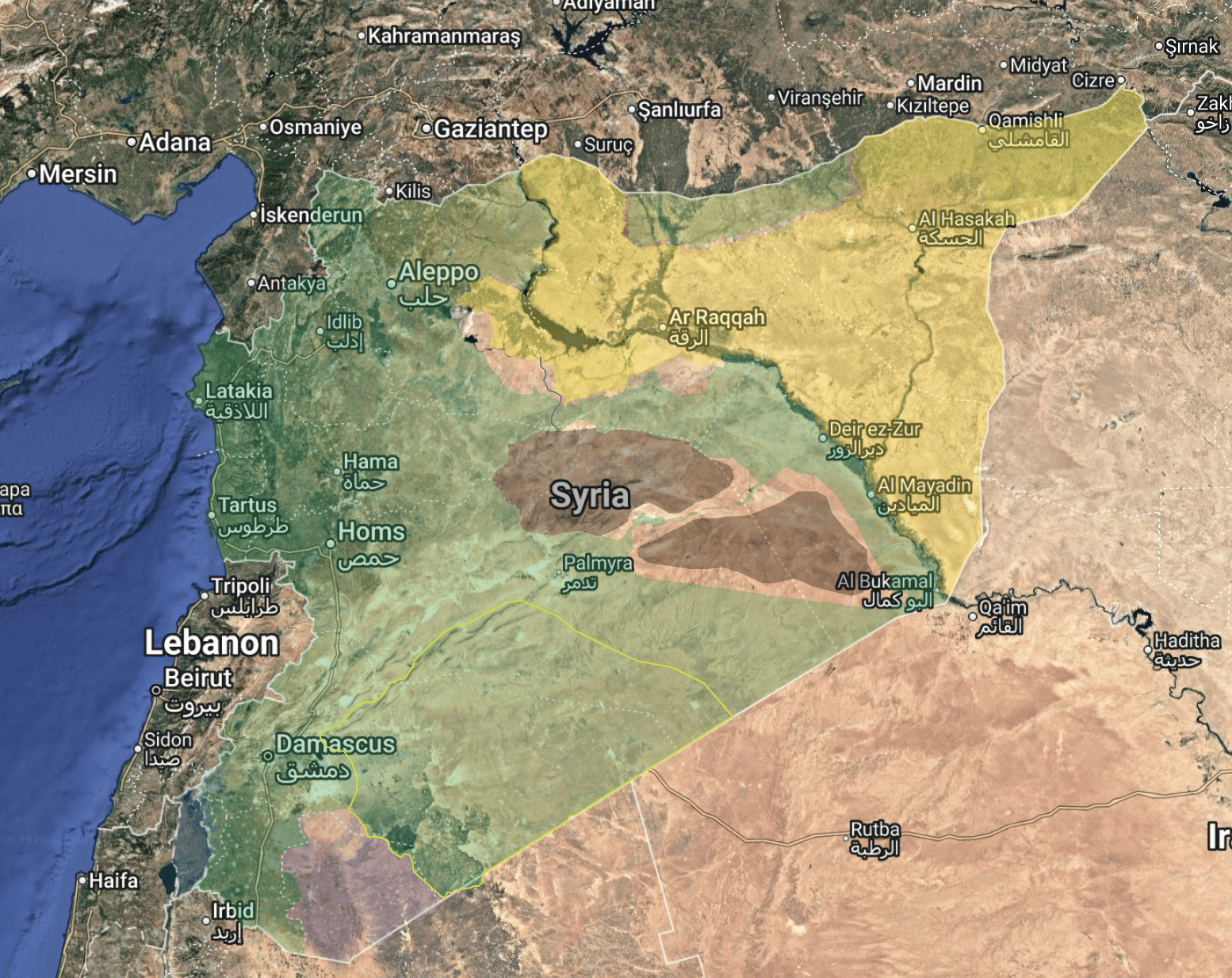
Current territorial map (Suriyak): Green: Government, Yellow: Kurds, Black: ISIS, Purple: Druze, Blue/Dark Blue: Israel.
Economic Realities
The war’s legacy is catastrophic. More than 600,000 people were killed, 13 million displaced, and Syria’s economy shrunk by about 85% compared to pre-2011 levels. Reconstruction is estimated to require between $250–$400 billion.
That said, some green shoots are emerging. Mastercard has signed a framework agreement with the Syrian Central Bank to rebuild payments systems. If implemented, this would modernise Syria’s cash-dominated economy, restore remittance channels, and encourage banks to re-engage.
Syria has also secured large pledges of foreign investment: $6 billion at a Syria–Saudi business forum, $800 million in port projects with DP World, $14 billion in MoUs with partners from Qatar, the UAE, Italy, and Türkiye, and a $7 billion power sector program involving Turkish, Qatari, and U.S. firms. However, as analysts note, only a fraction of pledges usually materialise in such high-risk environments.
Multilateral and Institutional Pathways
A practical roadmap for recovery lies in Syria’s engagement with multilateral development banks (MDBs). Damascus already holds memberships in the IMF, World Bank, Arab Monetary Fund, and Islamic Development Bank, and is exploring entry into the European Bank for Reconstruction and Development and the Asian Infrastructure Investment Bank. These institutions can provide technical assistance, guarantees, and blended finance that help crowd in private investment and rebuild state capacity.
Syria’s geography is an asset: its Mediterranean ports (Latakia, Tartus, Baniyas) and east–west corridor through Aleppo and Deir ez-Zor to Iraq could anchor export-driven agriculture and light industry, provided logistics and power networks are rebuilt. Integration with Gulf markets and Turkey could accelerate this.
The Positives
Diplomatic openings: High-level dialogue with U.S. and European figures, plus UN engagement, signal that Syria is no longer an international pariah.
Financial reintegration: Mastercard’s entry lays the groundwork for modern payment systems and signals a path toward banking normalization.
Investor appetite: The volume of pledges suggests regional and global interest, particularly from Gulf states.
MDB involvement: A clear strategy exists to leverage MDBs for credibility, technical expertise, and capital mobilisation.
The Negatives
Security instability: Persistent clashes in Suwayda, unresolved Kurdish autonomy, and regular Israeli airstrikes deter serious investors.
Sanctions uncertainty: Until the Caesar Act is formally repealed or amended, international banks and companies will hesitate.
Governance deficits: Weak rule of law and opaque investment processes risk scaring off serious capital.
Social collapse: Widespread poverty, brain drain, and crumbling infrastructure make quick growth unlikely.
Foreign fighter problem: Trump has publicly stated a removal of foreign fighters is essential for future recognition geopolitcally.
The Overall Assessment and Geopolitical Reality
The single most important economic task for Al-Sharaa is to secure the full removal of sanctions. These measures were one of the main reasons Assad’s regime couldn’t sustain itself and eventually turned to the captagon trade for survival. Sanctions never truly crippled the elites (they always found ways around them) but they devastated the average Syrian. The sooner these are lifted, the sooner daily life can begin to stabilise.
Another key initiative should be a genuine push to bring back the diaspora through government incentives. This is no small challenge. Millions of Syrians have built lives in places like Germany, where security, opportunity, and stability far outweigh the uncertainty of returning to what still feels like a Middle Eastern version of “go west, young man”—a cowboy-era gamble on adventure in a lawless frontier.
Domestically, the picture is even messier. Talks with Netanyahu and Turkey are ongoing, but no one should expect a formal agreement anytime soon. Beneath the surface, sectarian divides and long-standing abuses against minorities remain unresolved. This is also compounded by a volatile mix of foreign fithers as we have written about before. Politically, the Kurdish enclave controls significant territory, and while many Arab residents there would actually prefer Al-Sharaa’s authority, the Kurdish forces are disciplined, well-armed, and politically entrenched. For Damascus, a direct confrontation would undermine the careful image Syria is trying to project abroad—and Ankara could easily escalate matters through airstrikes if fighting broke out. This is why Al-Sharaa has made Kurdish negotiations a top priority.
In the south, Israel has entrenched itself by supporting the dominant anti-government Druze faction while continuing to bomb Syrian military bases and depots at will. To counter this, Al-Sharaa is courting Gulf investment not just for capital but also for political cover: the hope being that once their money is tied up in Syria, Gulf states will leverage their influence to restrain Israel’s air campaign, which threatens both Syria’s security and foreign investors’ bottom lines.
Syria stands at a fragile but real crossroads. The positives provide momentum, but these gains can only be consolidated if al-Sharaa couples them with credible governance reforms, MDB-backed frameworks, and serious security stabilization. Without this, Syria risks remaining a country rich in MoUs and poor in actual reconstruction, falling short of the $250–$400 billion rebuild it desperately needs.
Sources:
Sources available upon request, not shown to maintain visual integrity of page.
TWEET OF THE DAY
every time I text the Basedment group chat…
every time i text the group chat
— sophie (@netcapgirl)
5:45 PM • Sep 22, 2025
TODAY IN HISTORY
(September 23, 1846): Neptune Discovered
German astronomer Johann Gottfried Galle became the first person to observe Neptune through a telescope. The planet’s existence had been mathematically predicted by French astronomer Urbain Le Verrier and independently by English mathematician John Couch Adams, making Neptune the first planet discovered through calculation before direct observation.