- Basedment
- Posts
- The Meaning Behind The US-AUS Deal
The Meaning Behind The US-AUS Deal
Your daily dose of geopolitical updates and strategic analysis. Unbiased, but not unbased.

Editor-in-Chief
October 22, 2025
THE BRIEFING
Here’s what’s happening in geopolitics today.
A busy start to the week across global politics.
Leaders from Ankara to Rabat are juggling domestic pressure and regional strategy, while Washington continues to look for ways to reduce its reliance on Beijing’s minerals. In Africa, Uganda sets the stage for a pivotal election, and Israel deepens its quiet diplomacy with Cairo amid ongoing Gaza tensions.
In today’s deep-dive we look into the big rare-earth deal signed by the U.S and Australia.
THE LAST 24 HOURS IN GEOPOLITICS
1. Erdogan travels to Qatar, seeking to purchase 24 Eurofighter Jets
Erdogan is expected to visit Doha in Qatar on Wednesday. The Turkish president wants to buy 24 used Eurofighter Typhoon fighter jets from the host country. The deal would require approval by the Eurofighter consortium and reflects Ankara’s growing desire to bridge its military capability gap as its domestic fighter programme remains under development. The procurement also aligns with Turkey’s broader turnover in strategic ties, as it navigates between Western defence partnerships and regional assertiveness.
read more
2. Morocco pledges $15B social spending following youth-led protests
Morocco has committed to allocating 140 billion dirhams (about US $15 billion) to health and education in its 2026 budget, marking a 16 % increase from last year and amounting to roughly 10 % of GDP. The announcement follows widespread youth-led protests under the banner of Gen Z 212, who have demanded improved public services, job opportunities and accountability as they criticised spending on mega-events while hospitals and schools lagged behind.
read more
3. US and Argentina sign rare earths deal to counter China’s dominance
The United States and Australia have signed a landmark critical-minerals agreement designed to build new rare-earth mining and processing capacity outside of China. The deal reflects growing concern in Washington over Beijing’s dominance of global supply chains for rare-earths, which are vital for everything from electric vehicles to advanced defence systems, and aims to diversify sourcing by leveraging Australia’s rich mineral resources.
read more
4. Uganda sets general election for January 15
Uganda’s electoral commission announced that the country’s general election will take place on January 15 2026, officially kicking off the new vote cycle. Yoweri Museveni, who has been in power since 1986 and is now among Africa’s longest-serving leaders and is expected to seek another term, with opposition figure Bobi Wine already positioning himself as a key challenger. Observers say the announcement comes amid increased scrutiny of Uganda’s political freedoms and will test the government’s ability to hold credible polls as the country approaches a critical juncture.
read more
5. Egyptian Intelligence chief meets with Netanyahu for Gaza talks
Netanyahu met in Jerusalem on Tuesday with Hassan Rashad, the head of Egypt’s intelligence service, in a move aimed at bolstering cooperation between the two countries. The talks centred on moving forward a U.S.-backed peace initiative, enhancing Israel-Egypt relations and coordinating on other regional security issues. While the meeting comes amid a fragile cease-fire in Gaza and ongoing regional volatility, it signals both sides are keen to keep strategic diplomacy alive even as challenges mount.
read more
DAILY DEEP DIVE
THE AUS-US DEAL
First off, we will not be discussing Trump’s comments to good old Kevin 07 but we are formally mentioning it here as it deserves one!
Context of the Deal
Today the United States and Australia agreed to an investment pipeline worth about US $8.5 billion, including at least US $2–3 billion in near-term funding and export-credit support through the U.S. Export-Import Bank. The package covers projects such as a gallium plant in Western Australia and expanded NdPr rare-earth mining in the Northern Territory and WA. The core objective is not just extracting ore but building a mine-to-magnet value chain outside China’s orbit.
This move comes as Beijing tightens export-licence controls on rare-earths, magnets and advanced materials, signalling that resource competition has become fully geopolitical. While the framework is ambitious, much of the investment remains pipeline rather than fully committed, and the details of who will lead magnet-manufacture are still emerging.
Why the US Wants This
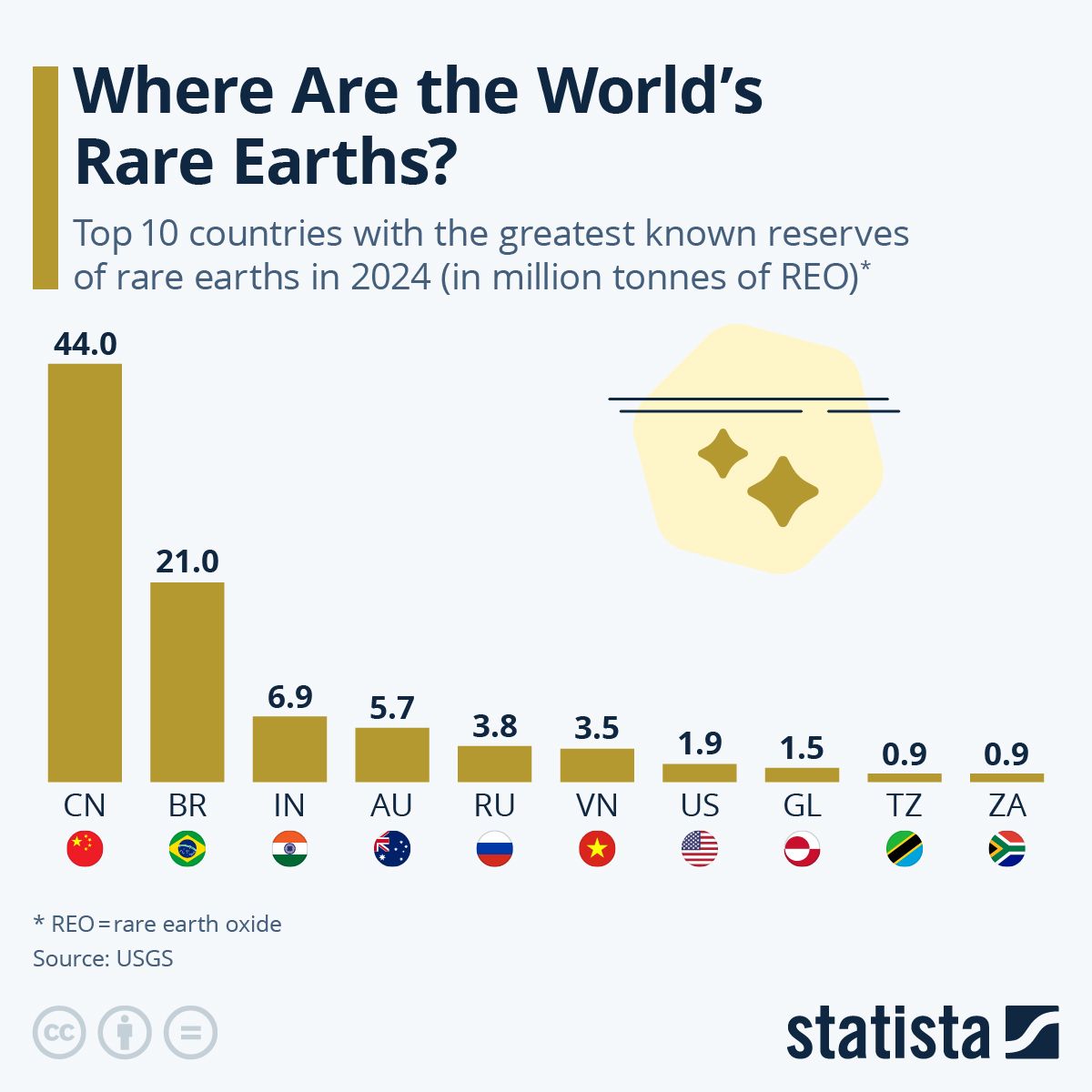
For Washington, the motivation is urgent and strategic. China dominates the rare-earth ecosystem — controlling 69 % of mining, 92% of worldwide refining capacity, and nearly all (98%) finished magnet production. That concentration is a vulnerability. The U.S. has learned from past supply-chain shocks and industrial dependencies. President Trump seeks to look elsewhere to lower this risk whether in Ukraine’s critical minerals or Greenland’s untapped reserves, but as of now Australia is part of this plan. The new policy focus is on leverage and resilience. Through long-term offtake agreements, price floors, and U.S. Department of Defense backing, Washington aims to re-create an end-to-end rare-earths capability from mining to separation, refining, alloying and magnet fabrication. Magnets like NdPr and SmCo, vital for EVs, wind turbines, and defence systems, are the true chokepoints.
More broadly, the U.S. views this as a contest for the foundational materials of the Fourth Industrial Revolution. Rare-earths underpin clean energy, microelectronics, telecommunications and hypersonic technologies. Building diversified supply chains means fewer vulnerabilities to coercion and strengthens the industrial backbone for both the U.S. economy and defence.
Why Australia Wants This
Australia’s rationale is both economic and strategic. The country’s mineral endowment is vast — with deposits of NdPr, dysprosium, terbium and other heavy rare-earths across WA and the Northern Territory. But Canberra’s focus now goes beyond exporting raw ore: it wants value-add, jobs and industrial diversification.
Partnering with U.S. capital and offtake guarantees helps de-risk major projects such as Arafura Rare Earths’ Nolans NdPr mine or Northern Minerals’ Browns Range HREE project. For a sector long plagued by boom-bust cycles, U.S. investment introduces much-needed stability, enabling long-term planning and regional development.
While Australia seeks to expand its processing capacity, environmental, logistical and cost hurdles make full domestic refining unlikely. The likely model is mining and partial processing in Australia, with final refining or magnet fabrication occurring in the U.S. or allied nations where industrial infrastructure already exists and more importantly are more lax with environmental laws.
It’s All About Refining
The greatest insight of this partnership is what it’s not about: simply mining. Mining has become commoditised; the strategic value lies in separation, refining and magnet-making, where China’s lead remains overwhelming.
Australia is not attempting to replicate China’s refining scale. Instead, it aims to supply feedstock and early-stage refined material, while the U.S. and partners develop advanced processing and magnet-manufacturing capacity. This approach spreads capital costs, shortens logistics routes, and keeps the highest-value manufacturing near end-use markets. It’s slower and more expensive, but ultimately more defensible and resilient.
Will This Damage Australian–Chinese Relations?
While some might expect backlash, most analysts foresee limited immediate fallout. Canberra’s goal is diversification, not decoupling. China still controls most of the rare-earth value chain, and both sides understand that supply-chain hedging is inevitable. Beijing has already adjusted its policies by tightening exports and asserting leverage, but Australia’s moves are seen as pragmatic balancing rather than provocation. China understands this is the game of geopolitics and a move like this was expected.
That said, risks remain. China could retaliate through trade or investment restrictions, and Australia must walk a fine line between economic interdependence and strategic autonomy. Still, with China’s dominance intact and global demand for rare-earths rising, the partnership is less about confrontation and more about long-term resilience-building.
In Short
For the United States, this deal is about re-wiring supply chains and reducing strategic dependence on China. For Australia, it’s about climbing the value-chain, securing jobs and investment, and anchoring itself in the next wave of industrial growth. And while China remains the undisputed heavyweight, the U.S.-Australia alliance has just taken a concrete step toward building the alternative, one ore, one refinery, and one magnet at a time.
Sources:
Sources available upon request, not shown to maintain visual integrity of page.
Playfra, Suriyak, and Divgen, Deepstate, ISW.
TWEET OF THE DAY
Must be nice… 😂
Jeff Bezos waking up on his 417-foot yacht in the South of France learning that he broke the internet for a full day and actually still made money
— Chris Bakke (@ChrisJBakke)
12:07 AM • Oct 21, 2025
TODAY IN HISTORY
(October 21, 1520): Magellan's discovery of gateway to circumnavigating the globe
On this day in 1520, explorer Ferdinand Magellan and three Spanish ships entered the strait later named for him, sailing between the mainland tip of South America and the island of Tierra del Fuego toward the Pacific Ocean.