- Basedment
- Posts
- The New Donbas Line - Updated
The New Donbas Line - Updated
This report examines how Ukraine’s eastern defences were built and why they're important in the negotiation process.

Editor-in-Chief
December 21, 2025
THE BRIEFING
Here’s what’s happening in geopolitics today.
Today’s headlines span tense waterways, fragile ceasefires and hard-to-shift conflicts, from the U.S. seizing another oil tanker off Venezuela and fresh drone strikes on Russian energy infrastructure, to renewed U.S.–Russia talks aimed at ending the war in Ukraine.
We also cover a deadly mass shooting in South Africa and a bold claim from Beirut that Hezbollah’s disarmament is now days away.
On today’s Deep Dive, we explain how Ukraine’s New Donbas Line marks a shift to drone-centric defence — and why the Dobropillya salient counterattacks mattered more than short-term losses.
THE LAST 24 HOURS IN GEOPOLITICS
1. US intercepts oil tanker off Venezuelan coast
U.S. forces intercepted and seized a second oil tanker off Venezuela’s coast on December 20, boarding the Panama-flagged vessel Centuries in international waters as part of a growing enforcement effort tied to Trump’s recently declared blockade on sanctioned Venezuelan oil shipments. Homeland Security Secretary Kristi Noem said the action, carried out by the U.S. Coast Guard with Department of Defense support, is intended to disrupt what Washington describes as the illicit movement of Venezuelan crude used to finance narco-terrorism, though details on the ship’s sanctioned status remain unclear.
read more
2. At least nine people killed in shooting at South Africa tavern
At least nine people were killed and around 10 others wounded early Sunday when unknown gunmen opened fire at a tavern in the Bekkersdal township west of Johannesburg, South African police said, prompting a nationwide manhunt for the attackers. The assailants, believed to have driven up in two vehicles, fired indiscriminately at patrons and nearby bystanders before fleeing the scene, according to police statements. The incident marks another tragic instance of gun violence in South Africa, where authorities are continuing their investigation to identify and apprehend the suspects.
read more
3. Ukraine says it struck a Lukoil drilling platform in Caspian Sea
Ukraine’s military said its forces used long-range drones to hit a Russian offshore oil drilling platform owned by Lukoil in the Caspian Sea, marking a continuation of Kyiv’s campaign against Russian energy infrastructure that it says helps finance Moscow’s war effort. The strike damaged the Filanovsky oil rig’s platform and was carried out alongside an attack on a nearby Russian patrol ship, though the full extent of the damage and operational impact is still being assessed. Ukrainian officials frame such strikes on energy assets as legitimate wartime targets, but independent verification and comment from Lukoil have not yet been available.
read more
4. US, Russian officials meet in Miami for talks on Ukraine war
U.S. and Russian officials met in Miami, Florida, this weekend for renewed talks aimed at finding a diplomatic path to end Russia’s nearly four-year war in Ukraine, with the discussions led by U.S. special envoy Steve Witkoff, Jared Kushner and Russian presidential envoy Kirill Dmitriev. The session followed earlier meetings in Berlin with Ukrainian and European representatives on security guarantees and a potential peace framework, though Moscow has so far resisted direct negotiations with Kyiv and key disagreements remain over territorial issues. Zelenskyy has expressed conditional support for a U.S.-proposed three-way negotiation format if it leads to substantive results such as prisoner exchanges and future leader summits.
read more
5. Lebanon is ‘days away’ from disarming Hezbollah, PM claims
Lebanese PM said on Saturday that Lebanon is “days away” from completing the first phase of its plan to disarm Hezbollah fighters south of the Litani River, a key requirement of the U.S.-backed ceasefire deal with Israel reached in November 2024. The Lebanese army, mandated by the government, has been consolidating weapons under state control in the south and is preparing to move to the next phase of the disarmament plan, which would extend operations north of the Litani. However, tensions remain high, with continued Israeli airstrikes in southern Lebanon and criticism from some quarters about the pace and feasibility of disarming Hezbollah.
read more
DAILY DEEP DIVE
The New Donbas Line
Over the past nine months, Ukraine has quietly constructed what front-line mappers now call the New Donbas Line, a 350-kilometre defensive system designed not for massed infantry warfare, but for a battlefield dominated by drones, precision fires, and attrition. Built in phases since early March 2025 and reinforced continuously, the line represents a doctrinal shift in how Kyiv intends to blunt Russian advances in the east.
When, Where, and Why It Was Built
The first segments of the New Donbas Line began appearing in March, as Ukraine assessed that Russia’s manpower-heavy assaults would persist through summer and into winter. Rather than relying on sprawling trench cities vulnerable to breakthrough and envelopment, planners opted for a dispersed obstacle-and-fire system stretching from Kharkiv through Kupyansk, down past Izyum, west of Kramatorsk, and into northern Zaporizhzhia. Analyst Playfra believes this is a correct step forward in the defence system, arguing that centralised trench networks run the risk of causing a mass break if one trench is taken. Others argue against this, small pockets of trenches are harder to reinforce with supplies and infantry as they are more isolated.
The logic is geographic as much as tactical. The line is anchored behind rivers, along dominant high ground, and at natural chokepoints, with “urban pins” — towns and logistics hubs — acting as fixed reference points that deny easy flanking manoeuvres. The issue here is that this year we have seen that Ukraine has struggled to defend urban centres, so this could be a weakness in the future.
The line would also act as a final barrier to the inner parts of Ukraine. Much flatter plains, less folliage — i.e hard to defend.
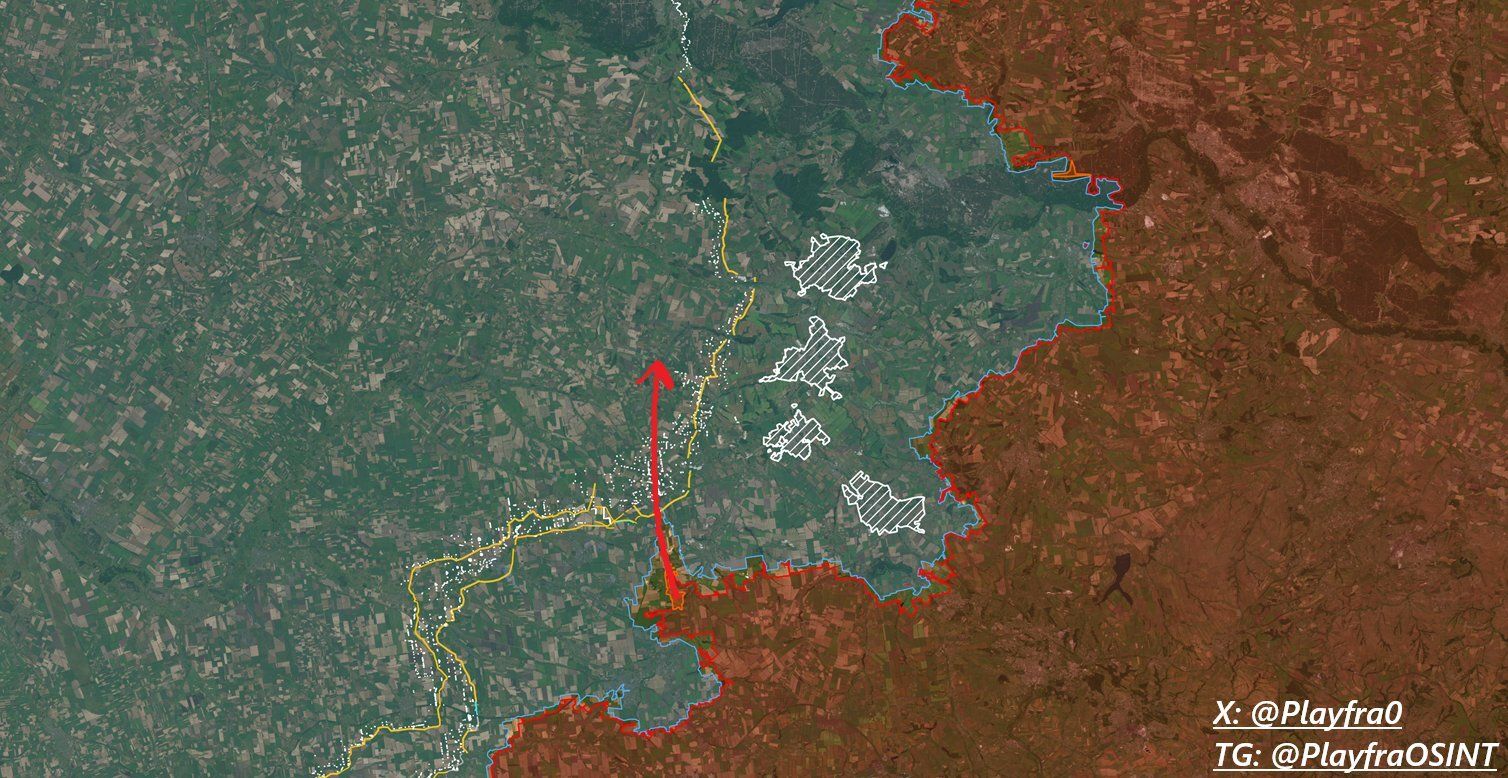
The Donbas line sits behind the major cities of Donetsk. (Old Map)
What the Line Actually Consists Of
According to Ukraine’s Ministry of Defence and independent mapping estimates, the scale is immense:
Over 3,000 km of anti-tank trenches
More than 1,000 km of concrete pyramid barriers (dragon’s teeth)
Roughly 16,000 km of Yegoza and concertina wire
Thousands of low-visibility and trip-wire obstacles
A fully developed sector typically features 12 rows of concertina wire, three ditches, three rows of dragon’s teeth, and multiple layers of MZP “Putanka” trip wire — not to stop an assault outright, but to slow, expose, and fix it in place.
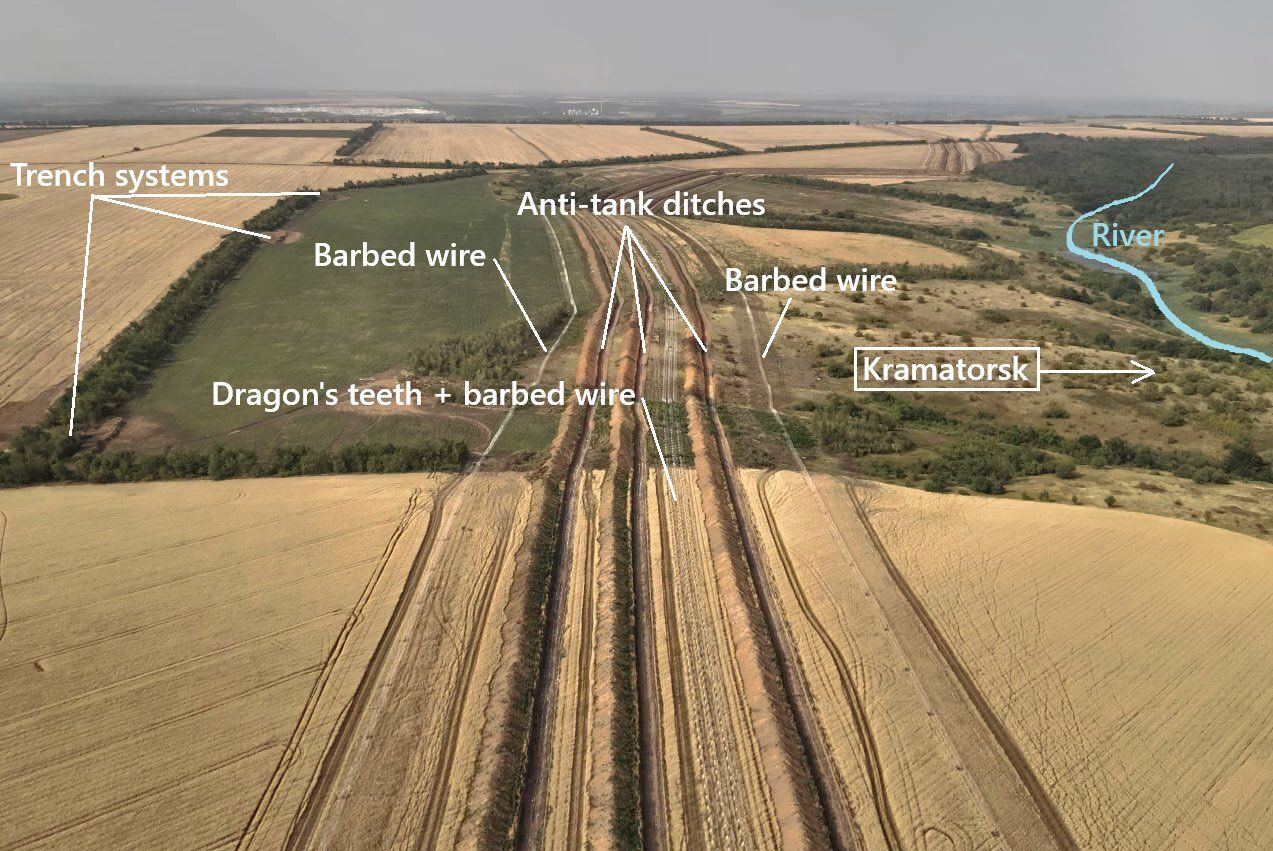
@Playfra source
Why It’s Proven Effective And Ongoing Issues
The New Donbas Line is not manpower-intensive. Instead of dense trench rings that collapse if breached, it relies on hundreds of independent, 60-metre T-shaped strongpoints. Each position can fight alone, denying Russia the cascading breakthroughs it has exploited elsewhere.
Crucially, obstacles are paired with 24/7 drone surveillance. Any unit attempting to cross is delayed, stripped of concealment, and held in the open long enough for FPV drones and precision strikes to engage. In effect, the fortifications buy time — and time, on today’s battlefield, is lethal. The result is not an impenetrable wall, but a grinding defensive system optimised for attrition. The New Donbas Line reflects Ukraine’s recognition that modern defence is no longer about holding ground with bodies, but about controlling space with sensors, drones, and layered denial.
When we argued that Ukraine’s counterattacks on the Dobropillya salient were strategically significant, the backlash was inevitable. At the time, Ukrainian forces were losing ground elsewhere (most visibly around Pokrovsk) leading critics to frame the operation as poorly timed or misallocated. But that critique focused on surface-level map changes rather than the structural threat the salient posed.
What made the Dobropillya counterattacks decisive was their preventative effect. The salient sat directly alongside the New Donbas Line, and at one point Russian forces briefly occupied sections adjacent to, and in some cases inside, the defensive network. Had Russia been able to consolidate this foothold, it would have created a durable launchpad to unravel the line from the flank, placing the entire defensive architecture at risk and potentially accelerating the fall of Kramatorsk and Sloviansk.
Compounding the danger was the manner of Russia’s penetration. Ukrainian units were initially caught off guard by the speed and depth of Russian DRG incursions, which operated ahead of main forces and targeted rear-area assets. In several instances, Ukrainian drone teams — a cornerstone of the defensive concept — were hunted down and eliminated by these groups. This created a temporary dual crisis: a shortage of drones and a shortage of trained units to man and monitor the obstacle network.
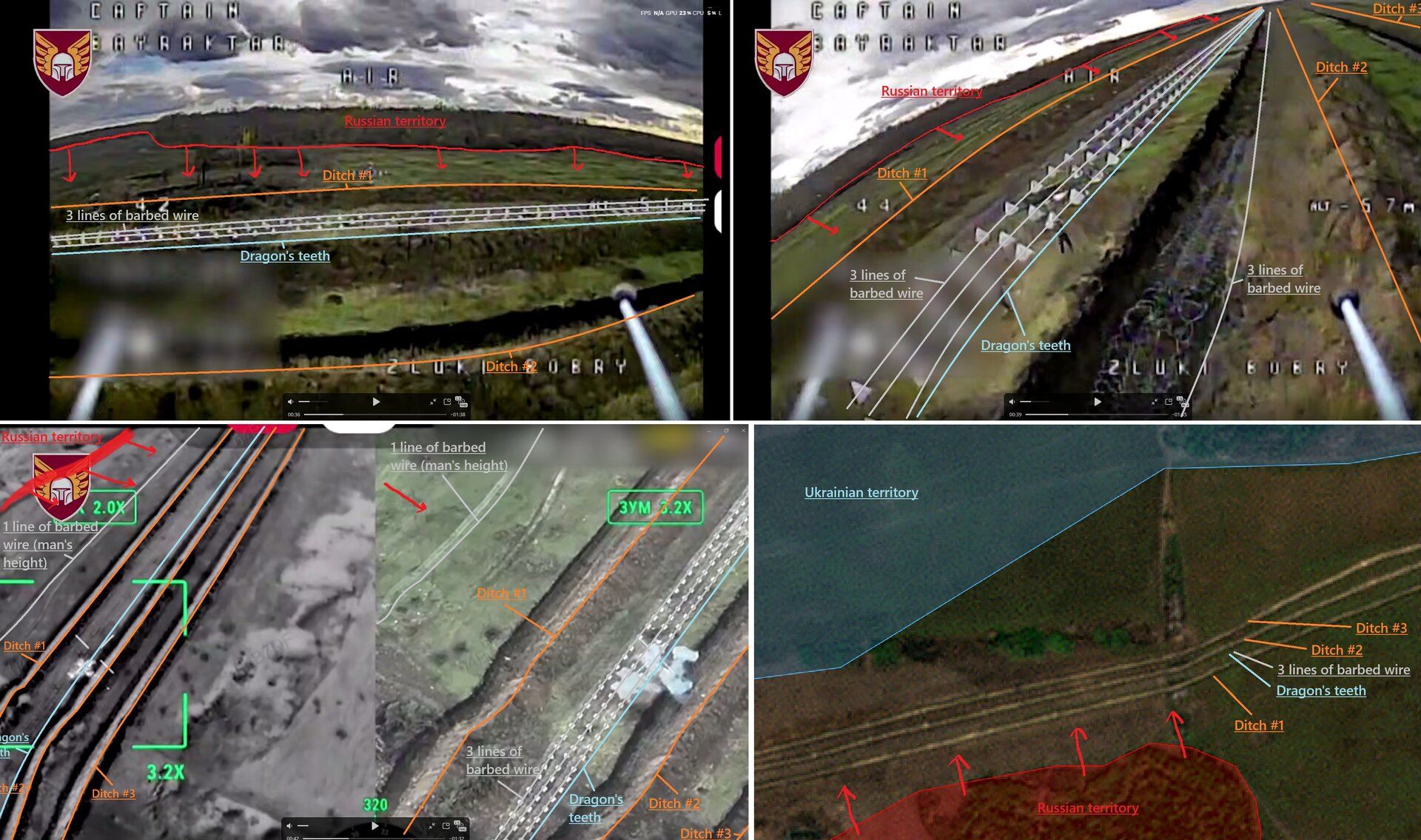
The counterattacks, therefore, were not about reclaiming ground for its own sake. They were about restoring depth, denying Russia a staging area, and buying time to reconstitute drone coverage and manpower — a trade-off that mattered far more than the losses visible elsewhere on the map. So this is why Vladimir Putin wants Donetsk conceded in negotiations, and why Ukraine is fighting relentlessly to prevent it. Control of Donetsk would unravel the New Donbas Line, strip Ukraine of depth, and collapse its drone-centric defences.
Sources
News/Journal sources available upon request, not shown to maintain visual integrity of page.
https://x.com/Mylovanov/status/2002411392289198321
https://x.com/Playfra0/status/1928183254089429005
TODAY IN HISTORY
(December 21, 1891): The first basketball game.
Gym teacher James Naismith organized the first game of basketball, which was played on this day in 1891 in a school in Springfield, Massachusetts. Chaos reigned and a fight broke out, which prompted Naismith to develop the sport's original rules.