- Basedment
- Posts
- The New World Order Won't Be a 'Rules-Based' One
The New World Order Won't Be a 'Rules-Based' One
In today’s deep dive, we unpack why the rules-based order collapsed and what replaces it in an era of great-power rivalry.

Editor-in-Chief
February 10, 2026
In partnership with

THE BRIEFING
Here’s what’s happening in geopolitics today.
From courtroom brinkmanship in Washington to bridge politics on the US–Canada border, today’s headlines span legal drama, power plays and shifting alliances.
We’re also tracking a fresh US–Armenia security and nuclear pact, Indonesia’s potential troop role in Gaza, and a surprise Islamist surge in Bangladesh’s election race.
In today’s deep dive, we unpack why the rules-based order collapsed and what replaces it in an era of great-power rivalry.
WORD FROM TODAY’S SPONSOR
Better prompts. Better AI output.

AI gets smarter when your input is complete. Wispr Flow helps you think out loud and capture full context by voice, then turns that speech into a clean, structured prompt you can paste into ChatGPT, Claude, or any assistant. No more chopping up thoughts into typed paragraphs. Preserve constraints, examples, edge cases, and tone by speaking them once. The result is faster iteration, more precise outputs, and less time re-prompting. Try Wispr Flow for AI or see a 30-second demo.
THE LAST 24 HOURS IN GEOPOLITICS
1. Maxwell pleads the fifth but will clear Trump’s name in exchange for clemency
Ghislaine Maxwell, the convicted associate of Jeffrey Epstein serving a 20-year federal sentence, invoked her Fifth Amendment right and refused to answer questions during a closed-door deposition before the U.S. House Oversight Committee on Monday, citing ongoing legal concerns and her right against self-incrimination. Maxwell’s lawyer told lawmakers that she would be willing to testify fully and “speak honestly” about Epstein’s network but only if President Trump grants her clemency.
read more
2. US & Armenia sign nuclear pact and announce drone sale
The United States and Armenia signed a civil nuclear cooperation agreement in Yerevan on Monday during a visit by JD Vance, marking completion of negotiations on a “123 Agreement” that will allow for peaceful collaboration on nuclear energy and pave the way for U.S. exports of technology and services. The two countries also announced an $11 million U.S. military sale of V-BAT reconnaissance drones to Armenia, reflecting broader efforts to deepen defense and strategic ties.
read more
3. Indonesia weighs sending up to 8,000 troops for Gaza peace plan
Indonesia is considering deploying up to 8,000 troops as part of an international peacekeeping mission in Gaza under a US-backed peace plan, with its army preparing personnel and logistical elements amid ongoing talks on a stabilisation framework. The plan is tied to broader discussions about an international force to help secure a ceasefire, protect civilians and support reconstruction in the war-torn Palestinian enclave, though Jakarta has not set a definitive timetable or formal deployment date. President Prabowo Subianto has previously offered larger contingents of troops for UN-mandated peacekeeping in Gaza, contingent on international approval and clear mandates.
read more
4. Trump threatens to block opening of US-Canada bridge
Trump has threatened to block the opening of the nearly completed Gordie Howe International Bridge between Detroit, Michigan and Windsor, Ontario, saying he will withhold approval unless Canada enters negotiations and compensates the United States for what he describes as unfair treatment. The $4.6 billion bridge (fully funded by the Canadian government and designed to ease one of North America’s busiest trade corridors) is expected to open in early 2026, but Trump cited broader trade disputes, including tariffs and Ottawa’s talks with China, as reasons to demand concessions first.
read more
5. Islamist leader rises from obscurity to challenge for Bangladesh’s top job
Shafiqur Rahman, leader of the Islamist party Jamaat-e-Islami, has risen from political obscurity to become a serious contender for Bangladesh’s premiership ahead of the country’s February 12 general election, as his party campaigns strongly nationwide. Jamaat-e-Islami, once banned and long on the margins of Bangladeshi politics, has re-entered the mainstream after recent political upheaval and is now part of a broader coalition that could challenge more established parties for power. Rahman’s platform emphasises anti-corruption, Islamic governance and economic promises.
read more
DAILY DEEP DIVE
THE NEW WORLD ORDER - GREAT POWER RIVALRY RETURNS
Wider Context
Canadian Prime Minister Carney’s speech at Davos may be one of the most important moments of self-revelation in the Western world since the collapse of the USSR. Carney said out loud what many have been quietly acknowledging for some time: “The rules-based order is freefall.” The final nail in the coffin may well have been the last three years. The rules-based order, in some form, has existed since the creation of the United Nations and the Nuremberg trials. The decades that followed produced a mixed record — moments of genuine success, repeated failures, and no shortage of hypocrisy.
What Is the Rules-Based Order?
The rules-based order emerged at the end of the Second World War. Its core idea was that international law and norms could be upheld through multilateral institutions, the largest and most recognisable being the United Nations. While its institutional form dates to the post-1945 period, its intellectual roots go back several decades and are grounded in the tradition of international liberalism. This school of thought argued that cooperation, interdependence, and shared democratic values could reduce conflict and sustain peace between states. Woodrow Wilson was among the earliest figures to articulate this vision through his Fourteen Points, intended to guide reconstruction after the First World War. Central tenets included the creation of the League of Nations and the right to self-determination. Alongside legal and security foundations, the order also rested on an economic framework linking global prosperity to political cooperation.
Successes, Failures, and Hypocrisy
The rules-based order has always presented itself as a neutral framework for peace and stability, but in practice its record has been deeply uneven and increasingly difficult to defend. While it produced institutions, legal norms, and periodic successes in diplomacy, peacekeeping, and human rights advocacy, these mechanisms functioned selectively rather than universally. Enforcement consistently bent around power. The UN Security Council veto allowed major states to shield allies, block accountability, and paralyse action, rendering “international law” conditional rather than binding.
Its failures were not abstract. The genocide at Srebrenica exposed the hollowness of civilian protection guarantees. Marginalised states repeatedly discovered that participation did not translate into influence. Most corrosive was the repeated violation of the system by those who claimed to uphold it — most notably the US-led invasion of Iraq in 2003 without clear UN authorisation. Over time, this pattern transformed the rules-based order from a universal ideal into a discretionary tool, applied rigorously to some and ignored by others. And given that the order was rooted in international liberalism and democratic interdependence, non-democratic states naturally felt alienated rather than bound by it.
Great powers hid behind this mirage because it was useful. It legitimised their actions, lowered resistance from smaller states, and stabilised the system far more cheaply than constant coercion or war. Acting “within the rules” provided moral cover, coalition buy-in, and domestic consent, turning rules into a force multiplier rather than a genuine constraint — particularly under US hegemony and now this hegemony is looking inward, why bother playing by the rules if the referee isn’t looking.
That pretense is now being abandoned because the cost–benefit has flipped. Power is more concentrated and visible, interdependence has become a tool of coercion, and repeated double standards have collapsed the system’s credibility — even among allies. Once belief evaporates, the ritual stops working, and pretending becomes a liability rather than a shield. Great powers do not believe they can do anything they want; they believe restraint no longer pays.
2022–2025: The Point of No Return
As revealing and monumental as Carney’s speech was, the open acknowledgement that even Western leaders understood the old order to be a mirage is deeply unsettling. Using Václav Havel’s metaphor, Carney argues that states continued to act as if the system still worked because it was convenient, even while knowing it was selectively enforced. That collective pretence sustained the order for decades, but the bargain has now collapsed.
With Russia’s invasion of Ukraine, the smoke and mirrors truly began to fall away. It was a textbook case of great-power politics: a major state attempting to reassert regional influence through hard power. The scale, intensity, and ambition of the war were unlike anything seen since the twentieth century. Then, after October 7, the Israel–Hamas war brought the near-total destruction of Gaza. Tens of thousands were killed, global outrage was significant — and yet it changed nothing. Russia continued its war, Israel continued its campaign, and despite international arrest warrants against both leaderships, allies and partners largely looked the other way. As many in the West decried expansionism and warmongering, those outside the inner sanctum of liberal democratic states pushed back, asking: where was this outrage in 2003? And so it began to unravel.
As it often goes, the collapse was slow, then sudden — and over these three years, it became clear that the mask had come off.
The Great Powers Strike Back
So the question becomes: what comes next? Recent US actions offer a crystal ball. Smaller states that sit within the traditional spheres of influence of great powers can increasingly be coerced — economically, politically, or militarily — for the benefit of the larger state. As Carney suggests, there will no longer be a mirage of careful word-mincing. It will no longer be framed as “saving people from dictatorship,” but stated plainly: it serves the interests of the state.
To reinforce this shift, the great powers — the United States and China — along with traditional centres of power such as Europe and Russia, are rearming. If the prevailing assumption is that war sits on the horizon, international order will matter even less than it already does. International law, after all, is only effective when it is treated as more than a tool of convenience.
Carney is again direct: middle powers have begun to recognise this reality. As restraint erodes, regional control and unresolved disputes will become more visible and more volatile. The Middle East offers the clearest example of what this next phase looks like.
Overall, what may be coming is deeply unsettling: a world defined by overlapping regional conflict zones involving every level of state power, from minor actors to major powers. At its worst, it may resemble the prolonged warring periods found in history books (the Napoleonic Wars, the War of the Seven Nations) but stripped of muskets and massed infantry. Instead, conflict would be fought through drone swarms, electronic warfare, autonomous systems, and robotics, compressing devastation into shorter, sharper, and more opaque forms of violence.
Sources
News/Journal sources available upon request, not shown to maintain visual integrity of page.
TODAY IN HISTORY
(February 10, 1763): The Treaty of Paris was signed, ending territorial conflicts between France and Britain in the Seven Years' War, the North American phase of which was called the French and Indian War.
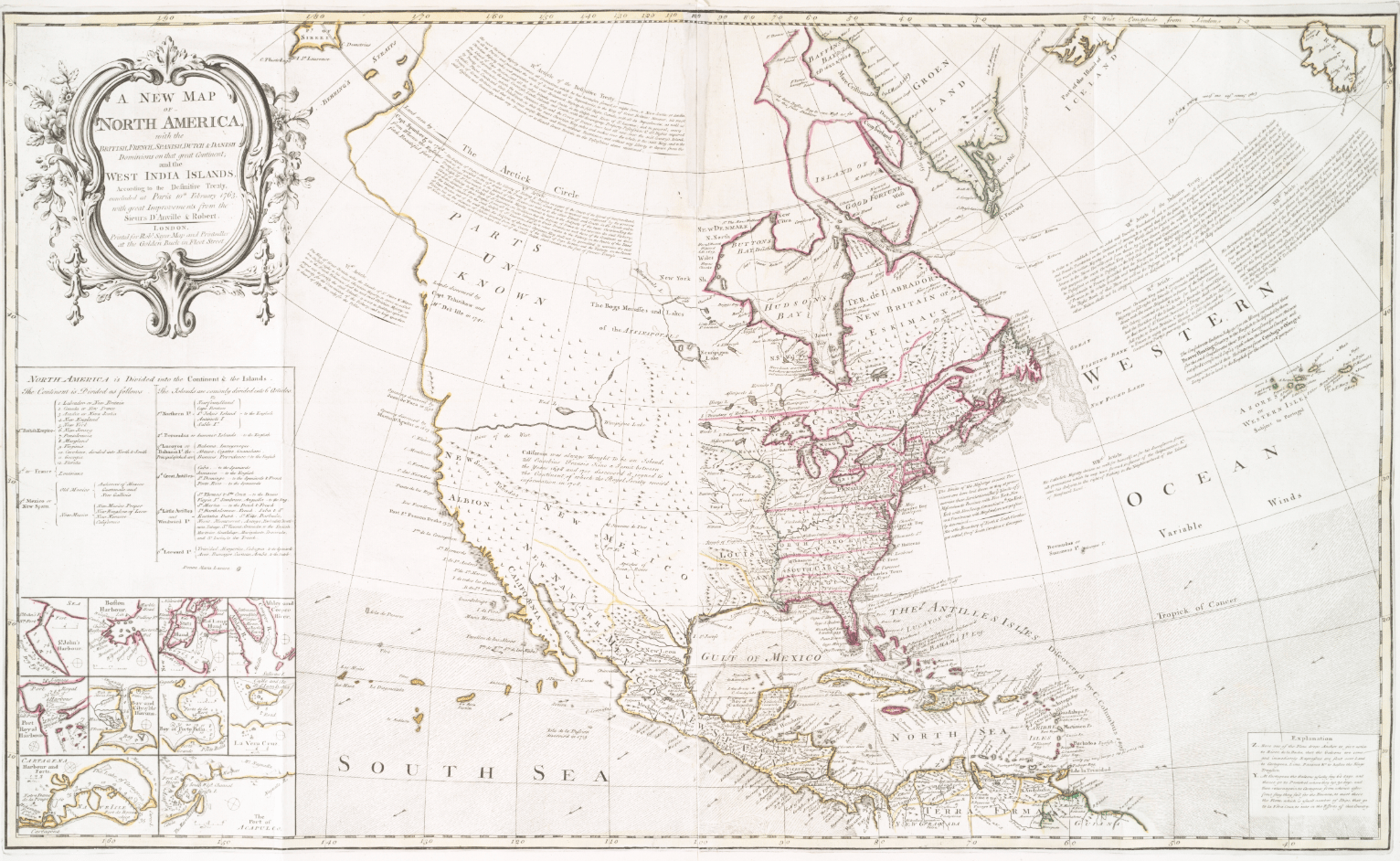
"A new map of North America" – produced following the Treaty of Paris