- Basedment
- Posts
- The Russian Winter Push For Donbas
The Russian Winter Push For Donbas
Your daily dose of geopolitical updates and strategic analysis. Unbiased, but not unbased.

Editor-in-Chief
September 06, 2025
THE BRIEFING
Here’s what’s happening in geopolitics today.
Welcome back to today’s briefing. From Washington’s plan to revive the “Department of War” name to a tense flyover by Venezuelan fighter jets, it’s been a busy 24 hours on the global stage.
We also look at Germany’s latest drone purchase, a deadly drone strike near Aleppo, and fresh pledges of postwar backing for Ukraine.
In today’s deep dive, we shift focus to the battlefield, where preparations are underway for a potential winter push for the Donbas
THE LAST 24 HOURS IN GEOPOLITICS
1. Trump to sign order renaming Pentagon ‘Department of War’
Trump is preparing to sign an executive order on Friday to rename the U.S. Department of Defense as the “Department of War,” a symbolic shift aimed at reviving the institution’s historical role and reflecting his administration’s emphasis on military strength. While Defense Secretary Pete Hegseth has embraced the change and the administration frames it as restoring a “warrior ethos,” legal experts note that the renaming likely requires congressional approval, raising questions about the move’s legitimacy.
read more
2. Venezuelan fighter jets flew over U.S. Navy ship in ‘show of force’
Two armed Venezuelan F-16 fighter jets flew over a U.S. Navy warship off Venezuela’s coast overnight in a clear show of force, though no conflict ensued, according to military sources. The flyover comes amid mounting tensions in the region, where both sides have recently escalated military posturing following U.S. naval deployments and cartel-related operations.
read more
3. Germany buys €1 Billion in Israeli drones despite Gaza friction
Germany is preparing to purchase three additional Israeli-made Heron drones in a deal worth approximately €1 billion. The announcement comes amid growing pressure from European allies urging Germany to pause military ties with Israel in light of its ongoing Gaza operations, a tension the drone acquisition underscores.
read more
4. One killed in drone targeting vehicle near Syria’s Aleppo Airport
A drone struck a vehicle on the road to Syria’s Aleppo airport on Thursday, killing one person, according to Syria’s state news agency SANA. The report offered no additional details about the attack or the identity of the victim. The incident highlights the continued use of unmanned aerial systems in Syria’s conflict zones, underscoring the persistent security risks around key infrastructure.
read more
5. Macron says 26 nations ready to provide postwar military backing to Ukraine
Twenty-six countries have pledged post-war security guarantees for Ukraine, promising to deploy a "reassurance force" via land, sea, and air once a peace deal is in place, though deployment won’t include direct front-line involvement. Some nations will contribute troops, while others will offer training, equipment, and remote support, highlighting a flexible, multi-pronged approach. U.S. contributions are still being finalised, underscoring transatlantic coordination in shoring up Ukraine’s long-term defence.
read more
DAILY DEEP DIVE
THE RUSSIAN ATTACKS WILL CONTINUE THROUGH WINTER
Will the offensive end after summer?
We’ve been asked whether the Russians will continue moving forward well after the end of the summer. And the answer is yes, do not expect a slowdown of Russian attacks. Some of the largest territorial gains were made during the autumn and winter periods in Ukraine.
Expect to see a concentration primarily on the Donbas. This includes continued efforts on Pokrovsk, Shakove, Kostiantinvka, Siversk and Kupiansk. These will be the key areas for the wider operational goal of capturing all of the Donbas. Kupiansk is also important because it will act as the frontal launch pad into the Kharkiv Oblast from the Oskil river if they do decide. Nonetheless, it holds up Ukrainian troops in the north.
Based on the OSINT research of @WarUnitObserver, Russia is completing a major strategic regrouping with its focus now shifting squarely onto the Donbas. Units previously stationed in Sumy and Kherson, including the 70th Motor Rifle Division of the 18th Army, are being transferred toward Bakhmut to provide urgent reinforcement. Within Donetsk, the 155th and 40th Marine Brigades have already arrived, with the 177th Regiment expected to join them, positioning for a likely push along the Dobropillya–Druzhkivka axis. Supporting this effort, airborne elements such as the 11th VDV Brigade and units of the 76th VDV Division have been urgently redeployed to what Russian sources call “the hottest direction,” though their precise attack vector remains uncertain. Meanwhile, the 17th Tank Regiment, equipped with T-72B Obr.22 and T-90M tanks, is also en route to Bakhmut. Together, these movements suggest Russia is preparing to escalate its offensive operations in the Donbas, with potential thrusts aimed at Kostiantynivka, Siversk, or deeper into Ukrainian defensive lines.
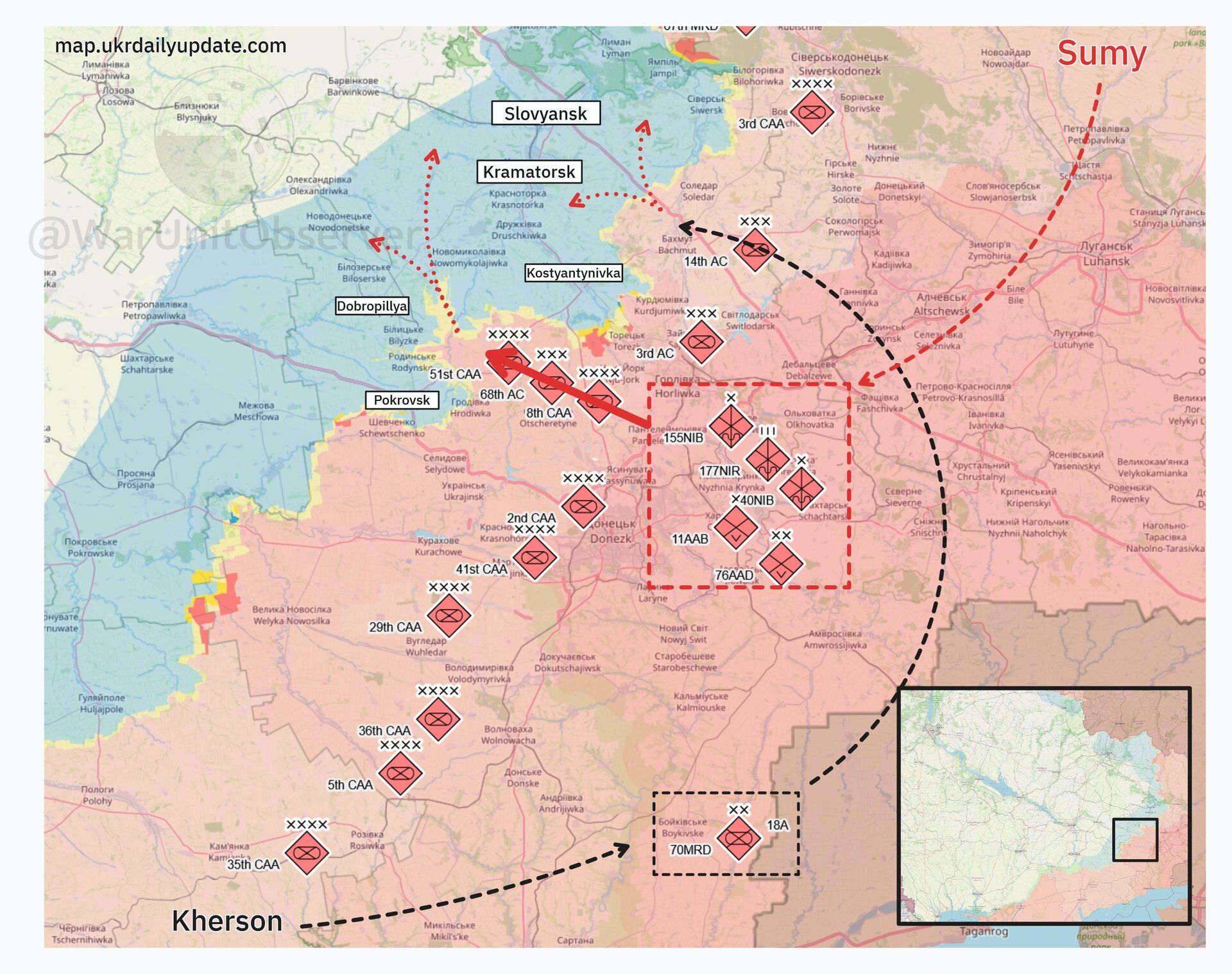
Renewed attacks
We might be seeing the prelude with new pressure on key sectors of the Donbas frontline. Russian forces made steady gains on the Lyman front, capturing around 9.6 km² by cutting the Lyman–Shandryholove road, pushing south near Shandryholove, advancing along the heights east of Derylove, and bypassing Myrne to reach the Zarichne–Drobysheve road.
On the southern flank of Siversk, they relaunched assaults from Rozdolivka and Pereizne, seizing most of Fedorivka and pushing north along the railway while also advancing on the heights toward Vyimka, adding another 5.5 km². This is a major localised breakthrough and will further put pressure on Ukrainian defenders here given there are now exposed flanks on the northern forests and now the southern villages.
Meanwhile, reports suggest Russian control has slightly expanded further south near Pokrovsk. Overall, these moves point to growing pressure across multiple Donbas fronts.
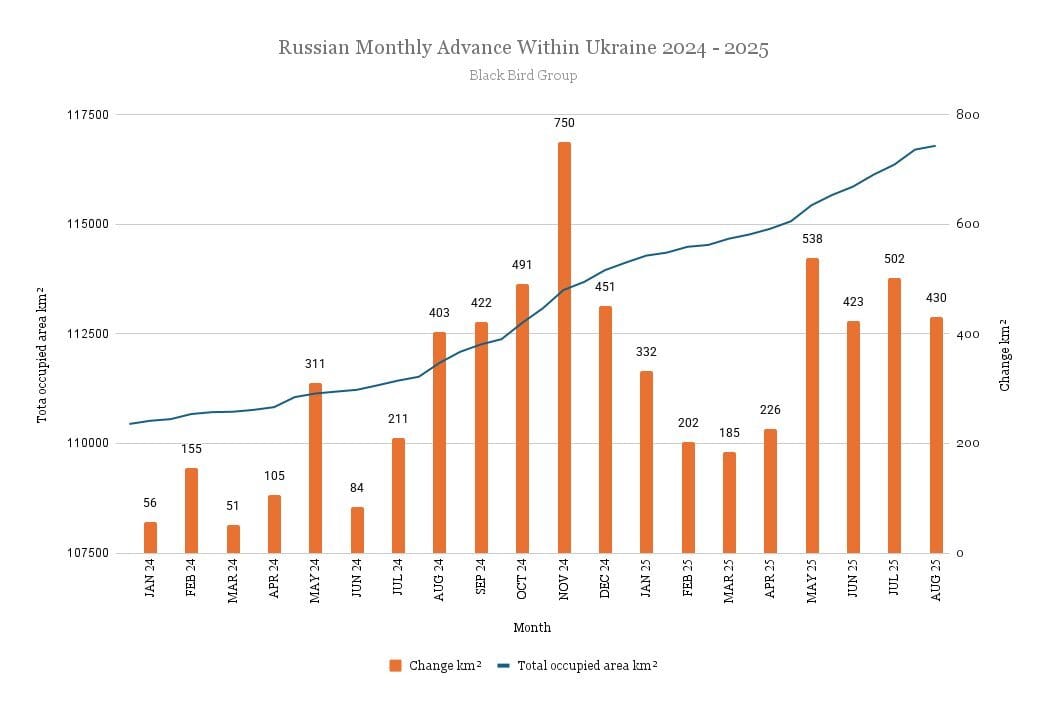
The Rasputitsa
Ukraine is approaching the seasonal rasputitsa, the period of heavy rain and mud that has historically bogged down military campaigns from the Mongols to Hitler on the steppe. This phase will complicate large-scale manoeuvres, especially for armour and mechanised pushes, as vehicles risk getting stuck or slowed in saturated ground. Infantry can still operate, but mobility becomes harder to sustain at tempo. Looking further ahead, winter brings its own challenges: the loss of foliage strips away concealment along tree lines, making it harder for Russian DRG units to infiltrate in small groups undetected.
For this reason, we suspect Russia may commit to a large-scale push using armoured units soon, before the Rasputitsa kicks in. The salient at Shakove shouldn’t be ignored either, it allows the same opportunities that the Dobropillya salient presented. Again, this is all dependent on the weather. Eastern European winters have become extremely mixed.
Our Summary:
Looking ahead from September 5, it seems unlikely that Russia will ease off its offensive momentum once summer ends. In fact, the recent redeployments (armour, marines, and airborne units massing around Bakhmut and Donetsk) point toward a deliberate effort to escalate in the Donbas before the rasputitsa sets in. The mud season has historically slowed mechanised pushes, which may explain why Moscow appears intent on committing armour sooner rather than later. Yet even when the rains arrive, Russian operations won’t grind to a halt; infantry and artillery-led advances can still pressure Ukrainian lines, and Moscow has shown in past winters that it can generate significant territorial gains. The broader picture is one of sustained pressure on key axes (Pokrovsk, Shakove, Kostiantynivka, Siversk, and Kupiansk) as Russia methodically works toward its long-term goal of capturing the entire Donbas, regardless of season.
Sources:
Sources available upon request!
Data from @WarUnitObservor, AMK, Suriyak, Deepstate, ISW, Blackbird Group
TWEET OF THE DAY
Geopolitics aside for a moment… What is it with the global property market at the moment?
"Because they can do math"
— Jon Matzner (@MatznerJon)
4:03 PM • Sep 4, 2025
TODAY IN HISTORY
(September 5, 1972): Munich Summer Olympics Terrorist Attack
At the Munich Summer Olympics, Palestinian gunmen from the group Black September stormed the Olympic Village, taking Israeli athletes and coaches hostage. After a tense standoff and a failed German rescue attempt, 11 members of the Israeli team were killed, along with a German police officer and 5 of the attackers. The “Munich Massacre” shocked the world, casting a dark shadow over the Games and forever changing international security at major sporting events.