- Basedment
- Posts
- The Saudi's Now Have Nukes. And What This Means
The Saudi's Now Have Nukes. And What This Means
Your daily dose of geopolitical updates and strategic analysis. Unbiased, but not unbased.

Editor-in-Chief
September 18, 2025
THE BRIEFING
Here’s what’s happening in geopolitics today.
Welcome back to your daily briefing. Here’s a quick run-through of the biggest geopolitical developments making headlines.
From ABC pulling Jimmy Kimmel Live! off air after his controversial remarks, to Venezuela launching military drills in the Caribbean, the headlines today cut across politics, media, and security. We’re also watching Trump’s high-profile state visit to the UK, clashes on the Thai-Cambodian border, and Albania’s prime minister beginning a new term with bold EU ambitions.
And in today’s deep dive we’re examining just how big of a deal this Saudi-Pakistan defence pact is.
THE LAST 24 HOURS IN GEOPOLITICS
1. ABC pulls “Jimmy Kimmel Live” from air indefinitely following Charlie Kirk comments
ABC is pulling Jimmy Kimmel Live! off the air indefinitely after controversial remarks by host Jimmy Kimmel about the assassination of Charlie Kirk drew sharp criticism. Nexstar said it will no longer air the show on any of its 32 stations, condemning Kimmel’s comments as “offensive and insensitive.” The network’s decision follows pressure from the FCC chair Brendan Carr, who expressed concerns about whether the remarks crossed a line in public discourse and hinted at possible regulatory consequences.
read more
2. Venezuela begins 3 days of military exercises on La Orchila Island
Venezuela kicked off three days of military drills on its Caribbean island of La Orchila, a show of force as tensions rise with the U.S. in the region. Washington, which has stepped up what it describes as anti-drug operations, has already destroyed at least two Venezuelan boats this month, leaving 14 suspected traffickers dead. The Maduro government is framing the exercises as a direct response to what it calls U.S. aggression.
read more
3. Starmer to host Trump for final day of second state visit to Britain
Donald Trump meets British Prime Minister Keir Starmer today during his second state visit, following all the pomp of a royal welcome at Windsor Castle. The aim is to shift focus toward foreign affairs and big investment deals. The agenda is heavy: a £150 billion package from U.S. firms in sectors like tech, energy, and life sciences, alongside talks on global issues such as Ukraine and Gaza.
read more
4. Thai police fire tear gas at Cambodian protesters at a disputed border village
Thai security forces fired tear gas and rubber bullets at Cambodian civilians protesting barbed-wire barriers in Prey Chan village, near the disputed Cambodia-Thailand border, leaving at least 28 people injured. Cambodia condemned the move, saying it violated the fragile ceasefire agreed in July after a deadly five-day conflict. Thailand countered that protesters crossed into its territory and acted provocatively, forcing its forces to respond to restore order.
read more
5. Albania’s Rama starts fourth term as PM, targets EU membership
Edi Rama has started his fourth consecutive term as Prime Minister of Albania after his Socialist Party won a decisive victory in May’s parliamentary elections, reinforcing his grip on power. He has pledged that Albania will complete its EU accession negotiations by 2027 and achieve full membership by 2030, an ambitious schedule given long-standing concerns over corruption, the rule of law, and institutional reform. While international observers noted that the elections were largely calm and well-organised, criticisms persist over media bias, alleged misuse of public resources, and challenges facing the opposition.
read more
DAILY DEEP DIVE
THE SAUDI-PAKISTAN DEFENCE PACT
Today we saw an unprecedented event: the signing of a new defence pact built on nuclear deterrence and fossil-fuel cash flow. It’s hard not to see the cracks in the so-called unipolar world when news like this breaks. For decades, Saudi Arabia has been one of Washington’s strongest allies, going back to the creation of the petrodollar. Billions have flowed in investments and defence deals between the two. And yet, Riyadh just signed a defence pact with Pakistan, telling the U.S. only after the ink was dry (according to the Financial Times).
The Long Saudi-Pakistan Relationship
Pakistan and Saudi Arabia have a long history of defence cooperation, stretching back to the 1960s, including training Saudi troops and deploying Pakistani personnel in the Kingdom. The relationship was deepened in 1979, when Pakistan’s special forces helped Saudi Arabia retake the Grand Mosque in Mecca after it was seized by militants. By the 1980s, the two countries formalized their security cooperation with a bilateral agreement in 1982, allowing Pakistani military advisers and troops on Saudi soil. Over the years, Pakistan has also become a significant recipient of Saudi investment and support, reinforcing its role as a strategic partner in the Islamic world.
A Signal of Distrust in the U.S.
When I first read this news, my immediate thought was: this is a massive blow to U.S. influence in the Gulf. The Washington–Riyadh relationship is long, complex, and controversial. From the petrodollar system to U.S. involvement in Middle Eastern wars, to billion-dollar defence packages, and the elephant in the room, 9/11 – Saudi Arabia has always played the game with Washington. Which makes this pivot impossible to dismiss as “just another deal.”
Saudi Arabia’s neighbour Qatar has been bombed twice in recent months, once by Iran, and most recently by Israel. The Israeli strike was particularly shocking: Washington was informed late, had little time to warn Doha, and, most humiliating of all, couldn’t prevent it. A public show of force by Israel, and a public reminder of America’s declining ability to enforce order. Don’t forget: Qatar recently gifted Trump a $400 million plane.
The Gulf states (despite their rivalries) were united in outrage. It was one thing to hit a U.S. base that had been cleared weeks earlier. It’s another to strike a sovereign state, without coordination, early warning, or negotiation, while America stood on the sidelines. The message to the region is clear: Israel can now act however it wants, with no restraint from its most powerful ally.
Shifting Geopolitical Plates
With this pact, Saudi Arabia now has indirect access to Pakistan’s nuclear arsenal, a powerful counterbalance against Israel, a clandestine nuclear power, and Iran, which has long sought the bomb. This adds another layer of deterrence, a shield against the kind of surprise strikes Israel carried out in Qatar, while also tilting the balance of power in Riyadh’s favour. For Iran, it’s a strategic setback: both of its key regional rivals, Saudi Arabia and Pakistan, now stand aligned under a mutual defence umbrella. Beyond the weapons themselves, the pact sharpens the Sunni–Shia divide, reinforcing the proxy dimensions of Middle Eastern conflict and escalating the stakes of any future confrontation.
Pakistan reaching out to deepen defence cooperation with Iran, while simultaneously strengthening its military pact with Saudi Arabia, suggests Islamabad is hedging its alliances. The recent economic agreements between Iran and Pakistan reinforce that Tehran remains a key partner, not just in trade and transit but potentially in military and strategic terms. This dual alignment gives Pakistan leverage: it can balance pressure from Riyadh while keeping ties with Tehran warm, reducing its dependency on either alone.
India Angle
A senior Saudi official, speaking off the record, emphasized that Riyadh must carefully balance its relationship with Pakistan’s rival, India — also a nuclear power. “Our ties with India have never been stronger. We will continue to deepen this partnership and do our part for regional stability wherever possible.”
India, for its part, has responded to the Pakistan-Saudi defence pact by saying it will take all necessary steps to protect its national interests and ensure comprehensive security across all domains. New Delhi is closely reviewing how this agreement alters the regional balance, especially given the growing defence and economic cooperation between India and Saudi Arabia. Over the past year, India and Saudi Arabia have boosted military ties: joint exercises, arms deals, and high-level visits have multiplied, showing that India is eager to solidify its stake in Gulf strategy.
India’s regional maneuvering adds another layer to the Saudi-Pakistan pact. Just weeks ago, Modi staged a high-profile show of unity with Putin and Xi, a move Trump himself blasted as “losing Russia and India to the dark China.” Whether Modi was seeking new friends or simply posturing to spook Washington, it shows New Delhi’s willingness to diversify away from U.S. alignment. At the same time, India fought a brief but sharp conflict with Pakistan in May, further hardening hostilities. Now, Pakistan’s binding defence pact with Saudi Arabia is not only a coup for Riyadh but also a strategic hedge for Islamabad, amplifying its deterrence against India while securing Gulf backing. With India flirting with Moscow and Beijing, and Pakistan now formally tied to Saudi Arabia, the great-power competition is increasingly playing out through South Asia’s rivalries.
Our Assessment
The Saudi–Pakistan defence pact marks a watershed in Gulf security, signalling both Riyadh’s mistrust of Washington and its search for new guarantees in an increasingly unstable region. By tapping into Pakistan’s nuclear deterrence, Saudi Arabia now holds leverage against both Iran and Israel, altering the balance of power across the Middle East. Pakistan, meanwhile, gains Gulf backing while still hedging ties with Tehran, giving it flexibility in a region of shifting alliances. India is left watching closely, as its brief war with Pakistan and Modi’s tilt toward Moscow and Beijing complicate New Delhi’s Gulf calculus. Overall, the pact underscores the erosion of U.S. dominance and the emergence of a messier, multipolar security order.
Sources:
Sources available on request, reduced to maintain visual integrity of page.
TWEET OF THE DAY
Pretty insane when you think about it.
Never seen anything close
To this for any other
US President……— Fletch17 (@RealFletch17)
12:52 PM • Sep 17, 2025
TODAY IN HISTORY
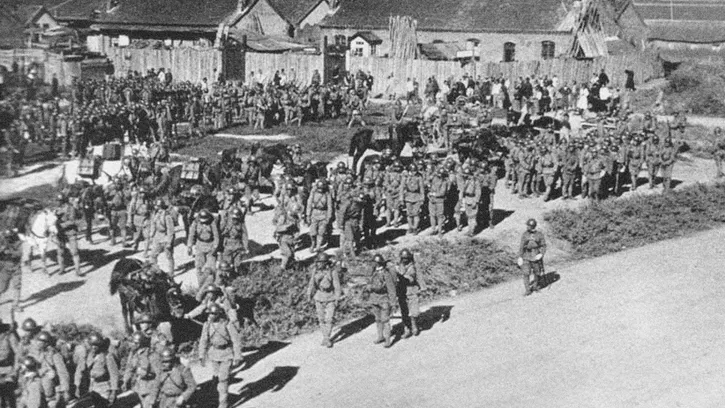
(September 18, 1931): Mukden seized by Japanese
On this day in 1931, in the so-called Mukden Incident, the Japanese army in Manchuria used the pretext of an explosion along its railway to occupy Mukden and to increase its control, within three months, to all of Manchuria.