- Basedment
- Posts
- The SDF Glass House: A Fragile Entity
The SDF Glass House: A Fragile Entity
Today we examine the latest updates on the ground in Syria and the fragile political and military situation for the Syrian Kurds and what is next for them.

Editor-in-Chief
January 18, 2026
THE BRIEFING
Here’s what’s happening in geopolitics today.
From tariff threats and street protests over Greenland to a long-awaited EU–South America trade deal, today’s headlines are dominated by economic pressure and geopolitical brinkmanship.
We’re also watching Iran–US tensions flare again, while Jordan weighs whether to take a seat at Washington’s proposed Gaza peace board.
In today’s deep dive, we examine the fragile political and military situation for the Syrian Kurds and what is next for them.
THE LAST 24 HOURS IN GEOPOLITICS
1. Trump vows tariffs on eight European countries over Greenland stand-off
Trump has threatened to impose escalating tariffs on eight European nations, including: Denmark, Norway, Sweden, France, Germany, the United Kingdom, the Netherlands and Finland, over their opposition to U.S. efforts to secure Greenland, an autonomous Danish territory. Trump said imports from these countries would face a 10% tariff starting February 1, rising to 25% on June 1, and that the duties would remain until “a deal is reached for the complete and total purchase of Greenland,” which he argues is vital for U.S. national security. The announcement has drawn sharp pushback from European leaders.
read more
2. EU, Mercosur bloc sign free trade deal after 25 years of negotiations
After more than 25 years of negotiations, the European Union and the South American Mercosur bloc officially signed a landmark free trade agreement in Asunción, Paraguay, on Saturday, aimed at lowering tariffs and boosting economic ties between the two regions. The pact, involving the EU’s 27 members and Mercosur countries Argentina, Brazil, Paraguay and Uruguay is designed to eliminate over 90 % of tariffs on bilateral trade and create one of the world’s largest free-trade areas covering more than 700 million consumers, though it still requires ratification by the European Parliament and Mercosur legislatures before coming into force.
read more
3. Danes protest against Trump as US threatens to take over Greenland
Thousands of people took to the streets across Denmark on Saturday to join “Hands off Greenland” protests, demonstrating against Donald Trump’s repeated threats to pursue control or influence over Greenland’s future. Protesters, many waving Danish and Greenlandic flags and chanting slogans such as “Greenland is not for sale,” rallied in Copenhagen and other cities to demand respect for Greenland’s autonomy and democratic rights.
read more
4. Iran’s leader Khamenei calls Trump a ‘criminal’ for backing protests
Iran’s Supreme Leader Ayatollah Ali Khamenei publicly denounced Trump as a “criminal” for backing anti-government protests in Iran, accusing him of encouraging unrest and blaming foreign interference for the resulting unrest and casualties. In a televised speech, Khamenei said the protests, which began on December 28 over economic grievances, had left “several thousand” people dead and described demonstrators as “foot soldiers” of the United States, reiterating long-standing accusations of U.S. attempts to dominate Iran’s political and economic affairs.
read more
5. Jordan says King Abdullah received invitation to join Gaza peace board
Jordan’s Foreign Ministry announced that King Abdullah II has received an official invitation from Trump to join the newly proposed “Board of Peace” tasked with overseeing Gaza’s transition and reconstruction under the Trump peace plan. The government said it is currently reviewing the invitation and associated documents through its internal legal procedures before making a decision. The proposed board is part of a broader U.S.-led peace initiative aimed at managing Gaza’s temporary governance and rebuilding efforts following a fragile ceasefire, and invitations have also been sent to several other international leaders.
read more
DAILY DEEP DIVE
The What, Why, How In The Latest Conflict In Syria
The Glass House Built On Sand
The rapid collapse of the SDF’s territorial control can best be described as a glass house built on sand. What appeared formidable on maps never truly existed in the many predominantly Arab villages scattered across Kurdish-controlled territory. The SDF rode the wave of ISIS’s collapse alongside the coalition, and with both Assad and Jolani (now Ahmed al-Sharaa) locked in a fight for Syria’s main population centres, the Kurds were left with de facto control over much of eastern and central Syria. So expansive was this reach that the Turkish army ultimately intervened to prevent Kurdish forces from potentially linking up with the enclave in Afrin.
What made the Kurdish position structurally fragile were the Arab tribes. These tribes are notorious for being decentralised, non-unified, and capable of switching allegiances overnight. The same tribal networks that once backed ISIS later aligned with the Kurds — and are now shifting again toward the Arab-majority government forces. Simply put, the SDF was never in a position to consolidate durable control, especially in eastern villages dominated by some of the most socially conservative communities in Syria, where the idea of women serving as soldiers alone created a deep legitimacy gap.
Economically, the SDF’s strongest card was its control over large swathes of Syria’s oil fields, the same fields that once financed ISIS during its peak. While insignificant by broader MENA energy standards, these resources generate substantial income for non-state or semi-state actors at a regional level. The problem, however, is structural: nearly all refining capacity lies in western Syria. This reality explains why al-Sharaa is so intent on ensuring Deir Ezzor governorate falls under STG control. The SDF’s main population centres run along the Euphrates, anchored by the Tabqa and Raqqa dams. This river corridor is the group’s economic and logistical lifeline. Once lost, the SDF will not only lose territory — it will lose leverage, revenue, and ultimately relevance.
When it comes to these regions, Western audiences often view conflicts through a superficial lens — coloured maps, shifting borders, and clean front lines. In reality, much like the Balkans, village-level dynamics matter far more than regional boundaries. Local grievances, clan ties, and social customs often outweigh flags on a map.
The Kurdish-led authorities have also faced accusations of suppressing Arab communities. In some areas, restrictions on political expression, cultural practices, and public gatherings have fuelled resentment. One example frequently cited is the reported banning in Raqqa of celebrations marking the one-year anniversary of Assad’s overthrow. Measures like this, regardless of intent, inevitably deepen animosity at the local level.
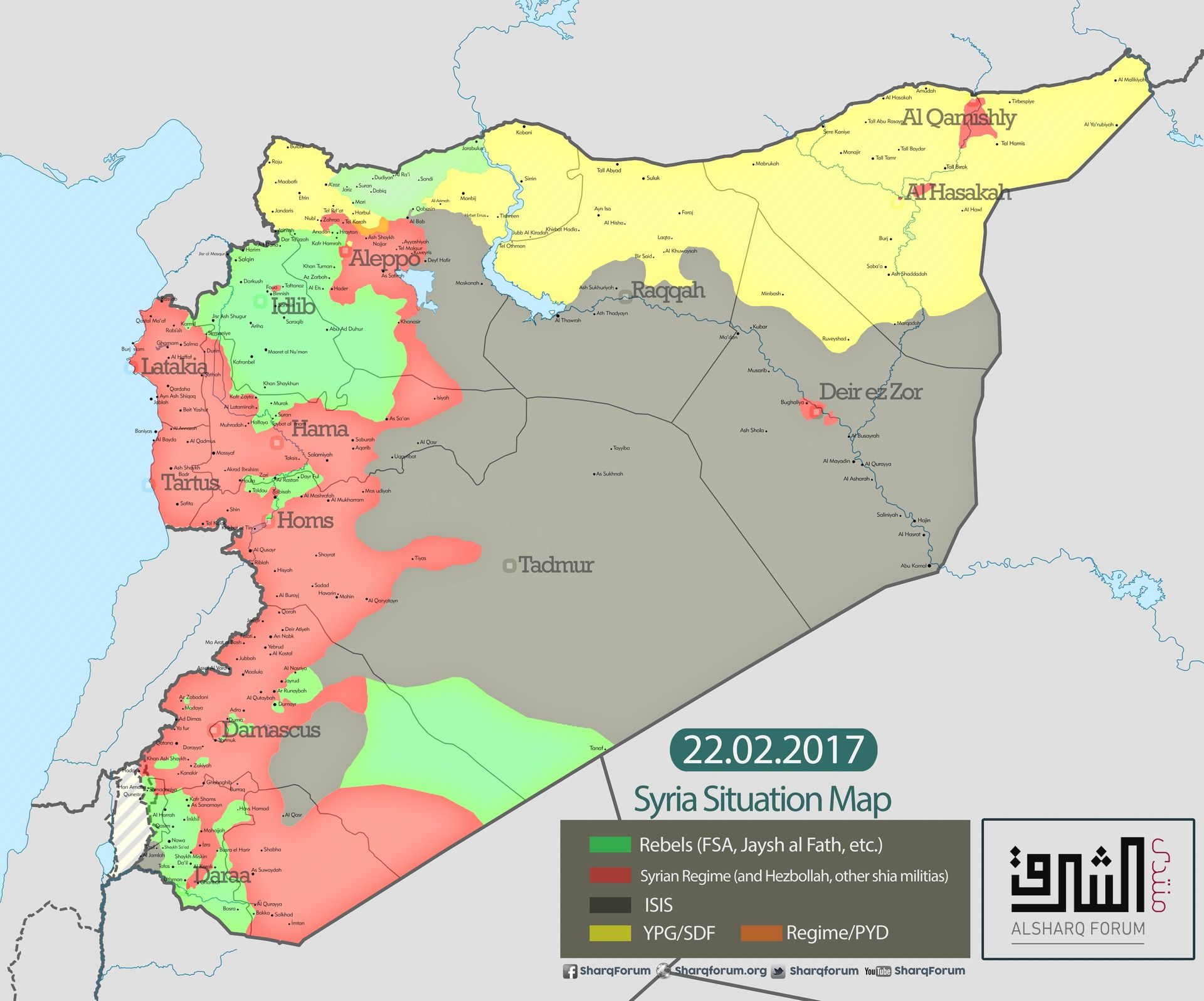
At one point, it seemed that the SDF would dominate almost the entire border with Turkey. This would be something Turkey would not allow, and began their own military operations — primarily against the SDF.
On The Ground Update
Following the complete withdrawal of the Syrian Democratic Forces (SDF) at dawn, Syrian Transitional Government (STG) forces entered Tabqa, marking a decisive shift west of the Euphrates. By mid-morning, Interior Ministry (MOI) units had deployed across the city to secure key sites, including the Tabqa Dam, consolidating government control over critical infrastructure.
Further south, the situation in Deir Ezzor has deteriorated rapidly for the SDF. STG elements began deploying along the east bank of the Euphrates after Arab tribal forces expelled SDF units from a broad corridor stretching from Hawayij Bu Musah to Baghuz at-Tahtani on the Iraqi border. As a result, several major oil fields — Kishma, Marad, South Omar, and Tabiye — are now reportedly secured by government-aligned forces. This represents the first meaningful transfer of Syria’s largest hydrocarbon assets away from SDF control. Tribal uprisings continue to expand geographically. Fresh clashes and defections have been reported in Hasakah governorate, particularly around al-Shaddadi and Markadah, as well as in eastern Raqqa governorate near Jazrat al-Buhamid and Jazrat al-Milaj. Local sources indicate SDF units are increasingly overstretched, attempting to contain unrest in Hasakah while simultaneously withdrawing from Deir Ezzor.
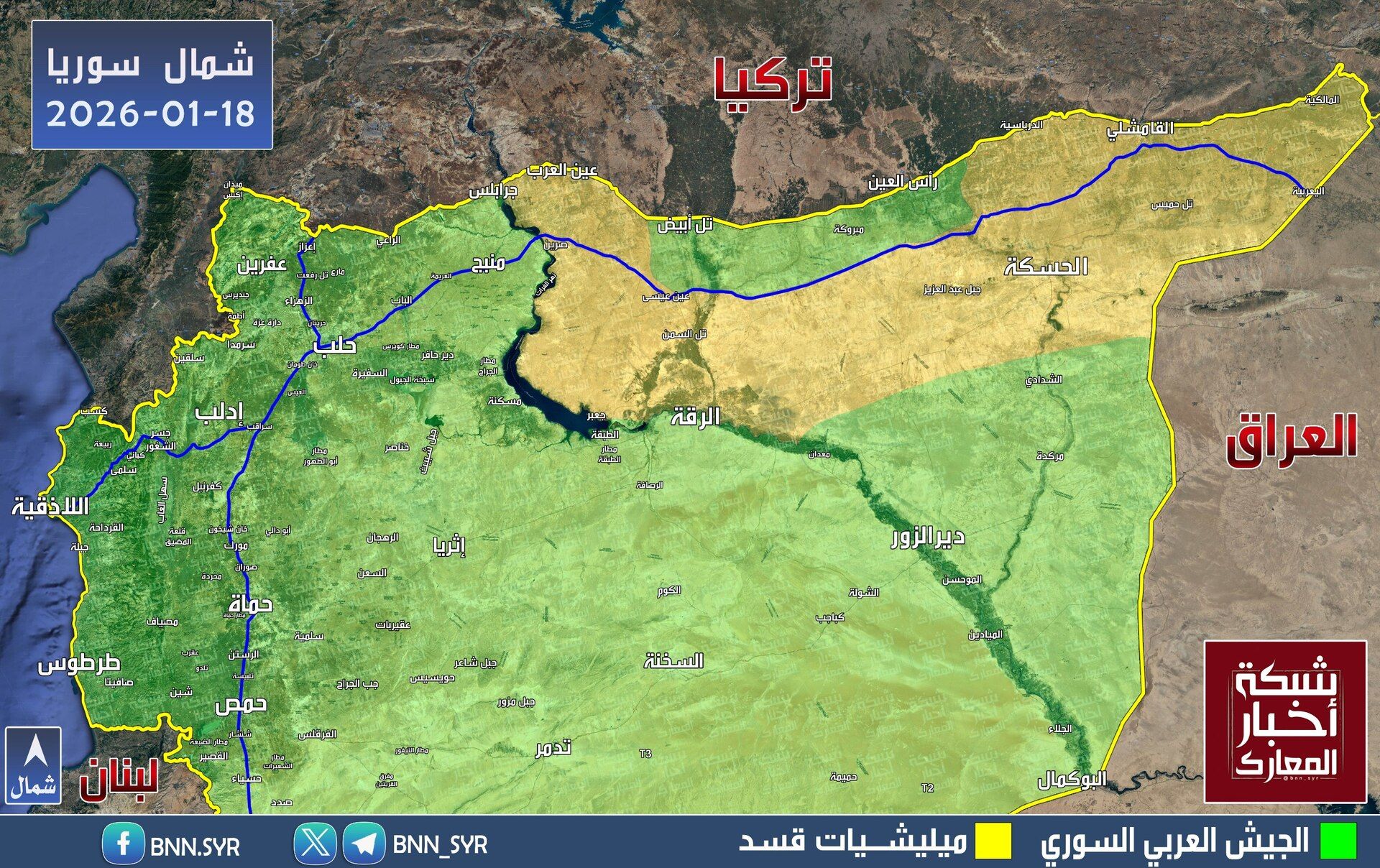
Depending how much of a handover/retreat there was the map may look something like this in the next 24-48 hours.
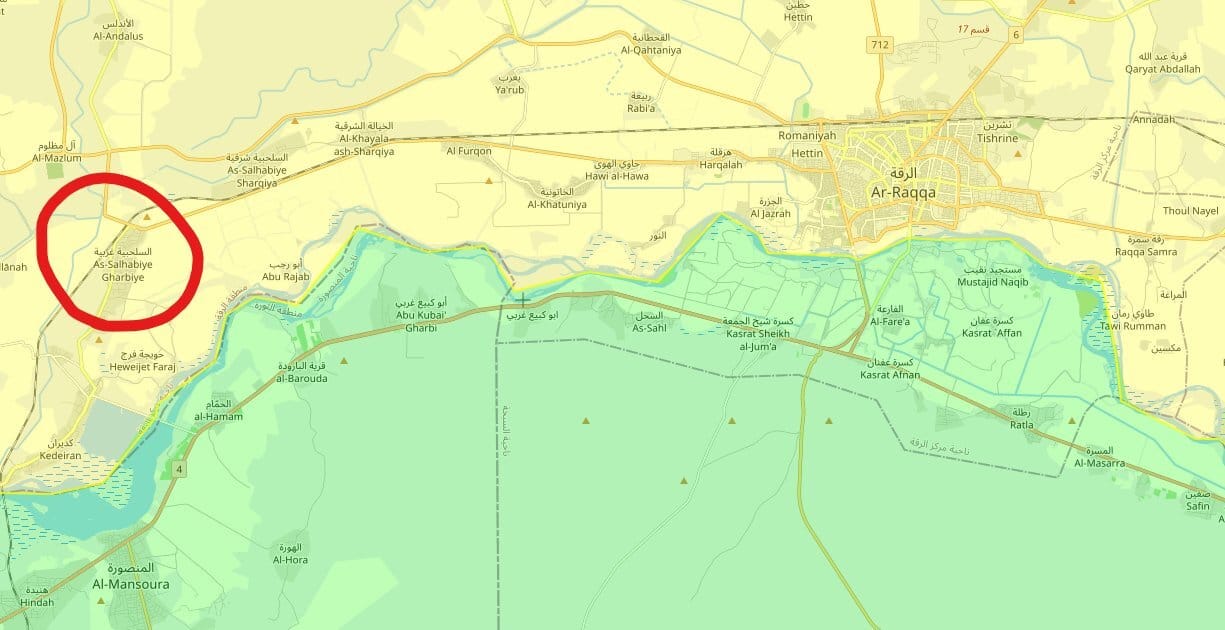
Government-aligned outlets report that Syrian army and tribal forces are advancing through As-Salhabiye Gharbiye toward Raqqa. A successful western river crossing could enable control of al-Mazlum, potentially severing two major western access routes into Raqqa city. Meanwhile, if SNA formations activate their northern Turkish-backed enclave front and advance even marginally on the M4 highway, SDF positions risk will be split in two — forcing a retreat toward Kobane or the northeast.
Al-Sharaa’s Gamble And SDF Failure To Be On The World Stage
Al-Sharaa has gambled that the strategic gains from dismantling SDF power in eastern Syria outweigh the diplomatic risks of alienating the United States, even in the face of renewed threats surrounding the Caesar Act. Stepping back, this move fits into a broader pattern. Ahmed al-Sharaa has spent twelve months on a global push to secure funding, legitimacy, and recognition on the international stage. This is precisely where the SDF fell short. Despite years of battlefield relevance, the SDF remained a largely regional actor with a single, narrow diplomatic anchor: Washington. In theory, that relationship appeared formidable. In reality, it was only as strong as US interest in northeastern Syria.
As the United States turns inward and recalibrates its foreign policy priorities, that foundation has weakened. Under Trump, diplomacy is increasingly transactional — focused on trade, burden-sharing, and tangible returns rather than open-ended security commitments. Direct involvement in Middle Eastern power struggles is no longer a priority unless it clearly serves American interests. For the SDF, this shift was fatal. They failed to translate military utility into broader international legitimacy, economic partnerships, or diversified political backing. When Washington’s attention drifted, the SDF was left exposed — diplomatically isolated and strategically vulnerable.
Al-Sharaa has recognised this window. If US pressure is limited to warnings rather than action, and Trump values economic gains over old friendships, then breaking SDF control in the east becomes a calculated risk rather than a reckless move. In that sense, the SDF’s collapse is not just a military failure, but a diplomatic one, rooted in over-reliance on a single patron in a world that no longer guarantees protection without payoff.
Turkey has also been a major factor in containing SDF and wider-Kurdish influence to a regional level. A decades-long war with the PKK and accusations of support from the SDF has meant Turkey has often blocked the SDF militarily, diplomatically and politically.
March 10th Agreement
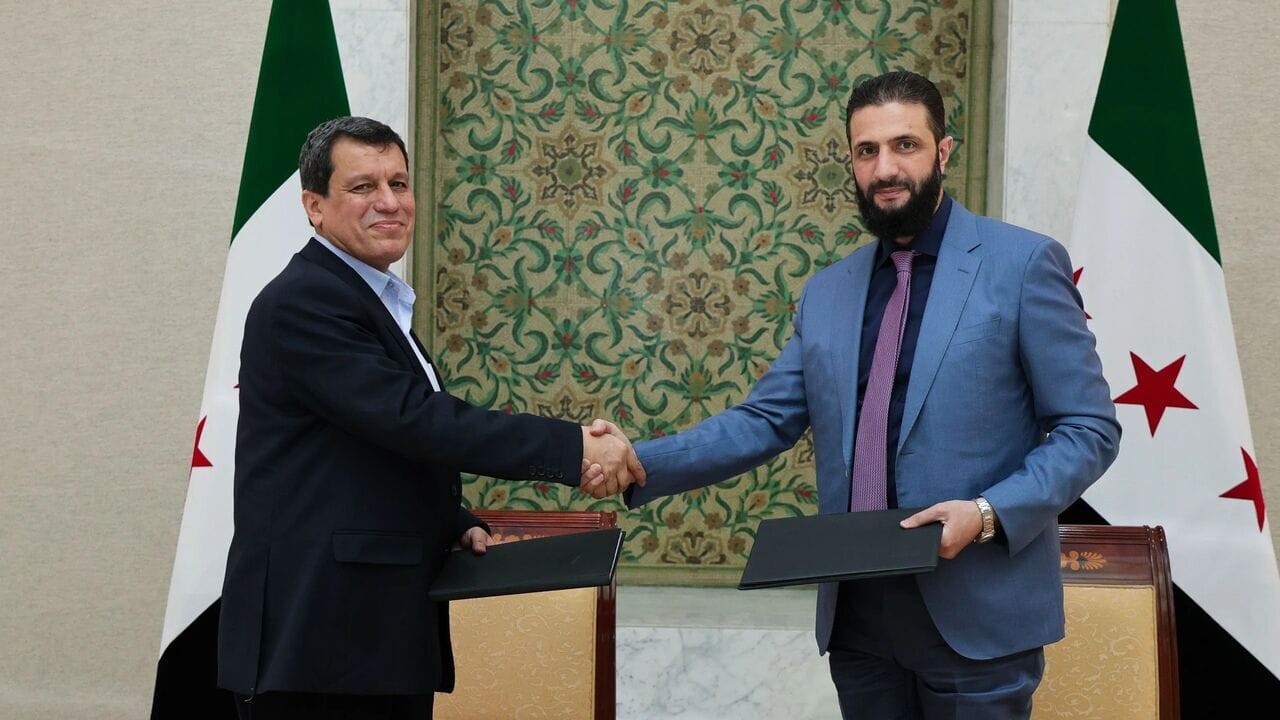
The March 10 agreement between Damascus and the Syrian Democratic Forces ultimately came to a halt due to unresolved core disputes, weak guarantees, and shifting power dynamics. While the deal envisioned phased SDF integration, decentralisation, and political inclusion, no binding mechanisms or timelines were implemented. Damascus has applied calibrated military pressure to force momentum, while the SDF has sought written guarantees and broader political rights. Turkey’s ambiguous role—publicly opposing institutional SDF integration while privately backing talks—has further complicated progress. Another factor has been the internal bickering amongst key figures in the SDF decision makers.
What’s Next
SDF commander Mazloum Abdi has arrived in Damascus ahead of a high-level meeting with al-Sharaa, expected to take place in the presence of US envoy Tom Barrack.
It will be up to Tom Barrack to devise some form of deal for Abdi, given that al-Sharaa will naturally take a maximalist position. He will also argue that he issued Decree 16 recognising Kurdish Syrians as an integral part of the nation, permitting Kurdish-language education, restoring citizenship to previously unregistered Kurds, and declaring Nowruz a national holiday for the first time. State institutions are mandated to enforce an inclusive, anti-discrimination discourse.
For Abdi, the argument will be about whether these are mostly symbolic gestures or genuine concessions — as after the coastal attacks on minorities, nothing can be certain. And whether Kurdish majority areas can remain autonomous with Kurdish-majority units in the Syrian Arab Army. And this is where it could observed that Abdi is throwing rocks from a glass house. In my opinion, whatever deal is reached, it will be a loss for the SDF — the question is how big the loss is.
From March 10th
Sources
News/Journal sources available upon request, not shown to maintain visual integrity of page.
TWEET OF THE DAY
It’s been all hands on deck monitoring the situation at Basedment HQ and we’re still only in January 😂
TODAY IN HISTORY
(January 18, 2002): The civil war in Sierra Leone was officially declared over; more than 50,000 people are estimated to have died in the fighting and some 2,000,000 were displaced.