- Basedment
- Posts
- The Syrian War: A Decade That Rewired Geopolitics Part 2
The Syrian War: A Decade That Rewired Geopolitics Part 2
Your daily dose of geopolitical updates and strategic analysis. Unbiased, but not unbased.

Editor-in-Chief
November 30, 2025
THE BRIEFING
Here’s what’s happening in geopolitics today.
From street stand-offs in Manhattan to high-stakes declarations over Venezuelan airspace, today’s headlines span domestic tension, diplomatic shockwaves, and conflict on the global stage.
We’re also tracking a rare papal visit to a wounded Lebanon, new legal drama surrounding Israel’s prime minister, and Iran’s latest crackdown on fuel smuggling in the Gulf.
Later on in today’s deep dive, we’re continuing on with our Syria special report with more notable events that shaped and Middle East and current conflicts.
THE LAST 24 HOURS IN GEOPOLITICS
1. Multiple arrested as protesters block federal agents in Manhattan
Protesters in Lower Manhattan blocked a garage used by federal agents as they attempted to disrupt a suspected immigration action, according to police and media reports. After repeated warnings from the New York Police Department to disperse, multiple demonstrators were arrested for obstruction and disorderly conduct. Authorities say the protest stemmed from anger over alleged recent immigration enforcement activity in the city, highlighting rising tensions around federal operations and community pushback in Manhattan.
read more
2. Trump says airspace above and surrounding Venezuela to be closed in its entirety
Trump announced that the airspace above and surrounding Venezuela should be considered “closed in its entirety,” calling on airlines, pilots to avoid the skies above the country. The declaration was made via social media and did not come with any public details about enforcement or official U.S. military orders. U.S. defence officials reportedly said they were unaware of any mission currently assigned to implement such a closure. The Venezuelan government condemned the announcement, calling it a “colonialist threat” and a violation of international law, while several international airlines suspended flights after the U.S. Federal Aviation Administration had already issued warnings about heightened security risks in the region.
read more
3. Lebanon’s Christians look to Pope Leo’s visit for a message of hope and peace
Pope Leo XIV has arrived in Lebanon to deliver a peace message during his first overseas trip, at a time when the country is still reeling from repeated Israeli Defence Forces air-strikes and regional conflict spillover. His visit is aimed at reassuring Christians and the broader population that Lebanon has not been forgotten amid ongoing violence. While Pope Leo will avoid the war-torn south, his symbolic presence is widely viewed as a call for unity, religious coexistence and an appeal to renew peace efforts in a deeply fractured region.
read more
4. Netanyahu submits request for pardon during ongoing corruption trial
Netanyahu has formally submitted a request for a presidential pardon to Isaac Herzog while his long-running corruption trial remains ongoing. The request, described by the President’s office as “extraordinary,” argues that continuing the trial hampers Netanyahu’s ability to govern and undermines national unity during a critical regional security moment. Critics, including opposition leaders, say granting a pardon without conviction or admission of guilt would erode democratic norms and under Israeli law, the trial cannot be halted by a pardon alone pending verdict.
read more
5. Iran seizes Eswatini-flagged vessel for alleged fuel smuggling
Iran’s Islamic Revolutionary Guard Corps (IRGC) seized an Eswatini‑flagged vessel carrying approximately 350,000 litres of smuggled fuel in the Persian Gulf, state media reported. The vessel was diverted to the port city of Bushehr under a court order, where its cargo is to be unloaded and crews are now under investigation. This marks the latest in a series of fuel-smuggling crackdowns by Tehran, underlining ongoing efforts to curb illicit exports amid regional economic and political pressures.
read more
DAILY DEEP DIVE
The Syria War: Destruction And Innovation
Context
The Defeat of ISIS
In ISIS, we saw how depraved and corrupted the human soul could become. Their rise was so appalling that a global Western coalition formed almost overnight, with Kurdish ground forces carrying the heaviest burden in the east. To the west, Assad’s forces pushed forward as well, supported at times by rebel factions. ISIS would eventually be defeated as a state, though never truly as an organisation. From Iraq’s Battle of Mosul to the battles of Manbij and finally Raqqa, Kurdish forces paid an enormous price. For Assad, the recapture (and loss) and recapture again of Palmyra created mixed emotions, but the final offensive to relieve the besieged city of Deir Ezzor in the far east gave many the sense that the war might finally be nearing its end.
For the rebel groups, ISIS was both a PR disaster and a recruitment drain, as many hardliners defected to the caliphate. Yet geopolitically, ISIS also threatened them directly. With Turkish support, rebel factions managed to fracture ISIS’s northern holdings, contributing to the group’s territorial collapse.
Turkish Intervention
In August 2016, Operation Euphrates Shield was launched — a military campaign that would, in many ways, rival and eventually outperform the Russian intervention. As rebel factions appeared on the brink of total collapse, the prospect of millions more refugees spilling into Turkey was not unthinkable. Ankara moved quickly, establishing a foothold in northern Syria and forging what would become (and still is) a complicated relationship with the leading rebel groups. For the rebels, Turkish backing was a lifeline: a saving grace and a second wind powered by the Turkish military and air force. For the Kurds, it was a disaster. The Kurdish enclave of Afrin fell swiftly, and ethnic Kurds continue to pay the price for prolonged rebel and Turkish-backed occupation in the north. Euphrates Shield also halted the SDF’s eastern momentum and, in some areas, reversed it as Turkish-backed forces reclaimed key stretches of border territory.Overall, the operation marked a new phase of Turkish expansionism in the Middle East and firmly cemented Turkey as a major regional player.
Drone Warfare
Drone warfare became globally recognised during the Ukrainian conflict, but its roots go much further back to the Syrian Civil War. FPV drones were used by all sides for a range of purposes. In Syria’s dense urban battles, tanks were often accompanied by an FPV drone acting as a second set of eyes — essential in environments where armour is notoriously vulnerable. Drones provided constant surveillance and live updates to units on the ground. Watch any major battle, especially Aleppo, and you’ll see a highly organised communication link between Syrian rebel assault teams and their command centres using drones.
We also saw drones dropping munitions on enemy positions, though not at the scale seen in Ukraine. Toward the end of the war, the SAA regularly uploaded footage of Ukraine-inspired FPV drones striking rebel positions along frontline borders. Since 2019, HTS had steadily expanded its drone programme, beginning with attacks on Russia’s Khmeimim air base and later conducting six more strikes. Its deadliest was the 2023 Homs military academy attack. These operations were carried out by the Al-Shaheen Brigade, a well-funded drone unit reportedly trained by Ukrainian operators. But we did not see the frequency of attacks as we did with the SAA. This all changed in the November offensive, a mass drone campaign began and was instrumental in HTS’s final offensive.
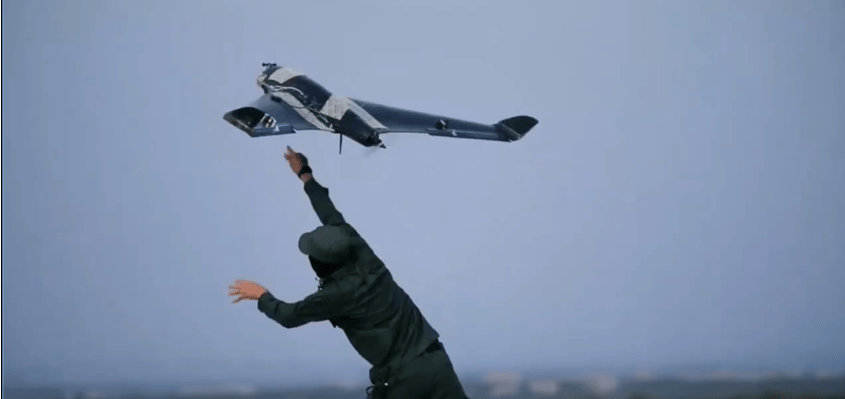
Syrian rebel soldier launching drone
Sources:
News/Journal sources available upon request, not shown to maintain visual integrity of page.
TODAY IN HISTORY
(November 30, 1966): Independence of Barbados
Barbados, an island nation in the Caribbean situated about 100 miles (160 km) east of the Windward Islands, had gained internal self-rule in 1961 and achieved its full independence from Britain on this day in 1966.