- Basedment
- Posts
- The U.S. Foreign Policy Embarrassment
The U.S. Foreign Policy Embarrassment
Your daily dose of geopolitical updates and strategic analysis. Unbiased, but not unbased.

Editor-in-Chief
November 24, 2025
THE BRIEFING
Here’s what’s happening in geopolitics today.
It’s a busy day on the world stage: Washington, Kyiv, and Europe are huddling in Geneva over Trump’s controversial peace plan, while Hamas and mediators gather in Cairo to hash out Gaza ceasefire disputes.
Tragedy and tension ripple elsewhere, with Ukraine raising the death toll from the Ternopil strike, the Pope urging the release of hundreds kidnapped in Nigeria, and China pressing Italy for fairer treatment of its investors.
New events are unfolding in what could be the biggest U.S foreign policy embarrassment in recent history. Backpaddling, confusion, infighting is just the tip of the iceberg.
THE LAST 24 HOURS IN GEOPOLITICS
1. US, Ukraine and European officials hold Geneval talks on Trump plan to end war
U.S., Ukrainian, and European security officials met in Geneva, led by U.S. envoy Steve Witkoff and Secretary of State Marco Rubio, to discuss former President Trump’s 28-point peace plan aimed at ending the war in Ukraine. The draft proposal, which calls for Ukraine to cede territory, limit its military, and renounce NATO membership, has drawn sharp resistance from Kyiv and its European allies, who say key parts favor Moscow. The talks come with a tight timeline: Trump has given Ukraine until later this week to formally accept the plan.
read more
2. Hamas team in Cairo to discuss Israel Gaza ceasefire violations
A Hamas delegation led by Khalil al-Hayya has arrived in Cairo to meet Egyptian, Qatari, and U.S. mediators amid rising accusations that Israel is violating the Gaza ceasefire. Hamas officials say they will raise issues including Israeli overflights, stalled reopening of the Rafah crossing, and the fate of its fighters trapped behind the so-called “yellow line” in Rafah. The talks also aim to clarify provisions of the “Sharm el-Sheikh” deal and pave the way for a second phase of the truce.
read more
3. Ukraine raises death toll from Ternopil missile strike to 34
Ukraine has raised the death toll from the Russian missile strike on Ternopil to 34 people, making it the deadliest civilian strike in western Ukraine this year. Rescue efforts have concluded, with 33 of the victims identified, including six children, while one body remains unconfirmed. More than 90 people were wounded in the attack, which Ukrainian officials say involved a missile launched from a Russian strategic bomber.
read more
4. Pope urges release of 315 seized in Nigerian mass Catholic school kidnapping
Pope Leo XIV has made a heartfelt appeal for the immediate release of 315 hostages abducted from St. Mary’s Catholic school in Niger State, Nigeria. He expressed “deep sorrow” for the young boys and girls taken, as well as their anguished families, and called on authorities to act swiftly to secure their safe return. In his message, the Pope urged prayers that “churches and schools may always and everywhere remain places of safety and hope.”
read more
5. China’s Li Qiang urges fair investor treatment in Italy
Chinese Premier Li Qiang urged Italy to provide a “fair, non-discriminatory” environment for Chinese investors during a meeting with Italian President Giorgia Meloni on the sidelines of the G20 summit. He also pledged to boost bilateral ties by aligning development strategies, deepening industrial cooperation, and widening two-way market access. Li called on both nations to expand dialogue under multilateral forums like the UN and G20, highlighting the importance of open, rules-based economic cooperation.
read more
DAILY DEEP DIVE
The Growing 28-Point Plan Scandal
Updated Context
The saga continues for what’s become one of the most fumbled foreign-policy scandals in recent memory. For those who’ve been out of the loop, and fair enough, because this story shifts every few hours, here’s the condensed version.
Four days ago, Axios released what looked like a heavily Russian-maximalist peace plan allegedly involving Witkoff and Dmitriev. Details were vague, neither Moscow nor Washington acknowledged it, and then 24 hours later Axios suddenly received the full 28-point plan from insider sources. Thanks to Witkoff’s now-deleted accidental public reply — “he must’ve got this from K” – it’s safe to assume the original leak came from Kiril Dmitriev, a close Putin ally.
Rubio chimed in with a vague tweet about “difficult but necessary concessions,” while Russia avoided engaging at all until November 23, when Dmitriev accused Ukraine of leaking the plan and denied Russian involvement.
U.S. senators were furious they hadn’t been briefed on what was supposedly a “U.S.-made plan,” with hawks like Lindsey Graham and Mitch McConnell blasting it, saying the President should “find new advisors” and was “rewarding Russian butchery.”
Kyiv looked equally confused. Early reports said Zelensky rejected the plan, then he said he was open to discussing it with European partners. Umerov was even accused of removing an anti-corruption clause from the original draft.
Meanwhile, multiple senior U.S. Army officials ( including Secretary Dan Driscoll and Gen. Randy George) made an unannounced trip to Ukraine. Officially it was about drone tech, but later reporting suggested they were assessing the frontline situation, with no public mention of the plan until the full text was out.
And now Politico reports that Driscoll privately told EU ambassadors in Kyiv: “the honest U.S. military assessment is that Ukraine is in a very bad position and now is the best time for peace.”
It Gets More Insane
The events of the last 24 hours have severely damaged this U.S. administration.
In a public address at the Halifax forum, Senator Rounds — alongside other senators in a bipartisan effort — stated they’d spoken with Secretary of State Rubio, who allegedly said “the 28-point plan is not the administration's position – it is essentially the wish list of the Russians”.
Read Here
Almost immediately, State Department Deputy Spokesperson Tommy Pigott tweeted that this was “blatantly false,” insisting the plan was authored by the U.S., with input from both Russia and Ukraine.
Read Here
This came just after Rubio retweeted his own earlier, vague statement, now clarifying that the peace proposal was drafted by the U.S., built as a framework for negotiations, and based on input from both sides.
One hour later, Rounds appeared to walk back his remarks, tweeting that he appreciated Rubio’s briefing and his efforts to bring peace using input from Russia and Ukraine.
U.S. envoy to Ukraine Kellogg — who had just announced his intention to resign over frustrations with the administration and its refusal to acknowledge Russian responsibility — is now saying on Fox News that the peace plan is a good plan. Lindsey Graham also seems to be shifting toward supporting it.
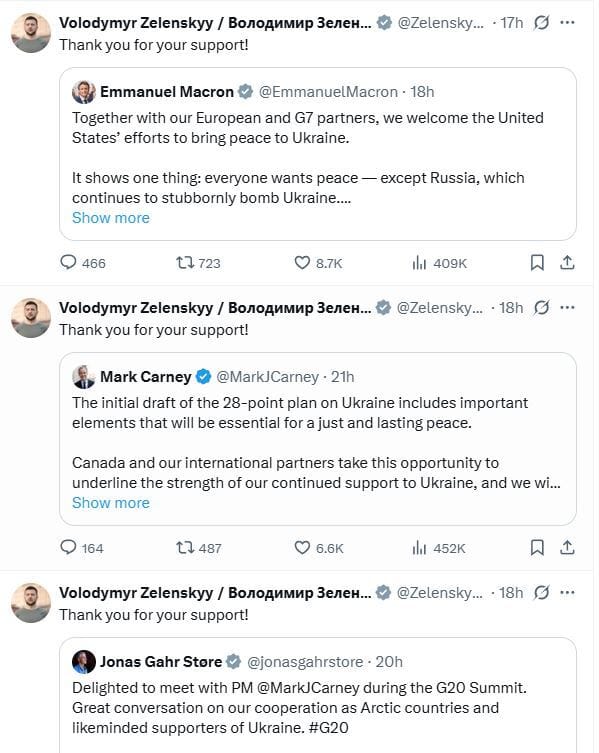
Meanwhile, Zelensky has retweeted more than a dozen accounts with the exact same message: “Thank you for your support!” — which is strange in itself.
What’s This All Mean?
The silence from the Russians is telling. The last few days have been a shocking embarrassment for the Western alliance — especially the U.S. Russia is simply sitting back and watching the flames grow. And it seems that if this was a Russian planned leak, the plan is working: The U.S. has been forced to hastily back this plan in a stumbling manner, whilst at first threatening Ukraine with a deadline, so much so that now European and Ukrainian officials are in Switzerland with U.S. officials discussing the plan.
It’s becoming clearer there are at least two camps inside the U.S. administration: one more pro-Ukraine, the other more willing to engage with Russia. Normally this wouldn’t be catastrophic, but there now appear to be deliberate efforts to keep one side in the dark.
Rubio has reportedly clashed repeatedly with Witkoff and JD Vance, who is seen as far more trusting of Moscow. Rubio’s back-peddling, the mixed messaging, and the sudden reversals all fuel the impression that Vance and Witkoff may be running a shadow effort to negotiate with Russia behind the scenes, effectively shaping a parallel peace track.
Sources:
News/Journal sources available upon request, not shown to maintain visual integrity of page.
TODAY IN HISTORY
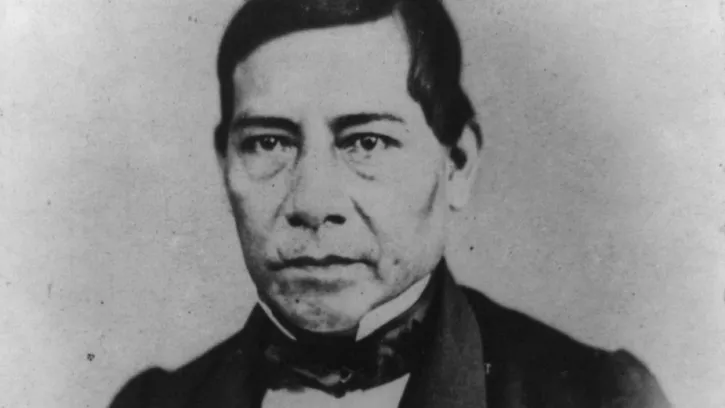
(November 23, 1855): Ley Juárez passed
Passed this day in 1855 in Mexico, the Ley Juárez abolished special courts for the clergy and military in an attempt by justice minister Benito Juárez to eliminate the remnants of colonialism in Mexico and promote equality.