- Basedment
- Posts
- This Battle Will Decide Syria's Future: The Battle For The Deir Haifer Strip
This Battle Will Decide Syria's Future: The Battle For The Deir Haifer Strip
Both the new government and SDF are sending reinforcements to the Deir Hafer strip, with a large battle expected.

Editor-in-Chief
January 14, 2026
In partnership with

THE BRIEFING
Here’s what’s happening in geopolitics today.
From Washington sending pointed messages to Tehran to Tokyo and Seoul striking an unexpectedly upbeat note, today’s briefing spans protest movements, diplomacy, and shifting alliances.
We’re also marking a historic loss in the U.S. civil rights movement, tracking farmers rolling tractors into Paris over trade fears, and watching a major shift in U.S. terrorism designations across the Middle East.
In Today’s Deep Dive, we take a look at eastern Syria as the new government and SDF are sending reinforcements to the Deir Hafer strip, with a large battle expected.
MESSAGE FROM OUR PARTNER
Smart Investors Don’t Guess. They Read The Daily Upside.

Markets are moving faster than ever — but so is the noise. Between clickbait headlines, empty hot takes, and AI-fueled hype cycles, it’s harder than ever to separate what matters from what doesn’t.
That’s where The Daily Upside comes in. Written by former bankers and veteran journalists, it brings sharp, actionable insights on markets, business, and the economy — the stories that actually move money and shape decisions.
That’s why over 1 million readers, including CFOs, portfolio managers, and executives from Wall Street to Main Street, rely on The Daily Upside to cut through the noise.
No fluff. No filler. Just clarity that helps you stay ahead.
THE LAST 24 HOURS IN GEOPOLITICS
1. ‘Help is on its way’, Trump tells Iranians as he urges them to keep protesting
Trump urged Iranians to continue anti-government protests and to “take over your institutions,” posting on Truth Social that “help is on its way,” though he did not specify what form that support would take. Trump also cancelled meetings with Iranian officials until the “senseless killing” of demonstrators stops and reiterated that his administration is weighing a range of options, including possible punitive measures against Tehran for the deadly crackdown.
read more
2. Takaichi and Lee end first day of summit on a high note
Japanese Prime Minister Sanae Takaichi and South Korean President Lee Jae-Myung wrapped up the first day of their bilateral summit in Nara with an informal drum session, playing along to K-pop hits in a video shared by Takaichi’s office, underscoring a notably amicable tone. The light-hearted close followed talks aimed at deepening security and economic cooperation and continuing “shuttle diplomacy” between Tokyo and Seoul as both leaders seek to build on improved ties despite historical tensions.
read more
3. Claudette Colvin, unsung civil rights pioneer, dies at 86
Claudette Colvin, a pivotal yet often overlooked figure in the U.S. civil rights movement, has died at age 86, her family and the Claudette Colvin Legacy Foundation confirmed. At just 15 years old, she was arrested in Montgomery, Alabama, in March 1955 for refusing to give up her seat on a segregated bus, nine months before Rosa Parks, an act that helped lay the groundwork for the landmark Browder v. Gayle case that ultimately ended bus segregation.
read more
4. About 350 tractors steered into Paris for new protests on the EU-Mercosur deal
Around 350 French farmers drove their tractors into central Paris on Tuesday to protest what they say are threats to agricultural livelihoods from low incomes and the EU-Mercosur trade deal with South American nations. The convoy, organized by major farm unions including the FNSEA, rumbled through rush-hour traffic toward the National Assembly and key avenues such as the Champs-Élysées, demanding “concrete and immediate action” to protect food security and local agriculture. Farmers argue the Mercosur deal would open EU markets to cheaper imports produced under different standards, undermining European producers.
read more
5. US labels Muslim Brotherhood in Egypt, Lebanon, Jordan as ‘terrorists’
The United States has officially designated the Egyptian, Lebanese, and Jordanian branches of the Muslim Brotherhood as terrorist organisations, with the Lebanese chapter labeled a Foreign Terrorist Organisation and all three listed as Specially Designated Global Terrorists under U.S. counter-terrorism law. U.S. officials said the move targets alleged support by these Brotherhood chapters for militant groups such as Hamas and seeks to cut off their resources and international activity, making it illegal to provide material support and imposing sanctions on members. The designations mark a significant shift in U.S. policy toward Islamist political networks in the Middle East.
read more
DAILY DEEP DIVE
The Cards Are Not In The Kurds’ Favour
The Syrian Democratic Forces (SDF) now face a structural disadvantage that has little to do with battlefield competence. Their problem is diplomatic, not military. Washington’s posture has shifted decisively toward Damascus, after the SDF’s earlier utility—denying the Syrian state access to energy resources and further constraining its economy—was effectively exhausted. With that objective met, U.S. political cover has thinned. What must be understood is that while eastern Syria holds much of the oil, it is western Syria that contains the core processing infrastructure, including refineries.
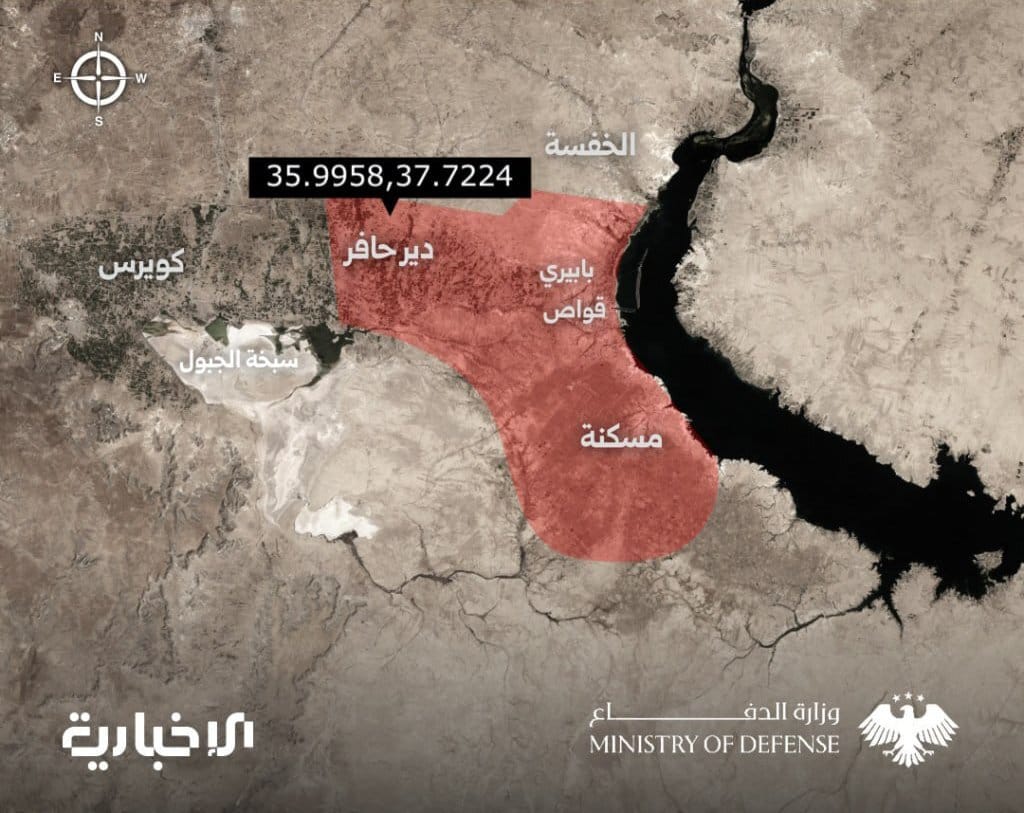
This image was released with a statement calling all the areas marked in red as active military zones.
By contrast, Turkey sees a rare convergence of timing and opportunity. Ankara has long framed the SDF as an extension of the PKK and has already tested this logic through three major operations in 2016, 2018, and 2019. The current phase allows Turkey to pursue what it considers unfinished business along its southern border. As in earlier stages of the war, this involves indirect military backing to proxy formations—a pattern established since the conflict’s early years. However, Turkey has recently—for the first time—publicly differentiated between the SDF and the PKK. This marks a significant tactical shift driven by political necessity rather than ideological change. Clashes in Aleppo exposed fractures within the Kurdish camp and threatened to derail Ankara’s domestic peace initiative with the PKK. By blaming PKK leadership based in the Qandil Mountains for sabotaging integration talks, Turkey shields its dialogue track from collapse while isolating hardliners.
This distinction also allows Ankara to exploit divisions between pragmatic SDF leaders—such as Mazlum Abdi—and more rigid PKK commanders, weakening Kurdish cohesion. Finally, it gives Turkey room to tolerate limited SDF–Damascus integration while continuing to block any federative Kurdish project in Syria, which it views as an existential threat.
An open question is whether Israel remains passive or intervenes politically—or materially—under its long-standing doctrine of supporting minorities to fragment hostile states. Any Israeli move would complicate the battlefield but is far from guaranteed. What the SDF could hope for is a rise in tensions among Druze communities and, to a lesser extent, in the Alawite coastal areas, forcing military units to divert away from the main front. Furthermore, another potential ‘hail mary’ is that the U.S. forces some sort of ceasefire, but I am doubtful.
Following their consolidation in Aleppo, the Syrian Transitional Government (STG) exploited momentum and tacit Turkish-American diplomatic backing to prepare an eastern offensive. Reinforcements, coordinated with the Syrian National Army and supported by the Turkish Armed Forces, have moved toward Tishrin, Deir Hafer, and the Ma’dan–Ghanem Ali axis near Raqqa. The SDF has responded in kind, rushing forces to these fronts. Diplomacy is receding. What is emerging instead is a new, more violent phase of the war—defined by internal fractures. Meanwhile, Turkish-aligned SNA units continue drone strikes on the Tishrin Dam, underscoring that the battle has already begun in its pre-emptive stages.
Operationally, the decisive arena is the strip running from Deir Hafer to Tabqa. It is striking that the SDF has not withdrawn from this area. By military logic, it is extremely vulnerable: there is a single main supply route, and Tabqa sits almost as close to the front as Deir Hafer. If fighting reaches Tabqa, SDF units could be trapped with relative ease. A withdrawal is likely, as the strip now serves little military purpose. Originally, it was intended as a launching platform into central and western Syria—if the new government failed to assert dominance or defeat Assad.
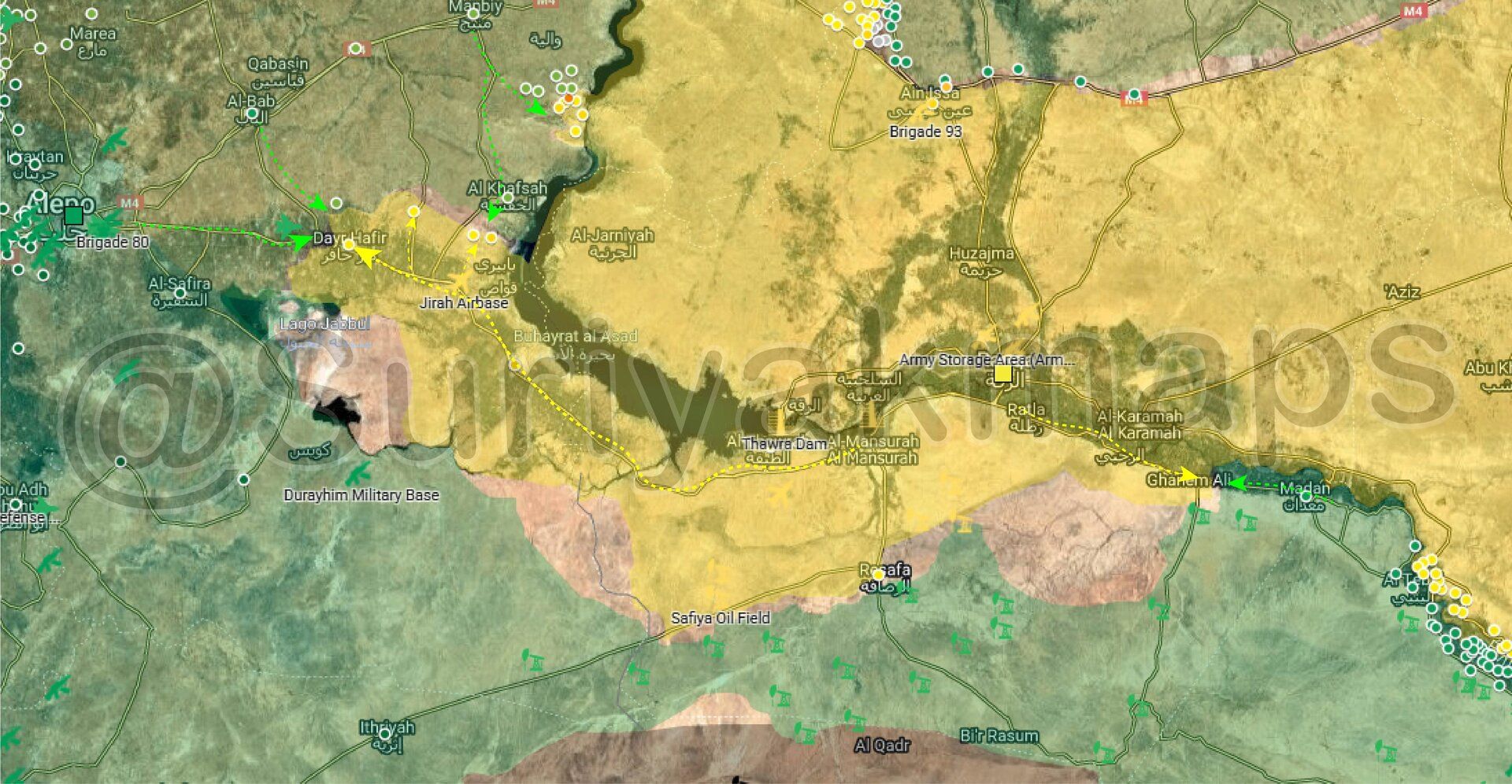
SuriyakMaps is the source. As we can see, the strip is in a horrible military position.
A sustained push across the Euphrates would expose the SDF to a far more dangerous internal threat: tribal fracture. A rebellion by Arab tribal leaders east of the river would be existential, collapsing cohesion from within and ending any realistic prospect of a secular, autonomous project in Syria for years—if not decades.
All in all, the cards are not in the Kurds’ favour.
Sources
News/Journal sources available upon request, not shown to maintain visual integrity of page.
TODAY IN HISTORY
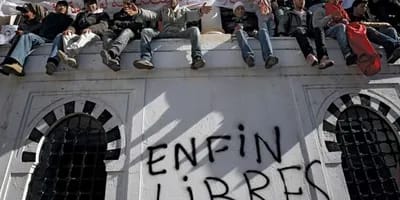
(January 14, 2011): Tunisian President Zine al-Abidine Ben Ali stepped down following mass protests against poverty, unemployment, and political repression. The uprising in Tunisia became known as the Jasmine Revolution.