- Basedment
- Posts
- Trump Launches "Project Freedom", Syria Ceasefire Unravels
Trump Launches "Project Freedom", Syria Ceasefire Unravels
In today’s deep dive, we discuss the new project being launched by U.S. forces in the Strait of Hormuz, as conflict breaks out in Southern Syria.

Editor-in-Chief
May 04, 2026
THE BRIEFING
Here’s what’s happening in geopolitics today.
From shifting alliances in the Indo-Pacific to legal disputes over Gaza-bound activists, today’s headlines span both strategic cooperation and growing diplomatic friction.
Trade resilience also takes centre stage with a new New Zealand–Singapore pact, while European and US diplomacy sees a Vatican meeting drawing attention in Rome. And in the Middle East, tensions remain elevated as Washington moves to reopen key shipping routes through the Strait of Hormuz.
In today’s deep dive, we discuss the new project being launched by U.S. forces in the Strait of Hormuz, as conflict breaks out in Southern Syria.
THE LAST 24 HOURS IN GEOPOLITICS
1. Australia and Japan expand defence ties amid rising China threat
Australia and Japan have agreed to expand defence cooperation during high-level talks between Prime Minister Anthony Albanese and Japanese Prime Minister Sanae Takaichi, amid growing concern over China’s regional influence. The two sides are deepening military ties through initiatives including a multi-billion-dollar warship deal and broader security coordination, alongside closer collaboration on energy and critical minerals. Officials framed the partnership as part of a wider effort to strengthen deterrence and stability in the Indo-Pacific, with both countries aligning more closely in response to shifting geopolitical and security dynamics.
read more
2. Israel court extends detention of two Gaza flotilla activists
An Israeli court has extended the detention of two foreign activists arrested after a Gaza-bound aid flotilla was intercepted by Israeli forces in international waters near Greece. The two men, from Spain and Brazil, are being held for further questioning, with authorities citing suspected offences including links to hostile groups, while no formal charges have yet been filed. The case has drawn international criticism, with Spain and Brazil condemning the detentions as unlawful.
read more
3. New Zealand signs deal with Singapore to ensure trade of essential goods
New Zealand and Singapore have signed a landmark agreement to guarantee the continued flow of essential goods such as food, fuel and medical supplies, even during global crises. The legally binding pact, signed during a leaders’ meeting between Prime Ministers Christopher Luxon and Lawrence Wong, commits both countries to avoid export restrictions and coordinate closely during supply chain disruptions. Officials said the deal aims to strengthen supply chain resilience amid increasing geopolitical tensions, with both sides encouraging other countries to adopt similar frameworks.
read more
4. Italian media reports US top diplomat Rubio to meet Pope Leo on Thursday
U.S. Secretary of State Marco Rubio is expected to travel to Italy this week, with Italian media reporting he will meet Pope Leo at the Vatican on Thursday. The visit comes amid heightened tensions between the Trump administration and the Vatican, following public disagreements over the war with Iran and broader foreign policy issues. Officials say the meeting is part of a broader diplomatic effort to stabilise relations with both the Holy See and European allies, with Rubio also scheduled to hold talks with Italian leaders during the trip.
read more
5. Trump says US will ‘help free up’ ships stuck in Hormuz Strait
Trump has said the United States will “help free up” ships stranded in the Strait of Hormuz, announcing an operation to begin immediately aimed at restoring safe passage through the waterway. Trump said the effort would involve guiding vessels from “neutral” countries out of restricted waters after weeks of disruption linked to the conflict with Iran. The announcement has heightened tensions, with Iran warning it would respond to any foreign military presence in the strait, underscoring the risk of further escalation in a region critical to global energy flows.
read more
SUPPORT THE PODCAST!
Happy Weekend! New Podcast!
In the podcast we discussed: Trumps amazing ability to make viral clips, UAE-Israel alliance, failure of Australian politics, idiocrasy of politicians and more!
Watch and listen here
CONFLICT TRACKER
USA-Iran
The launch of Project Freedom has triggered an immediate and kinetic Iranian response. Within 12 hours of CENTCOM's announcement, Iranian state media reported that two missiles struck a U.S. Navy vessel near Jask after it ignored warnings from the Revolutionary Guard to halt. According to sources at Axios, U.S. officials have denied the claim. The pattern is familiar: Iran announces a strike, CENTCOM stays silent or denies, and the information war runs parallel to the physical one. I would largely regard anything coming from Iranian media as lacking in reliability so take these things with a grain of salt.
The commercial shipping environment deteriorated sharply in the lead-up. UKMTO reported attacks on two cargo vessels on Sunday, with a northbound bulk carrier struck by multiple small craft near Sirik, Iran, and a second incident occurring 78 nautical miles north of Fujairah. Neither attack has been formally attributed.
Military chief Ali Abdollahi Aliabadi stated that any foreign armed force approaching the strait would be attacked, and that safe passage must be coordinated with Iranian forces under all circumstances. Senior Iranian official Ebrahim Azizi reinforced this, warning that any U.S. interference in the strait constitutes a ceasefire violation. Tehran is not treating Project Freedom as a humanitarian operation; it is treating it as a provocation.
The operational reality of Project Freedom also remains murky. Two senior U.S. officials described it as more of an international shipping coordination effort than a direct naval escort mission, with U.S. warships positioned nearby rather than physically accompanying vessels. This is something to take note of, when this was first announced there was a lot of mixed messaging — could be pointing to internal communication issues.
Diplomatically, Tehran said Monday it was reviewing Washington's latest counterproposal, while Iran's deputy parliament speaker stated the country will not return the strait to its prewar conditions. Brent crude is holding near $109 a barrel. Escalation risk is high.

West boundary: from Qeshm Island → UAE coast near Umm Al Quwain
East boundary: from Mobarak Mountain (Iran) → Fujairah
This the “border” that Iran has set up according to them.
Syria
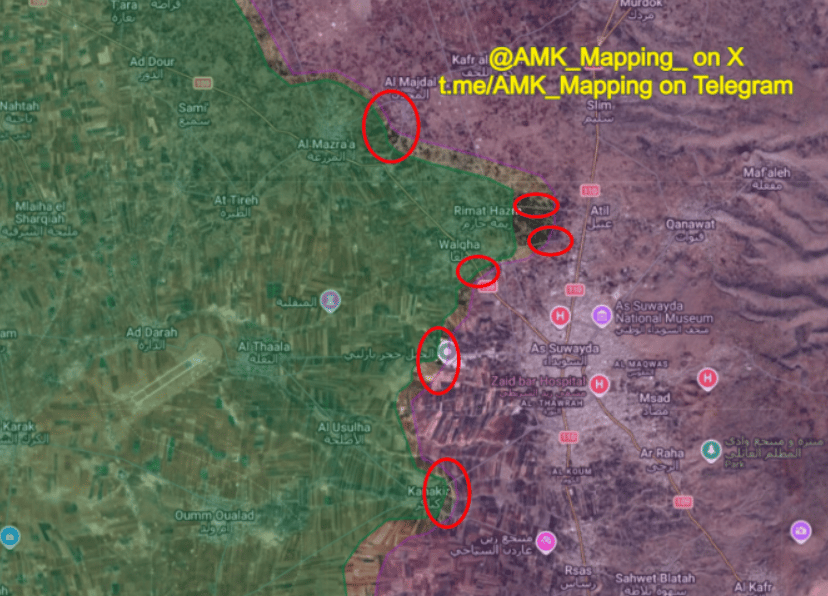
Syrian Transitional Government forces and Druze fighters are engaged in active clashes across at least six sections of the frontline in Suweida Governorate. The transitional government is deploying reinforcements west of Suweida City, with attacks on Druze positions involving machine-guns, artillery, mortars, and FPV drones. Druze forces are returning fire, targeting identified launch positions.
The timing is significant. Within the last 48 hours, Jordan conducted strikes inside Syrian territory targeting Captagon production and trafficking networks, a drug trade that has destabilised the Jordanian border region for years and which Damascus has been under pressure to dismantle. Sources indicate the current offensive against the Druze is part of a coordinated effort, suggesting the transitional government may be using the Jordanian strikes as political cover to consolidate control over Suweida, a region that has historically resisted central authority and maintained its own armed structures. The situation is developing.
Sources
Available upon request
TODAY IN HISTORY
(May 4, 1868): A Buddhist pagoda is completed, surrounded by a book
On this day in 1868, the Kuthodaw Pagoda in Mandalay, Myanmar, was completed. Inside and around it is a book unlike any other: 729 marble tablets, each more than five feet tall, inscribed on both sides with writings held sacred by Theravada Buddhism.
