- Basedment
- Posts
- Trump’s Changing Tune on Ukraine?
Trump’s Changing Tune on Ukraine?
Your daily dose of geopolitical updates and strategic analysis. Unbiased, but not unbased.

Editor-in-Chief
September 24, 2025
THE BRIEFING
Here’s what’s happening in geopolitics today.
From GPS interference over Kaliningrad to sharp exchanges at the UN, it’s been another eventful 24 hours on the world stage.
We’re tracking developments from Europe to Asia, with stories ranging from Iran’s nuclear diplomacy to NATO’s warning shots at Russia.
Trump has made some big statements regarding his views on the Ukraine conflict, we’re going to unpack it all.
THE LAST 24 HOURS IN GEOPOLITICS
1. Spanish Defence Minister’s jet suffers GPS disturbance near Russia’s Kaliningrad
Spanish Defence Minister Margarita Robles was aboard a Spanish military jet that experienced a GPS “disturbance” while flying near Russia’s Kaliningrad exclave on its way to Lithuania, according to Spain’s Ministry of Defence. The disruption comes as part of a pattern: earlier, the aircraft of EU Commission President Ursula von der Leyen also lost GPS signal, and countries like Estonia and Finland have reported similar electronic interference, which many Western governments suspect is linked to Russia.
read more
2. Iran, European powers struggle to reach deal over ret
Top European and Iranian diplomats are meeting in New York this week to try and prevent a fresh crisis over Iran’s nuclear program, with the looming threat that the E3 (France, Germany, UK) will trigger a “snapback” of U.N. sanctions if Tehran fails to comply. Iran’s Foreign Minister Abbas Araghchi is engaging with the IAEA’s Rafael Grossi and his European counterparts, pushing back against renewed pressure. Tehran says diplomacy remains its chosen path, but insists it will not bend to coercive language or ultimatums.
read more
3. South Korea vows to reduce tensions with North
South Korean President Lee Jae Myung, speaking at the UN General Assembly, pledged to break the “vicious cycle of unnecessary military tensions” with North Korea and pursue a phased, pragmatic approach to the nuclear issue. He emphasised that denuclearisation won’t happen overnight and pledged steps like halting propaganda broadcasts toward the North as trust-building measures. North Korea’s response was dismissive: Kim Jong Un rejected any phased deal and accused Seoul and Washington of insincerity, while leaving open possible talks only if the U.S. drops demands that Pyongyang abandon its nuclear weapons entirely.
read more
4. Trump tells world leaders their countries are ‘going to hell’ during UN speech
In a fiery 56-minute address to the U.N. General Assembly, Trump warned world leaders that their countries are “going to hell,” sharply criticising immigration policies and climate-change agendas he argued are undermining national sovereignty. He also rejected U.N. support for a Palestinian state and pressed European nations to adopt the same sanctions on Russia as the U.S., characterising global cooperation as weak and ineffective. The speech’s confrontational tone has stirred debate over whether Trump seeks to reset America’s role or simply dramatise divisions.
read more
5. NATO warns Russia to stop ‘escalatory’ actions after Estonia airspace violation
NATO sharply condemned Russia after three MiG-31 fighters breached Estonian airspace for about 12 minutes, warning Moscow that such violations are part of a “pattern of increasingly irresponsible behaviour” and that the alliance would defend itself with military and non-military means. Estonia has formally requested NATO consultations under Article 4, while Italian F-35s based in the Baltic region intercepted and escorted the Russian jets out.
read more
DAILY DEEP DIVE
TRUMP’S CHANGING TUNE ON UKRAINE (AGAIN)
Trump Talks The Talk
Trump’s rhetoric has become familiar, like a ship swaying side to side, unpredictable and hard to steady. Two factors explain this. First, he lacks the grounding in foreign affairs, politics, or history that most of his peers possess, instead approaching global issues as a deal-making businessman. This leaves him open to persuasion, often shifting positions when presented with a compelling argument. Second, unpredictability is also his negotiation tactic. As the world’s most powerful leader, it pressures others to appease him rather than risk falling out of favour. While this often works, it also carries risks: rash decisions and long-term consequences. Already, smaller states are rethinking their alliances as Washington pivots inward, signalling a retreat from its traditional global commitments.
Trump: NATO planes should shoot down Russian aircraft in NATO airspace
European Leaders React
Trump’s call for NATO to shoot down Russian jets has split Europe. The UK and Poland struck the hardest line, London declaring it was “ready to act” while Warsaw signaled it would not hesitate to engage. Sweden backed this stance, stressing its right to defend its skies by force if needed. Germany, however, urged restraint, with Defence Minister Pistorius dismissing Trump’s remarks as “reckless.” NATO chief Mark Rutte echoed caution, stressing any decision would hinge on intelligence. France, Denmark, and Germany meanwhile reinforced their presence in Poland after recent drone incursions.
It’s no surprise the UK backed Trump’s remarks. Starmer has pushed hard for strong ties with Washington and committed roughly $30 billion to Ukraine’s war effort. Poland’s stance is equally predictable, its military strength and bloody history with Russia make a hard line almost inevitable. Germany’s and NATO’s caution, however, points to a deeper problem: on paper, the alliance is not prepared for a large-scale war with Russia. Most resources are funneled into sustaining Ukraine, not outfitting millions of NATO troops. That leaves a fear among some members that escalation could expose real weaknesses, and the last thing they want is Trump noticing. The recent Polish drone incident underscored this vulnerability: NATO struggled to intercept them, firing off missiles worth hundreds of thousands of dollars at decoys – a moment many Ukrainian commentators openly mocked.
Bonus note: There’s a funny video of Zelensky appearing shocked at Trump’s reply when asked if NATO should respond to shoot down Russian aircraft.
REPORTER: Do you think that NATO countries should shoot down Russian aircraft if they enter their airspace?
TRUMP: Yes I do
— Aaron Rupar (@atrupar)
5:37 PM • Sep 23, 2025
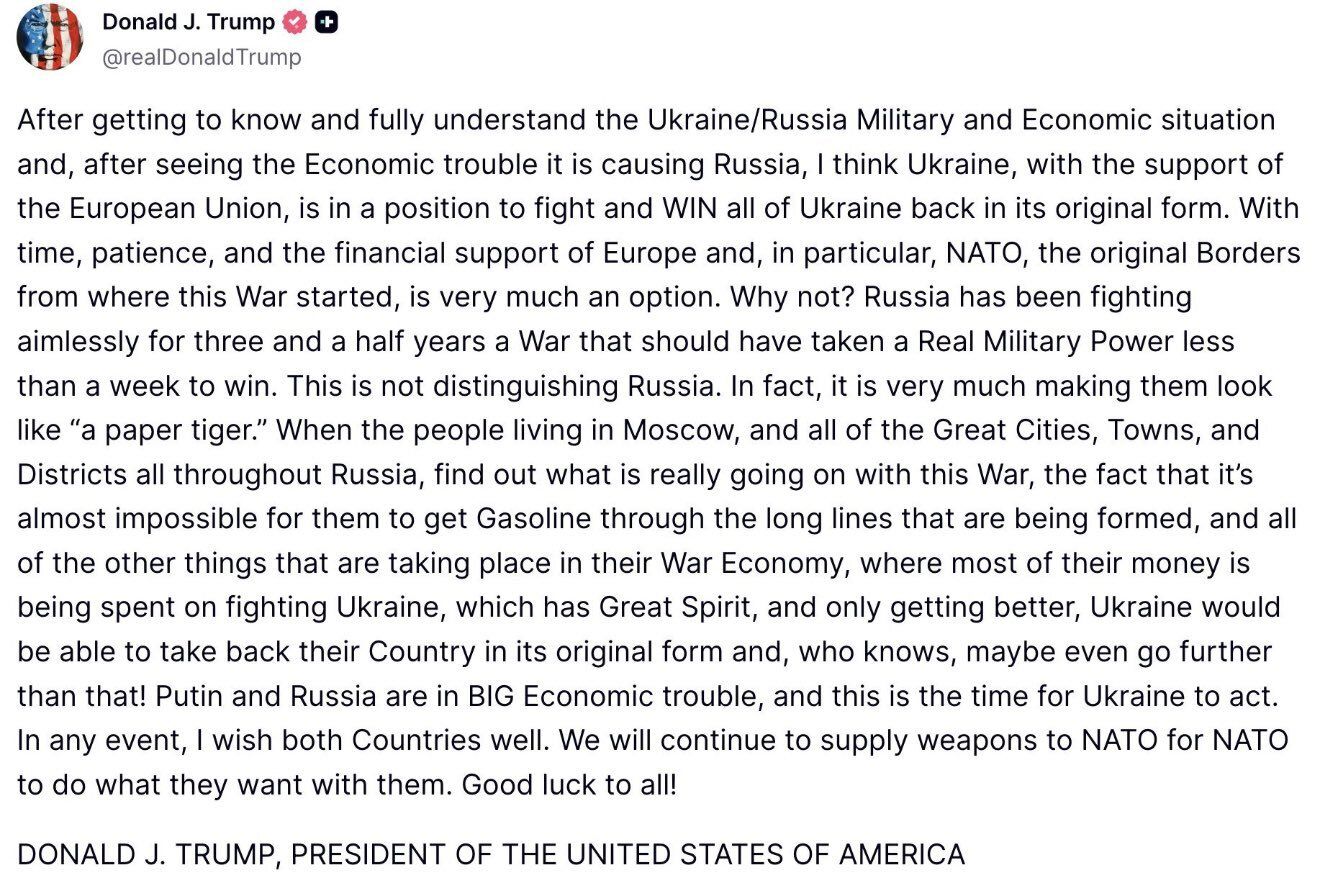
Trumps Big Truth Social Post
Like we wrote above, it’s simply hard to read Donald Trump. When you see posts like these (of which there are many) you have to ask whether this is part of his diplomacy tactics or whether it's pure frustration – or maybe both.
Trump’s abrupt shift on Ukraine feels less like a gift to Zelenskyy and more like a pointed message to Putin. After the failed Alaska summit, his choice to brand Russia a “paper tiger” and suddenly back Ukraine’s maximalist goal of reclaiming all occupied territory is all about throwing the ball into Putin’s court and applying pressure. It’s Trump signalling frustration, warning Moscow that if Putin keeps stalling, U.S. support could swing fully behind Kyiv. Zelensky stated himself that he was surprised by the ‘shift’ but welcomed it. This is classic Trump: raise the stakes, unsettle your rival, and keep everyone guessing.
Nonetheless, there is still personal frustration in this, he has repeatedly claimed he thought this would be his ‘easiest’ conflict to end.
And what did Russia do? The Kremlin rejected Trump’s dismissal of Russia’s army as a “paper tiger,” with spokesman Dmitry Peskov insisting Russia is “a bear, not a tiger,” and that “there are no paper bears.” Moscow framed Trump as a businessman seeking to push American oil and gas sales at higher prices. At the same time (and importantly), Russia sought to keep him on side, praising his stated desire to end the war and signalling that a phone call with Putin could be arranged quickly.
One for the history books.
The Reality
The reality is that Ukraine’s greatest challenge is manpower, not hardware, which explains its heavy investment in drones and deep-strike capabilities to pressure Russia into overextension. American weaponry can shift the balance at the margins, but large armored assaults and tank offensives are relics in the current phase of the war. More advanced aircraft would help, but they require enormous resources and years of training pipelines. Trump’s rhetoric can (and likely will) swing again, but for now, Russia is edging forward in the land war, if “winning” can even describe the slow attritional grind reminiscent of the First World War. At the same time, Ukrainian drones are proving decisive, targeting Russia’s oil and gas infrastructure and degrading air defense systems in Crimea. The Russian army still faces a long road to achieving its stated objectives against a resilient Ukrainian defense, while NATO and the EU are working to fill gaps in aid and capacity, though this is a slow process, and far from guaranteed.
Overlaying all this is a larger strategic shift in Washington. If reports are correct that the Pentagon is pushing a renewed Monroe Doctrine focus (prioritising the Americas while stepping back from major commitments against Russia and especially China) then the signs are already visible. The U.S. has quietly slowed or paused arms shipments to its European allies. Ukraine has repeatedly asked for additional air defenses such as Patriots, yet Undersecretary of Defense for Policy Elbridge Colby, stated recently he ‘doesn't like selling patriots to allies because they're in short supply’. Taken together, the clues suggest America is turning inward. And while Trump’s statements may grab headlines, the real story lies in the details: a gap between rhetoric and resources that leaves allies wondering how far U.S. support truly extends.
Sources:
Sources available upon request, not shown to maintain visual integrity of page.
TWEET OF THE DAY
The come-up by this man needs to be studied…
The most insane taste in men.
— DD Geopolitics (@DD_Geopolitics)
11:02 PM • Sep 23, 2025
TODAY IN HISTORY
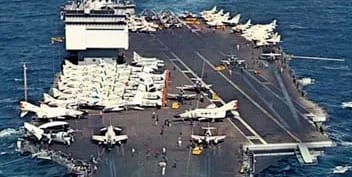
(September 24, 1960): Launch of the world’s first nuclear-powered aircraft carrier
The United States launched the world’s first nuclear-powered aircraft carrier, the USS Enterprise (CVN-65). Commissioned in 1961, Enterprise represented a breakthrough in naval technology, able to sail for over 20 years without refuelling. Nicknamed the “Big E,” it served for more than half a century, from the Cuban Missile Crisis to operations in the Middle East, becoming one of the most storied warships in U.S. history.