- Basedment
- Posts
- Trump's Gaza Peace Plan: The Reality
Trump's Gaza Peace Plan: The Reality
Your daily dose of geopolitical updates and strategic analysis. Unbiased, but not unbased.

Editor-in-Chief
September 30, 2025
THE BRIEFING
Here’s what’s happening in geopolitics today.
Overnight, we saw a mix of political standoffs, high-stakes diplomacy, and regional security challenges making headlines.
From Washington’s budget battles to a Gaza peace framework, fresh U.S. immigration moves, and renewed instability in Pakistan, the news cycle has been anything but quiet.
Trump’s Gaza peace plan has finally been unveiled, and we’re breaking down each point to see what it really means — on paper, in practice, and for the region’s future.
THE LAST 24 HOURS IN GEOPOLITICS
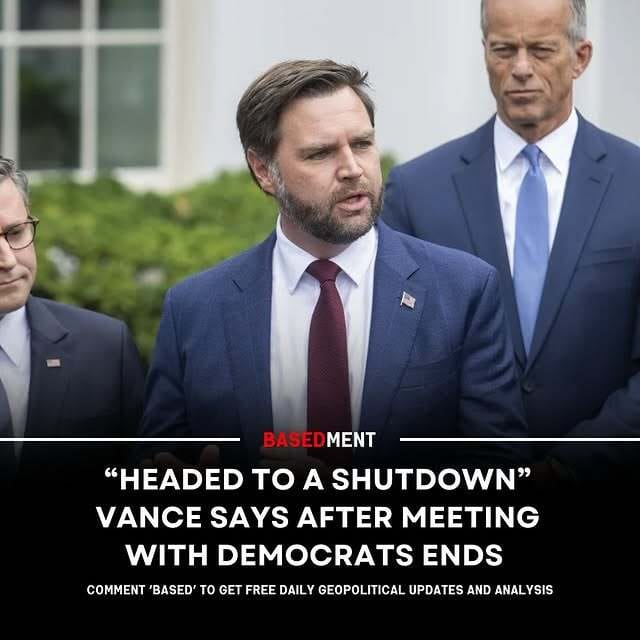
1. Vance says U.S. ‘headed to a shutdown’ after meeting with Democrats
After a high-stakes meeting with Democratic congressional leaders, Vice President J.D. Vance warned that the U.S. is “headed to a shutdown” if funding legislation isn’t passed in time. The impasse hinges partly on Democratic demands to include healthcare funding extensions alongside budget bills, a move Republicans oppose. With the deadline fast approaching, both sides are posturing for blame should federal services be disrupted.
read more


2. Netanyahu agrees to Trump plan for Gaza deal
Netanyahu publicly backed President Trump’s 20-point proposal to end the Gaza war, stating it aligns with Israel’s goals of rescuing hostages, dismantling Hamas’s military infrastructure, and ensuring the territory poses no future security threat. However, he added key conditions which critics say reveal lingering reservations. With Hamas not yet on board, the endorsement raises questions about how enforceable the plan will be and how much will depend on diplomatic pressure and military leverage.
read more
3. U.S. to deport hundreds of Iranians after deal with Tehran
The U.S. is reportedly preparing to deport as many as 400 Iranians, most of whom allegedly entered the country illegally, as part of President Trump’s tougher immigration enforcement push. Iranian officials, citing state TV, said about 120 detainees have already been identified for return flights, many of whom crossed the U.S.–Mexico border. The decision has received mixed reaction: Tehran has denounced the move as unjustified, even as U.S. authorities remain cautious about revealing logistics or timing.
read more
4. Suicide blast targeting Pakistan paramilitary kills 10
A suicide bomber struck outside a paramilitary headquarters in Quetta, killing at least 10 people and wounding dozens more, according to officials. The attack was followed by gunmen storming the building, triggering a firefight during which security forces reportedly killed four of the assailants. The incident underscores continuing volatility in Pakistan’s Balochistan province, where militants regularly target security installations and civilians alike.
read more
5. Japan and South Korea leaders commit to closer ties in their final summit
South Korean President Lee Jae Myung and outgoing Japanese Prime Minister Shigeru Ishiba met in Busan and agreed on the need for Seoul and Tokyo to act in concert given today’s unstable global trade and geopolitical environment. Their statement, released via the South Korean presidential office, emphasised deeper cooperation as both nations face economic headwinds and shifting alliances. The meeting also comes as South Korea and Japan explore common ground on U.S. trade negotiations and regional security issues.
read more
DAILY DEEP DIVE
THE GAZA PEACE PLAN: ON PAPER, AND IN SPEECH
Points 1–5: Ceasefire, Hostages, and Prisoner Exchange
The first five points are designed as a quick stabiliser. By freezing battle lines and demanding hostages be released within 72 hours, Trump front loads the humanitarian and emotional dimensions of the conflict. For Israel, this reassures the public that its citizens come first, while for Palestinians, the large prisoner release gives a symbolic win that restores some dignity. Yet the mechanics are fragile. The compressed timeline and fragmented Hamas command structure make compliance uncertain, and any delay risks derailing the entire framework. Politically, though, this opening sequence reframes the war not as a grinding stalemate but as a solvable humanitarian crisis where each side can claim a moral victory.
Points 6–10: Amnesty, Governance, and Economic Framework
The next cluster turns the ceasefire into a transition plan. Amnesty for Hamas fighters who disarm borrows from global demobilisation precedents but carries legitimacy risks if viewed as absolution for past violence. The humanitarian aid surge offers a lifeline to civilians and signals seriousness to outside donors. The real gamble is governance: by sidelining both Hamas and the unreformed Palestinian Authority in favour of a technocratic committee overseen by Trump’s “Board of Peace,” the plan seeks efficiency and foreign investor confidence but risks being perceived as an imposed trusteeship. Coupled with the economic vision of “miracle city” redevelopment, this batch reframes Gaza as a future hub of opportunity, but at the cost of alienating existing Palestinian political actors.
Points 11–15: Economic Zone, Demilitarisation, and Security Force
Here Trump sets out the backbone of his strategy: money and security. A Special Economic Zone would tie Gaza’s survival to regional partners like Egypt and the Gulf, while the pledge of free movement counters accusations of forced displacement. Full demilitarisation under international supervision, backed by a weapons buyback program, aims to neutralise Hamas militarily without looking like outright capitulation. The plan also calls for Arab states to underwrite compliance and, most radically, deploy an International Stabilisation Force (ISF) alongside vetted Palestinian police. If implemented, this internationalises Gaza’s security burden and gives Israel a way to step back without feeling exposed. But Arab states have historically avoided direct policing of Gaza, and without their buy-in, this section of the plan collapses.
Points 16–20: Withdrawal, Partial Rollout, Dialogue, and Statehood Horizon
The final batch outlines the long-term horizon. Israel is assured it will not be forced into annexation, instead withdrawing gradually as the ISF assumes control. If Hamas rejects the deal, aid and redevelopment still move forward in IDF-secured areas, preventing paralysis. An interfaith dialogue process is added to shift narratives, though this is more symbolic than structural. Most crucially, the plan gestures toward Palestinian statehood, tying it to successful PA reform and redevelopment benchmarks. This creates the language of a political horizon without locking in timelines, leaving flexibility for Israel and the U.S. but uncertainty for Palestinians. The risk is that without clear benchmarks, this could look like yet another deferred promise, but if coupled with real aid and governance reforms, it could serve as the first credible bridge back to negotiations.
One Thing on Paper, Another in Speech
There are many positives to this plan, but we have to ask how much substance lies behind them. Firstly, there are a lot of different actors involved. Internally, you have Hamas and the PA; externally, Israel, Egypt, other Arab states, the United States — and even figures like Tony Blair. That means a complex mix of interests, often conflicting.
The reality is that this plan places the ball firmly in Hamas’ court. Aid, reconstruction, and stability are all being dangled in front of the Palestinian people, who have endured the utmost brutalities of war, and it is all contingent on Hamas agreeing to bring it to an end.
Most importantly, we have to read between the lines of what Netanyahu said after his fourth meeting with President Trump this year. When Netanyahu speaks in English, it is aimed at the diaspora and the international audience. But when he speaks in Hebrew, it is often more blunt, partisan, and direct — as we have just heard.
Here are the key excerpts from his speech (we have linked the full video below):
Netanyahu:
“Instead of Hamas isolating us, we isolated Hamas. Now the entire world, including the Arab and Muslim world, is pressuring Hamas to accept the terms... to release all our hostages... while the IDF remains in most of the Strip.”
“Who would have believed this? After all, people said: ‘You must accept Hamas’ terms, get everyone out, the IDF should withdraw, Hamas can recover, it can rehabilitate the Strip.’ No way that’s happening.”
“On the contrary, he (Trump) will give full backing for the military to eliminate them… that’s why I think it was an excellent visit.”
Reporter/Aide: “President, did you agree to a Palestinian state?”
Netanyahu: “Absolutely not. It is not written in the agreement – but there is something we did say: that we would strongly oppose a Palestinian state, and Trump also said it.”
This short exchange clarifies the ambiguities left open in the written peace plan. Israel’s goal is to politically strangle Hamas; if Hamas refuses the terms, it effectively green lights an operation to occupy the remainder of Gaza. And perhaps most crucially, both Israel and the United States are making it clear: they oppose the establishment of a Palestinian state.
"Instead of Hamas isolating us, we isolated Hamas. Now the entire world, including the Arab and Muslim world, is pressuring Hamas to accept the terms... to release all our hostages... while the IDF remains in most of the Strip"
That was fast: Netanyahu reveals his own bluff. He
— B.M. (@ireallyhateyou)
1:06 AM • Sep 30, 2025
Sources:
Sources available upon request, not shown to maintain visual integrity of page.
Link to all peace points: https://www.bbc.com/news/articles/c70155nked7o
TWEET OF THE DAY
Meme game = strong
Lookin' at you, Democrats… don’t let your love for illegal aliens hurt American citizens.
— The White House (@WhiteHouse)
12:56 AM • Sep 30, 2025
TODAY IN HISTORY
(September 30, 1938): The Munich Agreement
On this day in 1938, Britain, France, Italy and Germany signed the Munich Agreement. Prime Minister Neville Chamberlain believed that by conceding to Adolf Hitler’s demands over Czechoslovakia’s Sudetenland, war could be avoided. Instead, the deal became infamous as a symbol of appeasement, paving the way for further Nazi aggression and, ultimately, the outbreak of the Second World War less than a year later.