- Basedment
- Posts
- Trump's "Yes-Men" Will Have Catastrophic Effects...
Trump's "Yes-Men" Will Have Catastrophic Effects...
Today we discuss the latest in Iran, primarily focussing on the recent F-15E loss and how it reflects the wider issues within the administration.

Editor-in-Chief
April 05, 2026
THE BRIEFING
Here’s what’s happening in geopolitics today.
A volatile mix to start the day: two U.S. warplanes down over Iran with a search mission underway, Tehran pressing ahead with executions, and cautious signs of movement in the Strait of Hormuz as select vessels make it through.
Beyond the Middle East, Cuba begins a major prisoner release as U.S. pressure eases, while a deadly Russian strike on a Ukrainian market underscores the ongoing toll of the war.
Today we discuss the latest in Iran, primarily focussing on the recent F-15E loss and how it reflects the wider issues within the administration.
SUPPORT OUR PODCAST!
We just released our first duo-pod, this is a great one to crack open a beer to — more of a relaxed vibe and just a chat about what’s going on in the world.
In the podcast we discussed: Iran, Russia-Ukraine, the potential ground invasion and whether Bibi is alive or not!
Click Here To Listen (And Sub!) - Youtube
We’re Also on Spotify CHA
THE LAST 24 HOURS IN GEOPOLITICS
1. Two US warplanes shot down, search ongoing in Iran for 1 missing crew member
Two U.S. warplanes were shot down during combat operations over Iran, marking a significant escalation in the ongoing conflict. One crew member from the downed F-15E Strike Eagle has been rescued, while another remains missing, triggering an active and high-risk search-and-rescue operation inside Iranian territory. The incidents underscore the continued threat to U.S. air operations despite earlier claims of air superiority.
read more
2. Iran executes two linked to opposition group, media says
Iran has executed two men accused of links to the opposition group the People’s Mojahedin Organisation of Iran, according to state media reports. The men were convicted of involvement in armed attacks, with authorities presenting the executions as part of ongoing security enforcement. The move is the latest in a series of executions targeting alleged opposition members, underscoring Tehran’s continued crackdown on dissent amid the broader conflict.
read more
3. Omani, French and Japanese vessels transit the Strait of Hormuz
Several vessels from Oman, France and Japan have successfully transited the Strait of Hormuz, marking a notable development after weeks of severe disruption caused by the ongoing Iran conflict. The ships (including three Omani-linked tankers, a French-owned container vessel and a Japanese gas carrier) were able to pass as Iran appears to be selectively allowing transit for countries it views as neutral or non-hostile. The crossings are being closely watched as a potential sign of easing tensions in the vital waterway.
read more
4. Cuba begins to free more than 2,000 prisoners as US eases fuel blockade
Cuba has begun releasing more than 2,000 prisoners in one of its largest amnesties in years, describing the move as a “humanitarian and sovereign gesture.” The releases come as the United States eases aspects of its fuel blockade, which had severely restricted oil supplies and contributed to widespread energy shortages on the island. The timing has raised questions about a potential link to ongoing diplomatic talks, though uncertainty remains over whether political prisoners are included in the release.
read more
5. Five killed by Russian strike on market in frontline Ukrainian City
A Russian drone strike hit a busy market in the frontline Ukrainian city of Nikopol, killing at least five civilians and injuring 19 others, according to Ukrainian officials. Authorities said the attack occurred during the morning in a populated area, with victims including both men and women, and emergency services responding to the scene. Nikopol, located near Russian-occupied territory across the Dnipro River, has been a frequent target of strikes, highlighting the continued toll of the war on civilian areas.
read more
GLOBAL CONFLICT TRACKER
Iran-USA-Israel
As the old saying goes, “never assume, as you make an ass out of you and me.”
I thought of this as soon as I saw the news of the downed F-15E. Not long ago, President Donald Trump was bragging about completely destroying Iranian air defences in the region. Not only was this clearly not true, but it pointed to a much larger issue within this administration. There is an evident disconnect from reality playing out. Trump continues to surround himself with “yes-men,” and at the same time this war plan appears to be held together by duct tape at best.
I have repeatedly warned that the terms “air superiority” and “air supremacy” are thrown around far too loosely. Iran is an extremely large country, and given its terrain and extensive underground infrastructure, achieving total air supremacy would be incredibly difficult. The alliance likely maintains air superiority over certain parts of western and southern Iran, but nothing approaches true supremacy. This is likely because those around him are not telling him the truth. It really is that simple, and it is a common problem historically in politics. Based on insider reporting, the atmosphere in the White House is one where Trump is told what he wants to hear, not what he needs to hear. That dynamic can have catastrophic consequences.
Now, because the President publicly claimed Iranian air defences had been completely destroyed, and they clearly were not, he is forced to double down in order to maintain credibility. It resembles a sunk cost fallacy, but applied to narrative and perception. This only leads to increasingly risky decision-making and a gradual erosion of rationality.
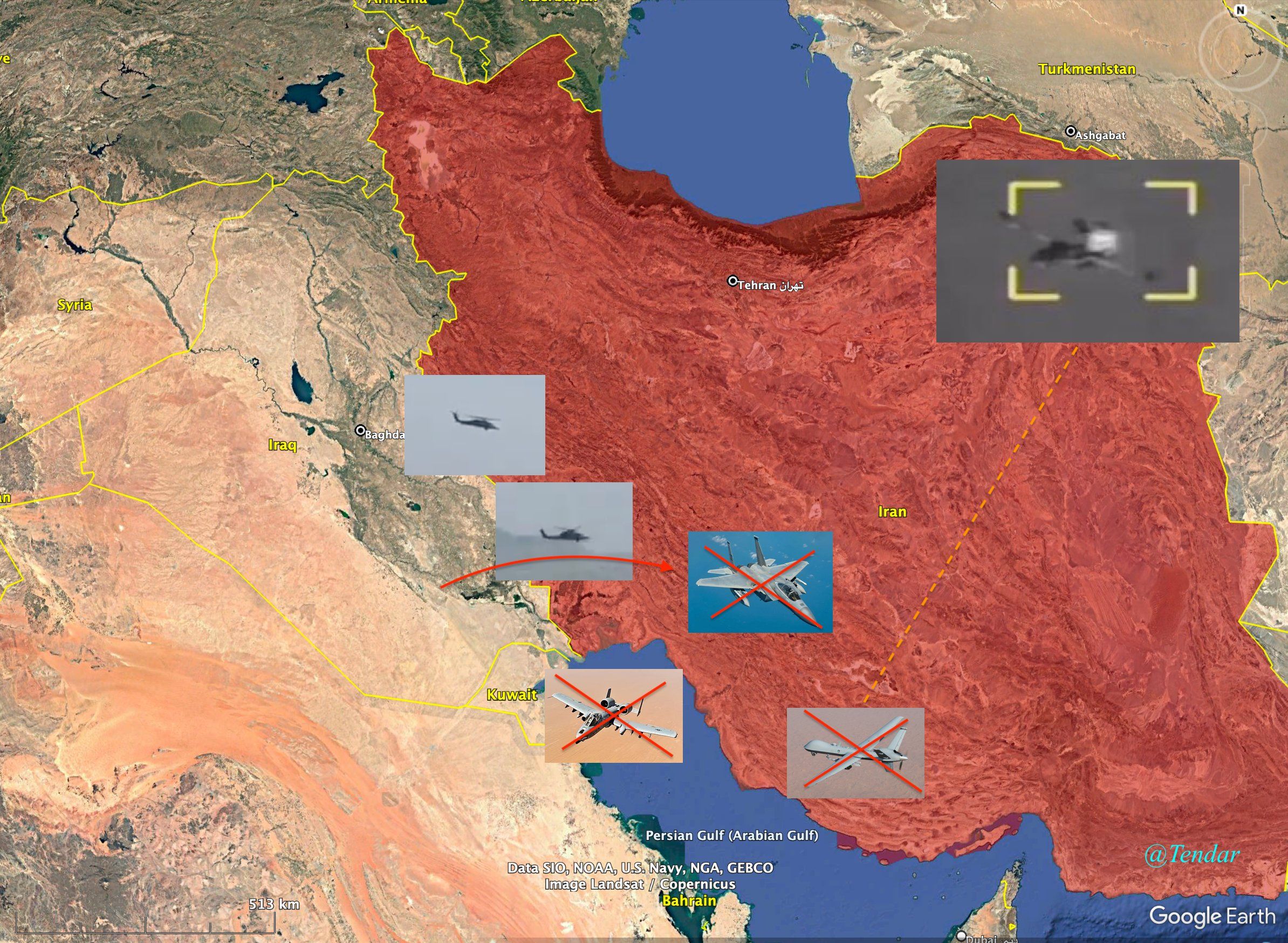
We saw this play out immediately following the F-15E incident. An F-15E Strike Eagle has reportedly been shot down, with one pilot rescued and the WSO still missing. This follows a USAF A-10 crash in the Persian Gulf, with the pilot recovered, and a Black Hawk helicopter being hit during a SAR operation for the F-15E. The crew survived but were injured. Like I said from day one, this conflict should not be assessed purely through material metrics on the American side. The U.S. operates under a far lower tolerance for losses, particularly in an already unpopular war. Every incident, whether a single aircraft or personnel loss, carries disproportionate political weight, compounding scrutiny on the administration. By contrast, Iran’s strategic posture allows it to absorb significantly higher losses with far less immediate domestic political fallout.
This scrutiny, combined with the American media machine and the reality-TV style drama of this administration, converges into a corporatised political pressure cycle bearing down on Trump. We are already seeing signs of strain, with reports of senior officials and figures such as Pam Bondi being sidelined, and growing speculation around Pete Hegseth struggling to maintain his position.
Trump, meanwhile, has warned the U.S. has “not even started destroying what’s left in Iran,” signalling potential strikes on bridges and power infrastructure next, threats that international legal experts have already flagged as possible war crimes. This brings us to a broader dilemma: how much further can escalation go before it either backfires or loses strategic value. This somewhat reminds me of Putin’s red line paradox. The red line was repeatedly shifted, from Javelins to Abrams to F-16s, yet once crossed, no decisive response followed. The reason is simple. Beyond a certain threshold, the only remaining step is nuclear escalation, and that remains off the table.
Day 35. No end in sight.
Other Notable Mentions
On the strike front, U.S. and Israeli attacks hit two petrochemical plants in Iran's southern Khuzestan province, and one person was killed in a separate strike on the Bushehr nuclear site. Iran hit back hard. The UAE bore the brunt of today's Iranian retaliation, responding to 23 ballistic missiles and 56 drones.
An Iranian missile carrying a cluster bomb warhead struck central Israel's Ramat Gan area, lightly wounding a 52-year-old man.
Iran has been digging out underground missile sites struck by U.S. and Israeli strikes, restoring them to operation within hours, according to intelligence reports cited by The New York Times. Israeli media also reports that some tunnel entrances can be bulldozed open in under 12 hours, highlighting the resilience of Iran’s underground network. (NYT Sources)
Sources available upon request
TODAY IN HISTORY
(April 4, 1968): Martin Luther King, Jr., is assassinated
On this day in 1968, Martin Luther King, Jr. was assassinated in Memphis, Tennessee, where he was supporting striking sanitation workers. While in Memphis, he delivered his famous Mountaintop Speech, in which he invoked the strike as one of many fights for freedom and economic justice for all, regardless of race. The next day, the civil rights leader was shot and killed while he stood on his hotel balcony. Many responded to news of King's murder with anguish and fury, and over the next several days riots and violence broke out in multiple American cities.