- Basedment
- Posts
- Trumps "Board Of Peace" Is a Influence-Mapping Tool
Trumps "Board Of Peace" Is a Influence-Mapping Tool
By looking at a map, we gain a better understanding of the purpose for the Board of Peace in a wider geopolitical lens, as well as giving context to this new board.

Editor-in-Chief
January 22, 2026
In partnership with

THE BRIEFING
Here’s what’s happening in geopolitics today.
From Greenland diplomacy softening in Davos to NATO still trying to square the circle on the Arctic, today’s headlines are heavy on alliance politics and quiet negotiations.
We’re also watching Hong Kong reopen old wounds with a landmark national security trial, fresh strains in Syria’s fragile ceasefire talks, and ASEAN’s latest attempt to pull Myanmar’s warring sides back to the table.
In today’s deep dive, we’re analysing what the Board of Peace really means and how it might shape geopolitics.
A WORD FROM OUR SPONSOR
Practical AI for Business Leaders

The AI Report is the #1 daily read for professionals who want to lead with AI, not get left behind.
You’ll get clear, jargon-free insights you can apply across your business—without needing to be technical.
400,000+ leaders are already subscribed.
👉 Join now and work smarter with AI.
THE LAST 24 HOURS IN GEOPOLITICS
1. Trump walks back Greenland tariffs threat, citing vague ‘deal’ over territory
Trump has backed away from his recent threat to impose tariffs on several European allies over their opposition to his push on Greenland, saying he will not go forward with the scheduled trade penalties after announcing what he described as a “framework of a future deal” regarding Greenland and the broader Arctic region. Trump made the announcement from the World Economic Forum in Davos, saying the tentative framework emerged from a “very productive” meeting with NATO Secretary-General Mark Rutte, though he provided few details on the substance of the agreement.
read more
2. NATO Chief says ‘still a lot of work to be done’ on Greenland
NATO Secretary General Mark Rutte said on the sidelines of the World Economic Forum in Davos that while talks with the United States on Greenland have been positive, “there is still a lot of work to be done” to reach a clear agreement on the issue. Rutte emphasised that the dispute over U.S. ambitions for the Arctic island requires careful and “thoughtful diplomacy” and that he is working behind the scenes to broker progress. He also stressed that any resolution must respect alliance unity and that NATO’s broader security priorities, including support for Ukraine, remain paramount even as members navigate disagreements over Greenland’s future.
read more
3. Hong Kong begins national security trial for organisers of Tiananmen vigils
Hong Kong’s High Court has opened a high-profile national security trial against three former leaders of the now-disbanded Hong Kong Alliance in Support of Patriotic Democratic Movements of China, who organised annual vigils commemorating the 1989 Tiananmen Square crackdown before they were banned. Chow Hang-tung, Lee Cheuk-yan and Albert Ho are charged under the 2020 national security law with “inciting subversion of state power,” facing potential prison sentences of up to 10 years; Chow and Lee pleaded not guilty while Ho has entered a guilty plea.
read more
4. Syria accuses Kurds of breaking truce in threat to chances of deal
The Syrian government has accused the Kurdish-led Syrian Democratic Forces (SDF) of breaking a fragile four-day ceasefire after a drone strike killed seven Syrian soldiers, an incident Damascus says jeopardises a proposed deal to integrate Kurdish forces into the central state. The SDF denied it carried out the strike, saying the explosion occurred while Syrian troops were moving explosives, and also accused government forces of violating the truce in multiple areas.
read more
5. Philippines hosts Myanmar political, ethnic groups for ‘stakeholder meeting’
The Philippines, as chair of ASEAN for 2026, hosted a “stakeholders’ meeting” that brought together various political and ethnic groups from army-ruled Myanmar in an effort to reinvigorate the bloc’s stalled peace initiative. Philippine Foreign Affairs Secretary Maria Theresa Lazaro, serving as ASEAN’s special envoy on the Myanmar crisis, encouraged participants to share perspectives on implementing the ASEAN Five-Point Consensus, which aims to de-escalate violence, facilitate humanitarian aid, combat transnational crime and promote political dialogue. The dialogue comes against the backdrop of Myanmar’s ongoing civil conflict since the 2021 military coup and a military-run election that has drawn broad criticism for low turnout and questions over legitimacy, with ASEAN having previously declined to send official observers.
read more
DAILY DEEP DIVE
The Board Of Peace Is Trump’s Personal Influence-Mapping Tool
The Trump administration’s proposed Board of Peace has evolved well beyond its original mandate, raising concerns among Western allies about intent, structure, and long-term implications for global governance.
Initially floated in mid-2025 as part of a second phase of the U.S.-brokered Gaza ceasefire, the concept received international legitimacy in November when the United Nations Security Council endorsed a resolution referencing a temporary oversight mechanism for Gaza’s demilitarization and reconstruction. That endorsement was narrowly framed around the Gaza conflict.
However, the charter draft later circulated by Washington significantly expanded the scope. The Board is now described as a permanent international body tasked with conflict resolution, governance support, and stabilization worldwide. Gaza is barely mentioned. Instead, the document outlines a Trump-chaired structure with broad authority, including agenda control, member selection, and the power to issue resolutions independently.
Membership is divided into renewable three-year terms, with the option to purchase permanent seats for a reported $1 billion. While U.S. officials say funds would be directed toward Gaza reconstruction, critics argue the model resembles a pay-to-play system vulnerable to political leverage and corruption.
Participation patterns reflect geopolitical alignment. Several Middle Eastern states — including Saudi Arabia, the UAE, Egypt, Qatar, and Bahrain — have accepted invitations, alongside Turkey, Pakistan, Hungary, Israel, Belarus, and select Central Asian and Southeast Asian states. Armenia and Azerbaijan have also joined following a separate U.S.-brokered agreement.
By contrast, France, Norway, Ukraine, and others have declined or expressed reservations, citing concerns about undermining the UN system and legitimizing Russia’s role amid the war in Ukraine. China confirmed it was invited but has not committed, reiterating support for a UN-centric international order.
Taken together, the Board of Peace appears less a narrow post-conflict mechanism and more an attempt to construct a parallel diplomatic platform centered on U.S. presidential authority. Whether it functions as a genuine conflict-resolution tool or remains a symbolic leverage instrument will depend on participation, funding transparency, and its interaction with existing international institutions.
When In Doubt, Take a Look At A Map
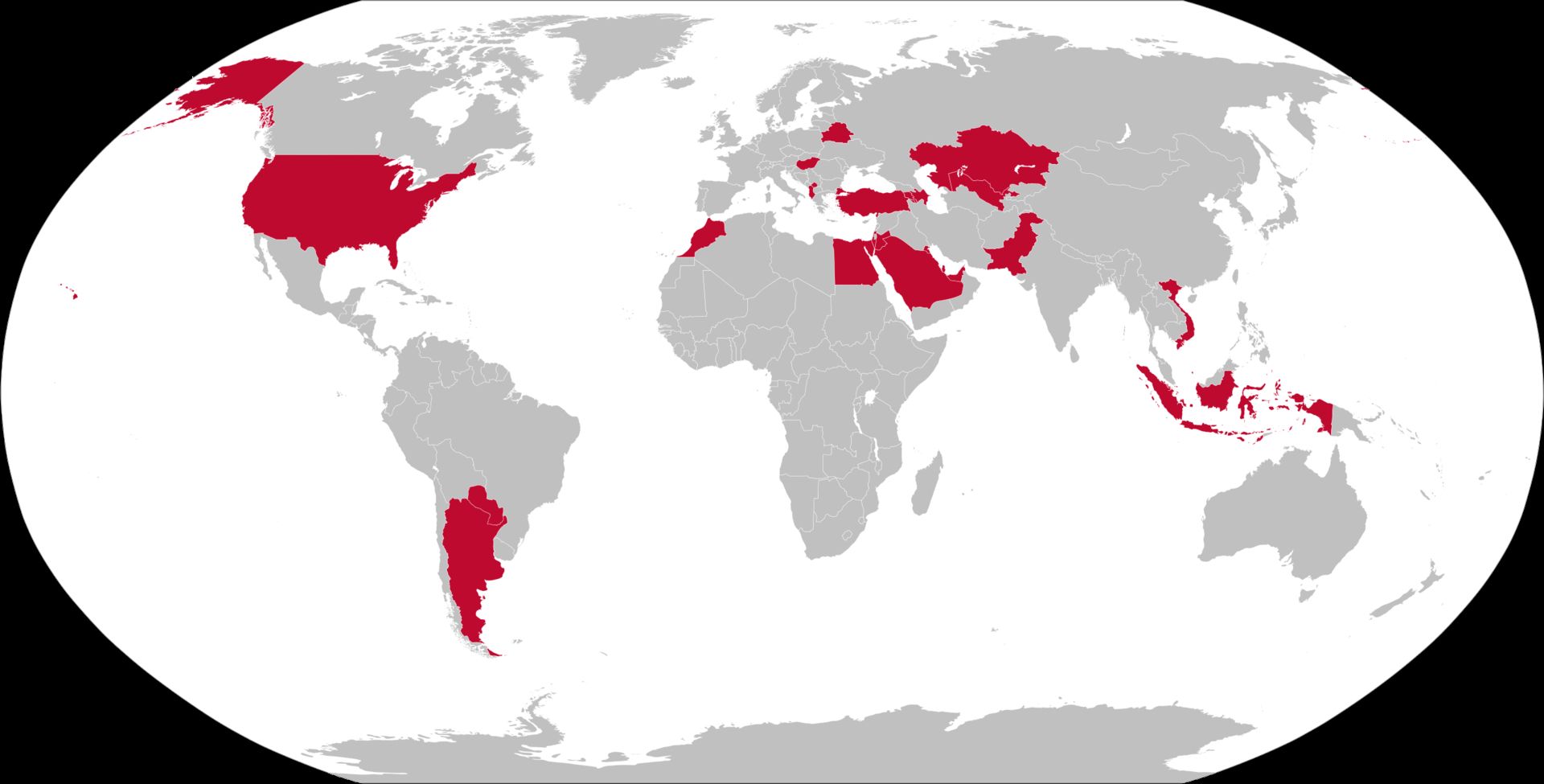
Source: Board Of Peace, Wikipedia
Sometimes a map tells the story more clearly. What stands out in the composition of Trump’s “Board of Peace” is that the countries invited — and those that have accepted — are not random participants. They are either leaders the President has strong personal rapport with, or states that sit astride critical geopolitical terrain: trade routes, energy corridors, conflict zones, and buffer regions bordering major powers such as Russia, China, and Iran. This is not accidental.
Rather than operating through multilateral institutions, the Trump administration prefers influence that is direct, leader-centric, and transactional. The Board provides Trump with a personal channel into multiple regions at once, allowing him to shape outcomes through relationships rather than rules. In effect, it offers a way to project U.S. influence without relying on institutions like the UN or EU, where leverage is diluted and consensus is slow.
Equally telling is the type of states involved. Countries such as Egypt, Pakistan, Belarus, Vietnam, Indonesia, and Morocco have long occupied the middle ground of the so-called “rules-based order.” These are states that hedge between great powers, prioritise sovereignty and regime stability, and are comfortable navigating competing patrons. They often chafe under Western conditionality but respond well to pragmatic, low-ideology engagement. There are also some that have been historically ostracised in global institutions such as the U.N.
Viewed this way, the Board of Peace looks less like a peacekeeping mechanism and more like an influence-mapping tool — one that consolidates U.S. access to key swing states across several continents, centred not on institutions, but on the presidency itself.
My main critic of it, is really just how much could get done? There are regional rivals that will sit beside each other on this board. Much how BRICS on the surface looks powerful, but is plagued by a multitude of internal disputes. However, at the moment, the range of members are spread are out with major clash points most likely not being as large an issue internally as it would in BRICS.
Sources
News/Journal sources available upon request, not shown to maintain visual integrity of page.
TODAY IN HISTORY
(January 22, 1984): Apple releases its famous “1984” ad
On this day in 1984, Apple Computer aired an ominous new commercial during Super Bowl XVIII. The 60-second ad, which was directed by Ridley Scott and drew inspiration from George Orwell's dystopian novel Nineteen Eighty-four, was Apple's promise that its new computer would help consumers avoid a dark age of technology.