- Basedment
- Posts
- U.S. Military Assets Continue To Move Into Position Around Iran
U.S. Military Assets Continue To Move Into Position Around Iran
Today we provide an update on what is going on in the Middle East, from new U.S. military movements to them agreeing to Iranian ‘Red Lines’ on enrichment.

Editor-in-Chief
February 23, 2026
THE BRIEFING
Here’s what’s happening in geopolitics today.
From Latin America to South Asia, today’s headlines capture a wide sweep of geopolitical shifts: Cuban security advisers are beginning to pull out of Venezuela under mounting U.S. pressure, while Donald Trump unveiled a rise in global tariffs to 15 % after a setback at the U.S. Supreme Court.
Militant activity continues to unsettle the Middle East with Islamic State declaring a “new phase” of attacks, and Pakistan’s military struck targets across the Afghan border, highlighting regional instability. Meanwhile, Pope Francis reiterated that peace in Ukraine “cannot be postponed.”
In today’s deep dive, we provide an update on what is going on in the Middle East, from new U.S. military movements to them agreeing to Iranian ‘Red Lines’ on enrichment.
THE LAST 24 HOURS IN GEOPOLITICS
1. Cuban security forces exit Venezuela as U.S. pressure mounts
Cuban security advisers, medical personnel and other officials have begun withdrawing from Venezuela amid mounting U.S. pressure on Interim President Delcy Rodríguez to unwind the long-standing Caracas-Havana alliance that underpinned the Chavista regime’s security apparatus. Unlike his predecessors Hugo Chávez and Nicolás Maduro, who relied heavily on Cuban elite forces and intelligence embedded in Venezuela’s counterintelligence services, Rodríguez has shifted to Venezuelan bodyguards and removed some Cubans from key posts.
read more
2. Trump to raise U.S. global tariff from 10 to 15% after Supreme Court ruling
Trump announced that he will raise the temporary global U.S. tariff rate from 10 % to 15 % on imports from all countries, a move he described as legally permissible following a U.S. Supreme Court ruling that struck down his broader tariff programme under emergency powers. The tariff increase, grounded in Section 122 of the Trade Act of 1974, represents the highest level allowed under that statute and is set to apply immediately, but the tariffs automatically expire after 150 days unless Congress extends them. Trump framed the hike as a response to what he called an “anti-American” court decision.
read more
3. Islamic State claims two attacks in Syria and declares “new phase”
The Islamic State militant group has claimed responsibility for two attacks on Syrian army personnel in Deir al-Zor and Raqqa, saying the actions mark the start of what it describes as a “new phase” of operations directed at Syria’s leadership. In its statement via the group’s Dabiq news outlet, IS said one attack used a pistol and another involved machine gun fire against regime forces, while Syria’s Defence Ministry reported a soldier and a civilian were killed. The claims reflect a broader escalation by IS against the transitional Syrian government under President Ahmed al-Sharaa.
read more
4. Pakistan carries out strikes in Afghanistan, ‘killing and wounding dozens’
Pakistan’s military carried out air strikes inside eastern Afghanistan, hitting what Islamabad described as militant hideouts along the border, including camps belonging to the Tehreek-e-Taliban Pakistan (TTP) and an affiliate of the Islamic State after a recent surge in deadly attacks inside Pakistan. Afghan officials accused the strikes of targeting civilian areas in Nangarhar and Paktika provinces, saying the bombardment killed and wounded dozens of people, including women and children, and called the action a violation of Afghan sovereignty. Islamabad has defended the operation as “intelligence-based” and aimed at those it blames for cross-border attacks.
read more
5. Pope says peace in Ukraine ‘cannot be postponed’
Pope Leo XIV made a renewed appeal for an end to the war in Ukraine, saying peace “cannot be postponed” as the conflict enters its fourth year and urging an immediate ceasefire and strengthened dialogue between the parties. Speaking during his weekly address at St. Peter’s Square, he lamented the immense human toll of the war and called on the international community to translate peace aspirations into responsible decisions.
read more
DAILY DEEP DIVE
The World Holds It’s Breath As U.S. Continues To Bring In More Assets
Wider Context
In the last 24 hours, there has been a noticeable shift according to OSINT analysts. The United States is no longer just reinforcing the region — it is obscuring its movements. Daily public tracking tables have reportedly stopped. Multiple aircraft are now flying with transponders switched off. Identification in several cases is no longer possible.
The most visible adjustment is tanker redistribution. At Al Udeid in Qatar, KC-135 numbers reportedly dropped from 20 to 7. Meanwhile, Prince Sultan Air Base in Saudi Arabia jumped from 2 to 14 tankers. That is not a drawdown. That is repositioning away from Iran’s immediate missile envelope. Tehran has previously demonstrated it can strike Qatar after Operation Midnight Hammer.
To add onto this, the U.S., Israel and Iran have without a doubt been evaluating and studying the events of 2025. For example, as we said above satellite imagery is showing a reduction of aircraft in Qatar, and an increase In Saudi bases. Why? Well we know now the capability Iran has in regard to strikes on bases sitting on the Hormuz Strait. By shifting further back, U.S. military assets are under the cover over a layered air defence system and therefore less exposed. This could explain the significant amount of aerial tankers sent over, utilising them as a way to mitigate the issue of being further from Iran.
Fighter deployments remain substantial. At least 48 F-16C/CJs, 30 F-35As, 36 F-15Es, 6 EA-18G Growlers, and 12 A-10Cs are confirmed in-theater. Twelve additional F-22 Raptors are expected from RAF Lakenheath. Carrier air wings from USS Abraham Lincoln and the incoming USS Gerald R. Ford are not included in these figures. Combined, they could add roughly 100 more aircraft.
Electronic warfare, ISR and command platforms are also in place: EA-18Gs in Jordan, RC-135 Rivet Joint aircraft in Crete, E-3G AWACS and E-11A BACN at Prince Sultan, and MQ-4C Triton drones redeploying from Al Dhafra. Airlift continues uninterrupted. More than nine C-17 Globemasters reportedly moved in recent hours, likely carrying munitions and air defence components.
In total, over 240 U.S. strike aircraft are positioned across the region. The real number may be closer to 300.
On the negotiating side there has also been movement.
According to a diplomat cited by Iran’s semi-official ISNA outlet, recent U.S.–Iran talks in Geneva did not include demands for “zero enrichment.” Instead, negotiations are reportedly focused on the technical parameters of Iran’s nuclear program — specifically the location of facilities, the enrichment level permitted, and the number of operating centrifuges.
The idea of a regional enrichment consortium or relocating Iran’s nuclear material abroad is not currently on the table. Tehran has rejected both concepts.
Iranian Foreign Minister Abbas Araghchi echoed this framing, stating that Washington is seeking a “fast deal” rather than total dismantlement. Both sides described the Oman-mediated discussions as constructive, with a general understanding emerging that could move toward drafting a formal agreement.
The talks unfold as President Trump signals a possible limited strike if negotiations fail, setting up a narrow window for diplomacy before escalation.
Is this entire diplomatic route at this point a large charade being played both sides given we have the largest military build up since 2003 casually lined up outside of Iran’s front door?
Sources
News/Journal sources available upon request, not shown to maintain visual integrity of page.
TODAY IN HISTORY
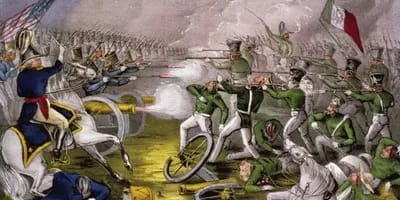
(February 22, 1847): U.S. General Zachary Taylor led troops against a Mexican force commanded by General Antonio López de Santa Anna at the Battle of Buena Vista during the Mexican-American War. Taylor's victories in the war made him a popular figure and helped him win the U.S. presidency in 1848.