- Basedment
- Posts
- U.S. Oil Blockade on Cuba And Do Sanctions Work?
U.S. Oil Blockade on Cuba And Do Sanctions Work?
Today we examine the growing economic blockade around Cuba and ask the question do sanctions work as a form of removing rival leaders?

Editor-in-Chief
February 09, 2026
THE BRIEFING
Here’s what’s happening in geopolitics today.
From a U.S. aircraft carrier cruising near Iran to ballot boxes opening across Thailand, today’s stories span hard power, trade deals and shifting political landscapes.
We’re tracking Washington’s military signalling in the Middle East, fresh economic courtships in Southeast Asia, a high-stakes Thai election, Trump’s personal diplomacy with Honduras, and a projected landslide win for Japan’s prime minister.
In today’s deep dive, we examine the growing economic blockade around Cuba and ask the question do sanctions work as a form of removing rival leaders?
THE LAST 24 HOURS IN GEOPOLITICS
1. Kushner, Witkoff visit USS Abraham Lincoln carrier amid tension with Iran
Steve Witkoff and Jared Kushner visited the aircraft carrier USS Abraham Lincoln in the Arabian Sea this weekend as part of a continued U.S. military presence near Iran following indirect nuclear talks in Oman. The visit, at the invitation of U.S. Central Command commander Admiral Brad Cooper, was intended to show appreciation for American service members and underscore U.S. readiness amid heightened tensions with Tehran.
read more
2. India, Malaysia renew pledges to boost trade and collaboration
India and Malaysia have reaffirmed their commitment to deepening bilateral trade and strategic collaboration during Indian Prime Minister Narendra Modi’s official visit to Kuala Lumpur, with both leaders emphasising that their Comprehensive Strategic Partnership continues to gain momentum. Modi highlighted that India is increasingly seen globally as a “trusted partner for growth,” pointing to expanding cooperation in sectors such as semiconductors, the digital economy, energy, and tourism, and the planned rollout of India’s UPI payments system in Malaysia. The two governments oversaw the signing of 11 cooperation agreements and expressed optimism that trade will continue to grow.
read more
3. Polls open in Thailand as reformists, conservatives vie for power
Polls opened in Thailand on Sunday for a closely watched general election, with more than 50 parties contesting but only three (the reformist People’s Party, conservative Bhumjaithai and populist Pheu Thai) seen as viable contenders to form a government. Voters are choosing all 500 seats in the House of Representatives amid economic stagnation, nationalist sentiment and recent border clashes with Cambodia, with no single party expected to win an outright majority. The progressive People’s Party, led by Natthaphong Ruengpanyawut, is widely viewed as the frontrunner in opinion polls, campaigning on broad reform of institutions including the military and judiciary, but faces resistance from establishment forces and potential coalition-building among rivals.
read more
4. Trump meets new Honduran President at Mar-a-Lago
Trump met with newly inaugurated Honduran President Nasry “Tito” Asfura at Trump’s Mar-a-Lago residence in Florida on Saturday, underscoring close bilateral ties after Trump’s public endorsement of Asfura during Honduras’s contentious 2025 election. During their discussions, the leaders emphasised cooperation on security issues, including combating drug cartels, trafficking and illegal migration, and also touched on investment and trade between the United States and Honduras. The meeting reflects an unusually direct diplomatic engagement between the U.S. and Honduras at a time of heightened political scrutiny.
read more
5. Japan’s Takaichi set for major lower house victory
Japanese Prime Minister Sanae Takaichi’s ruling coalition is poised for a major victory in the country’s snap lower house election, with exit polls and media projections showing her Liberal Democratic Party (LDP) and partner Japan Innovation Party set to win well above the 233 seats needed for a majority. Public broadcaster NHK’s exit polls indicate the coalition could secure between 274 and 366 of the 465 seats in the House of Representatives, potentially giving it a commanding majority to advance its legislative agenda.
read more
DAILY DEEP DIVE
U.S. And Iran Deal - Iran Extremely Vulnerable
U.N Comments
The UN has warned that Cuba faces a potential humanitarian collapse as U.S. efforts to block oil supplies intensify, compounding fuel shortages, blackouts, food inflation, and economic strain following the loss of Venezuelan oil and threats of secondary tariffs on suppliers. While Cuba’s social systems and civil defence capacity have so far limited outright catastrophe, the UN assesses that prolonged energy shortages and sanctions are eroding core services and accelerating vulnerability across the population.
Wider Context
Cuba’s deepening energy crisis is tipping daily life toward a breaking point as U.S. pressure on the island’s oil supply tightens. Public transport in Havana has effectively collapsed, leaving workers stranded, walking long distances, or sleeping overnight near their jobs as fuel shortages worsen. President Miguel Díaz-Canel has warned that U.S. actions to block oil shipments will force further sacrifices, but for many Cubans, the question is no longer how much more they can endure — but what remains to give.
The crisis has accelerated following new measures by Donald Trump, including threats of tariffs on countries supplying oil to Cuba. The pressure has compounded existing shortages after Venezuela halted shipments in January following a U.S. military operation, and Mexico suspended exports soon after. Cuba now produces only around 40% of the oil it consumes.
While essential services continue operating in parts of Havana, blackouts, fuel lines, and transport cuts are increasingly normalized. Universities have shifted events online, routes have been canceled across the island, and tourism — a key source of hard currency — is faltering.
Do Sanctions Work?
Sanctions are formally designed to coerce a state’s leadership by degrading its economic capacity: limiting revenue, restricting access to fuel, finance, technology, and trade, and raising the cost of maintaining the regime’s policies. On paper, this pressure is supposed to force elites to change behaviour to avoid instability.
But the reality is much different — and those who enact sanctions know it. In practice, sanctions hit the average person far harder than the elites. Elites can hide or embezzle assets and, more importantly, have the capacity to endure greater “hardship.” We have seen this repeatedly in dictatorships such as Maduro’s and Assad’s, where inefficient, nepotistic systems already create leaks in the running of the state. When sanctions are layered on top, those structural failures are simply amplified at scale.
Take the Caesar Act as an example. The Caesar Act imposed sweeping U.S. sanctions on Syria aimed at isolating the state economically and deterring reconstruction under Assad, but in practice it sharply restricted fuel, electricity, medical supplies, and basic goods for civilians. While framed as pressure on the regime, the sanctions deepened inflation, unemployment, and service collapse across Syria, with ordinary people absorbing most of the economic shock.
The result of inefficient systems and institutions coupled with sanctions is a population that feels as though a piano is hanging from a thin rope above their heads at any moment of the day. This leads to a collapse in internal legitimacy. A loyal citizen is only as loyal as he (and his family) are fed. Hunger and survival rise above any loyalty to the state.
There are exceptions to this. Cuba can be included here, as can Russia and Iran. Russia has taken real blows from sanctions but has largely been able to operate and conduct a large-scale war since sanctions first began in 2014. Iran is a similar case, though with a weaker hand. The key similarity between these states is that they are major resource exporters. Where there is a will, there is a way: Russia and Iran both operate shadow fleets to sell sanctioned oil. Cuba has survived decades of sanctions by repeatedly securing external patrons, spreading scarcity through rationing and state control, and using emigration and repression to defuse internal pressure. The result has been endurance rather than prosperity — a system able to absorb prolonged civilian hardship while avoiding the kind of elite fracture or mass uprising sanctions are meant to provoke, for now.
Naturally, the smaller and more globally isolated a nation is ( especially one with little export capacity) the easier it is to cut off from the rest of the world. Sanctions work best on states that lack strategic resources, alternative markets, and geopolitical leverage.
Sources
News/Journal sources available upon request, not shown to maintain visual integrity of page.
TODAY IN HISTORY
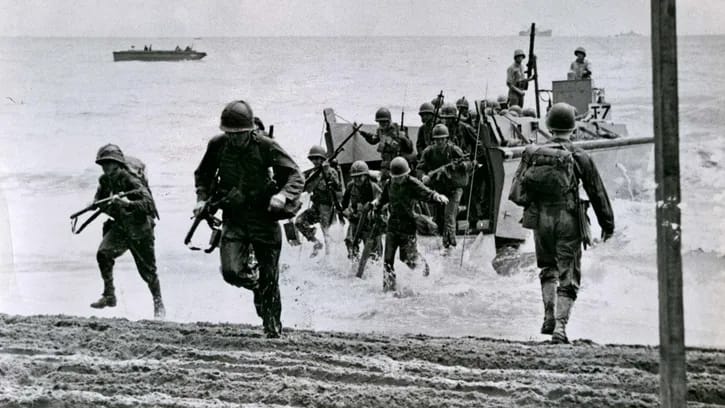
(February 8, 1943): Japan evacuates final troops from Guadalcanal
On this day in 1943, the last 10,000 troops of the Imperial Japanese Navy withdrew from the island of Guadalcanal (based in the Pacific, near Australia) in the midst of World War II. Allied forces had been determined to retake the island, as controlling Guadalcanal meant controlling communications between the U.S., New Zealand, and Australia. Guadalcanal was Japan's first major defeat in the Pacific theater, marking a significant shift in the course of the war.