- Basedment
- Posts
- Ukraine and Russia's Peace Terms: A Comparison
Ukraine and Russia's Peace Terms: A Comparison
Your daily dose of geopolitical updates and strategic analysis. Unbiased, but not unbased.

Editor-in-Chief
August 18, 2025
THE BRIEFING
Here’s what’s happening in geopolitics today.
Today’s briefing takes us from the streets of America to the power corridors of Washington, with stops in Gaza, Yemen, and Beijing along the way.
Protests, peace talks, and military strikes all shaped the headlines, while world leaders traded both promises and pressure. Together, they sketch a picture of a world caught between conflict and uneasy diplomacy.
In terms of our deep dive we compare the peace terms proposed by Putin and Zelensky and dig deeper on the ethnic and national identity aspects that most don’t consider.
THE LAST 24 HOURS IN GEOPOLITICS
1. Thousands join ‘Fight the Trump Takeover’ protests against Republican redistricting plans
More than 300 protests took place across the U.S. on Saturday as pro-democracy and labor groups rallied against the Trump-backed effort to redraw Texas congressional maps in a way that would benefit Republicans with events held in 44 states and Washington, D.C., and drawing tens of thousands of participants. Notable figures like Beto O’Rourke spoke out, accusing Republican leaders of fearing the democratic power on display, while Texas Democrats continued their strategy of fleeing the state to block the redistricting vote. Meanwhile, California pushed back with its own counter-plan, unveiled by Governor Gavin Newsom, aimed at balancing potential losses by potentially securing five more Democratic seats.
read more
2. European leaders to join Zelenskyy for Washington talks as Trump presses peace deal
The leaders of Britain, Italy, Finland, and France are set to meet with Ukrainian President Volodymyr Zelenskyy, who is facing mounting U.S. pressure to accept a swift peace deal with Russia. Washington hopes a quick agreement could bring an end to the war, but the reported terms would be extremely difficult for Kyiv to accept, raising fears of concessions on sovereignty and territory. European leaders are walking a fine line with supporting Ukraine’s position while also signalling interest in a resolution to Europe’s deadliest conflict since World War II.
read more
3. Hamas rejects Israel’s relocation plan
Hamas has forcefully rejected Israel’s proposal to relocate residents from Gaza City to the south, branding it a “new wave of genocide and displacement” and warning that the display of tents and shelters is a deceptive cover for an impending offensive. Israel’s military, on the other hand, insists the move is about protecting civilians amid operations to secure northern Gaza City. This clash highlights escalating humanitarian and political tensions, as more than two million people in Gaza already face widespread destruction, displacement, and international scrutiny.
read more
4. Israel says it targeted power station used by Houthis near Yemeni capital
The Israeli military confirmed it struck an energy infrastructure site used by Iran-aligned Houthis south of the Yemeni capital Sanaa early Sunday framing the strike as retaliation for the group’s repeated missile and drone attacks on Israel. Houthi-run Al Masirah TV reported that the attack knocked some of the station’s generators offline and sparked a fire that crews later contained, though it didn’t name the attacker. This move marks a notable escalation in regional tensions, highlighting how the conflict’s reach continues expanding beyond Gaza and Ukraine.
read more
5. Trump reveals Xi Jinping told him China will not invade Taiwan while he’s US president
President Trump revealed on Friday that Chinese President Xi Jinping personally assured him China would not invade Taiwan while Trump remains in office, noting Xi described Beijing as “very patient”. While Taiwan’s leaders have not commented directly, one prominent lawmaker stressed that “security cannot rely on the enemy’s promise,” reinforcing the need for strengthened self-defence regardless of verbal assurances.
read more
DAILY DEEP DIVE
PEACE TERMS COMPARED: UKRAINE
Close to 48 hours since the historic summit, and we have a much clearer picture of the direction that each party is taking.
Reuters reports on Putin’s proposal for ending the war in Ukraine:
No ceasefire until a comprehensive agreement is reached.
Ukraine to fully withdraw troops from Donetsk and Luhansk.
Russia to freeze front lines in Kherson and Zaporizhia.
Ukraine to regain control of areas in Sumy and Kharkiv.
Ukraine to formally recognize Russian sovereignty over Crimea.
Partial lifting of sanctions against Russia.
Ukraine barred from joining NATO.
Putin open to Ukraine receiving specific security guarantees.
Official status for Russian language in Ukraine.
Freedom for the Russian Orthodox Church to operate in Ukraine.
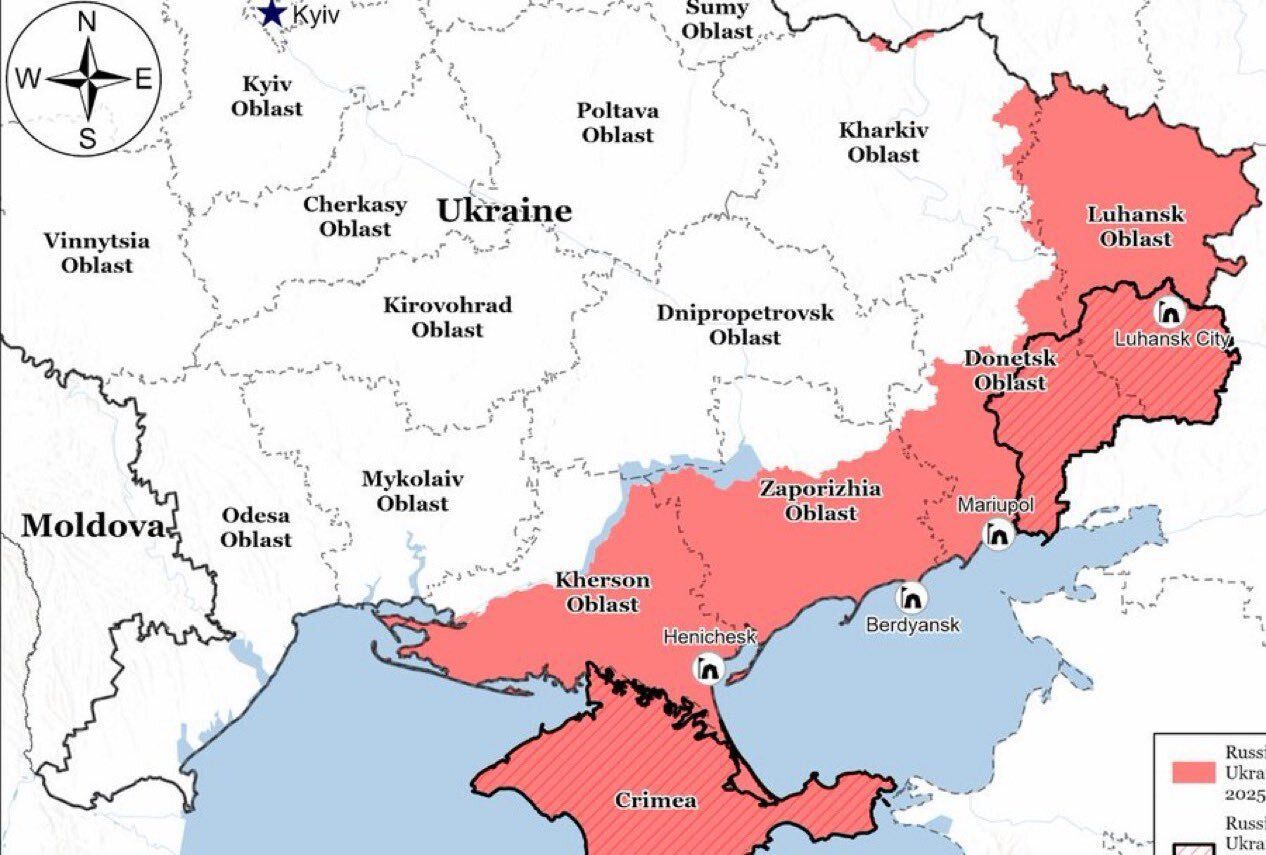
Russia would freeze the frontline here, with the added addition of taking back the 40% of Donetsk that is under Ukraine’s control and the 1-3% of Lughansk
Now Trump is to meet with Zelensky, but he is not flying alone. European leaders will join him:
European Commission President von der Leyen, President of Finland Stubb, President of France Macron, German Chancellor Merz, NATO Secretary General Rutte, and Italian Prime Minister Meloni.
Ukraines Peace Terms:
Zelensky said peace requires an immediate ceasefire, the release of all Ukrainian prisoners and abducted children, and sustained international pressure on Russia. He stressed that sanctions must be strengthened if Moscow evades talks, and that lasting security depends on U.S. and European guarantees. Crucially, he insisted no territorial or political decisions can be made without Ukraine’s participation.
The Clash:
We can see the first clash: Putin wants no ceasefire until a solid agreement is reached, while Zelensky wants one immediately. This is due to the situation on the ground. Every day Russia is making incremental gains across the front. A ceasefire would allow Ukraine crucial time to entrench, resupply, and halt Russia’s momentum. Putin, on the other hand, is trying to buy time to maximize his position in Ukraine through territorial control.
The most important part of Putin’s demands is total control of Luhansk and Donetsk. It is simply something that Zelensky cannot agree to. The current frontline has held for close to a decade in some sections. We’ve discussed it repeatedly: the Kramatorsk–Sloviansk front is a fortress that Russia has been trying to scale for years without success. This year has seen some advances, but it would take another year of conflict for them to reach Kramatorsk if Ukraine’s defenses remain firm. From Ukraine's perspective, this would open the door to another invasion if Putin decides to attack again. And once the Donetsk region is taken, much of the inner Ukrainian land is not as defensible.
A Deeper Issue:
Both the Russian and Ukrainian peace terms also include demands that cut deeply into societal identity. Putin wants Russian to be an official language and the restoration of the Orthodox Church that answers to the Moscow Patriarch. Since the 1996 Constitution, Ukrainian has been the sole state language, with bilingualism at the state level prohibited. While Russian and other minority languages are legally protected, a 2017 education law restricted Russian as a teaching language. In August 2024, Ukraine passed a law banning the Russian Orthodox Church and any organizations tied to it, with Human Rights Watch warning that it risks undermining religious freedom.
Ukraine is also demanding the return of abducted children, which has gained more attention since the First Lady’s personal letter to Putin calling for their return. Russia claims to have brought about hundreds of thousands children from Ukraine’s conflict zones into its territory since the war began, saying it is to protect orphans and abandoned minors. Ukraine, its allies, and NGOs, however, accuse Moscow of illegal deportations, with Kyiv listing nearly 20,000 children as taken and Washington estimating 260,000 were forcibly removed. The forced deportation, re-education, and illegal adoption of Ukrainian children by Russia may constitute war crimes and crimes against humanity, according to international law. These actions led the International Criminal Court to indict Vladimir Putin and Children’s Rights Commissioner Maria Lvova-Belova in 2023.
A depth most don’t understand
Both Russia’s and Ukraine’s proposed terms contain points that cut deeply into national identity. Russia and Ukraine have a complicated and bloody history, largely stemming from the Soviet Union Era in the early 20th century. For Ukraine, granting Russian language official status or allowing the Russian Orthodox Church to operate again would contradict years of constitutional and legislative shifts away from Moscow’s influence. For Russia, Ukraine’s demand for the return of abducted children strikes at the heart of its war narrative, as international bodies label these deportations war crimes. These are not just political issues but societal ones, tied to culture, faith, and collective memory.
The listed terms could be the hardest obstacle to peace, and might even be designed to make peace unattainable. Those who have lived in the West often struggle to understand how deeply these conflicts run in Eastern Europe. They are rarely just wars about territory; for many of those living in the warring nations, they are wars about ethnicity, identity, and history. That murkies the conflict and makes peace harder to draw on a map, especially when village and neighbour are set against each other. We saw similar dynamics in Yugoslavia, where conflict was driven less by territorial borders and more by competing identities and historical grievances - often by neighbours who had lived as friends for decades.
Sources:
References available upon request. A full citation list has been omitted to preserve the visual integrity of the page.
TWEET OF THE DAY
AI is making the world a scary place…
What are we doing folks 🤦
— @jason (@Jason)
5:17 AM • Aug 17, 2025
TODAY IN HISTORY
(August 17, 1945): Indonesia's declaration of independence.
On this day in 1945, Sukarno declared Indonesia's independence from the Netherlands, and, after the Dutch transferred sovereignty four years later, he served as the country's first president (1949–67).
