- Basedment
- Posts
- Ukraine Continues Large Scale Drone Strikes, As Ceasefire Looks Uneasy
Ukraine Continues Large Scale Drone Strikes, As Ceasefire Looks Uneasy
Today we put a spotlight on the Ukrainian deep-strike drone strategy and provide an update to the Gulf War III in the last 24 hours.

Editor-in-Chief
April 09, 2026
THE BRIEFING
Here’s what’s happening in geopolitics today.
A heavy day on the geopolitical front: Israel’s strikes on Lebanon are driving mass casualties and hardening Iran’s stance against peace talks, while Washington signals it’s not going anywhere just yet.
At the same time, tensions are spilling into alliances, with Trump taking aim at NATO, as Myanmar’s military tightens its grip at home with a new cabinet.
Today we put a spotlight on the Ukrainian deep-strike drone strategy and provide an update to the Gulf War III in the last 24 hours.
SUPPORT OUR PODCAST!
You guys asked for it, we delivered it! New podcast based off your questions.
In the podcast we discussed: The F-15E crash and rescue, Iranian capabilities, Russia and Ukraine, Fall of the Roman Republic
Watch and listen here
THE LAST 24 HOURS IN GEOPOLITICS
1. Israel kills hundreds of civilians in ‘barbaric’ strikes on Lebanon
Israel has launched one of its largest air campaigns in Lebanon, carrying out more than 100 strikes in a short span and hitting targets across Beirut, southern Lebanon and the Bekaa Valley. The attacks have resulted in hundreds of deaths, with Lebanese authorities reporting at least 180–250 people killed and many more injured, including civilians in densely populated areas. Israel said it was targeting Hezbollah infrastructure embedded in civilian areas, while the strikes have drawn widespread international condemnation over the scale of casualties and humanitarian impact.
read more
2. Iran says peace talks would be ‘unreasonable’ after Israel strikes on Lebanon
Iran has said peace talks would be “unreasonable” following Israel’s large-scale airstrikes on Lebanon, which killed more than 250 people in one of the deadliest days of the conflict. Tehran argued that any negotiations are meaningless while attacks continue, insisting that a ceasefire must include Lebanon as a key condition for broader de-escalation.
read more
3. Trump says US military to remain in Middle East until ‘real’ agreement is reached
Trump said American military forces will remain deployed in the Middle East until a “real agreement” with Iran is fully reached and implemented, despite the current two-week ceasefire. He warned that U.S. ships, aircraft and personnel will stay in position and could resume operations if Tehran fails to comply with the terms of the deal. The comments underscore the fragile nature of the truce, with both sides still far apart on key issues such as the Strait of Hormuz and broader security guarantees.
read more
4. Trump slams NATO over Iran after meeting Rutte, renews Greenland threat
Trump has sharply criticised NATO following talks with Secretary-General Mark Rutte, accusing the alliance of failing to support Washington during the Iran war. Trump said NATO “wasn’t there when we needed them,” highlighting frustration that several member states declined to provide military backing or access for operations in the region. He also revived tensions with European allies by renewing rhetoric around Greenland.
read more
5. Myanmar’s Min Aung Hlaing names new cabinet dominated by military figures
Myanmar’s military leader Min Aung Hlaing has appointed a new cabinet dominated by military figures, reinforcing the army’s control over the country’s political system. The government includes around 30 ministers, many of whom are serving or former military officers, with key portfolios such as defence, home affairs and border security held by senior generals. The appointments signal continuity rather than reform, with analysts saying the reshuffle effectively maintains military rule under a nominally civilian government.
read more
GLOBAL CONFLICT TRACKER
Iran-USA-Israel
A two-week ceasefire between the U.S. and Iran came into effect on April 8, brokered by Pakistan, but has been under strain from the moment it was announced.
The agreement was reached just before Trump's self-imposed 8 PM Tuesday deadline. Trump announced the deal on Truth Social, describing Iran's 10-point proposal as "a workable basis on which to negotiate" and stating that "almost all of the various points of past contention have been agreed to." Iran confirmed the ceasefire. Oil prices dropped sharply on the news, with Brent Crude falling roughly 16% to around $95 a barrel, and global equity markets rallied.
The central dispute since then has been Lebanon. Pakistani PM Sharif announced the truce covered "Lebanon and elsewhere," while Israel maintained the deal did not apply to its ongoing operations against Hezbollah. Israeli forces struck over 100 Hezbollah targets in Lebanon in a single operation, killing more than 250 people and wounding over 1,160, the largest Israeli assault on Lebanon since the war began. The U.S. did not intervene or object publicly.
On the Gulf side, throughout April 8, Kuwait intercepted 28 Iranian drone attacks and the UAE faced 35, with a fire reported at Abu Dhabi's Habshan gas complex and a direct drone hit on a Saudi pipeline. Qatar confirmed intercepting 7 missiles and drones. Iran stated these strikes were carried out in response to attacks on Iranian oil facilities, and formally accused the United States of violating the ceasefire. Faytuk news says that Iranian media accused UAE jets of attacking Iranian facilities, marking a first entrance to the war.
Both the U.S. and Iranian delegations are expected in Islamabad on April 10 for the first formal negotiating session under Pakistani mediation. Whether the agreement holds long enough to get there remains the core question, the ceasefire is technically in place, but both sides are already disputing what it covers and whether it's being respected. Vance also essentially said the Pakistani delegation gave both sides different versions of the ceasefire proposal to add to the confusion.
Russia-Ukraine
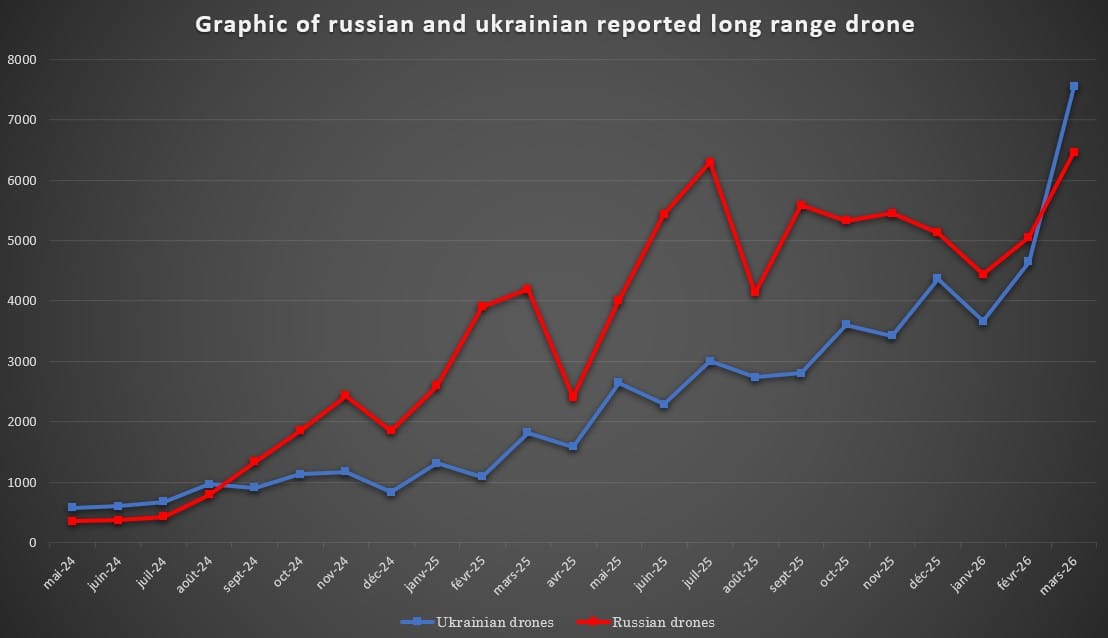
Ukraine's long-range drone program has grown from a niche capability into one of its primary offensive tools. The trajectory is significant: Ukraine launched roughly 1,000 drones into Russia in August 2024, 3,000 in July 2025, and approximately 7,000 in March 2026 alone, the first month Ukraine launched more long-range drones into Russian territory than Russia sent into Ukraine.
The targeting logic is consistent and deliberate. Rather than striking military frontline positions, Ukraine has focused on economic and logistics infrastructure deep in Russian-held territory. Oil terminals have been a recurring priority — Primorsk and Ust-Luga in the Leningrad and Karelia oblasts were hit five days in a row in late March, followed by the Novorossiisk oil terminal on the Black Sea. Rail is also a sustained focus, with 16 separate hits recorded against roughly 8 different trains, primarily fuel trains in occupied southern Ukraine.
In occupied territory specifically, Ukraine has now crossed 400 total documented long-range strikes since January 2026, targeting air defence systems above all else — 52 radars and 27 air defence platforms including Tor, Pantsir, Buk and S-300 systems. The intent appears to be systematically degrading the Russian layered air defence network to enable future strike operations.
Incredible work done by Mollin once more. A great source to look at.
See source here
My comments:
For me, the most critical aspect of this campaign is the deliberate destruction of air defence systems. Crimea has been a particularly large target, primarily due to its role as a major staging ground for military operations into Ukraine. It is also the first line of defence for the Kerch bridge, which has been targeted multiple times.
Toward the second half of 2025, Ukraine began to shift targeting to railway and infrastructure in an attempt to disrupt logistics to the Russian army — especially near Lughansk Oblast-Russian border. This can be attributed to not being able to do significant damage to reinforced factory-cities that produce tanks, missiles and drones and instead opting for easier railway targets, of which are literally linked to the factories.
The pattern here is clear, keep targeting Russian air defence systems en masse and continue to strain the air coverage in both Ukraine and mainland Russia. Whilst at the same time, Ukraine continues to experiment with its domestic cruise missiles.
Sources available upon request
TODAY IN HISTORY
(April 9, 1865): General Robert E. Lee, commander of the Army of Northern Virginia of the Confederate States of America, signed a treaty of surrender at Appomattox Court House, effectively ending the American Civil War.