- Basedment
- Posts
- Ukraine In Full Retreat On Southern Front
Ukraine In Full Retreat On Southern Front
Your daily dose of geopolitical updates and strategic analysis. Unbiased, but not unbased.

Editor-in-Chief
November 13, 2025
THE BRIEFING
Here’s what’s happening in geopolitics today.
In the U.S., the government finally reopened after its longest shutdown on record, while fresh controversy emerged over newly released Epstein emails mentioning Trump.
Abroad, Iran’s worsening water crisis is forcing the government to consider drastic measures, and Iraq’s elections have left the country in another round of coalition talks. Meanwhile, at the G7, Secretary of State Marco Rubio faced pushback from allies over U.S. military strikes, a reminder that Washington’s unilateral moves are still stirring debate among its closest partners.
And in today’s deep dive we’re looking over Russia’s steam roll across the southern front.
THE LAST 24 HOURS IN GEOPOLITICS
1. Longest Government shutdown in U.S. history ends
The U.S. government officially reopened on November 12 after a 43-day shutdown following President Donald Trump’s signing of a funding bill. The legislation restores pay for federal workers, revives food-aid programs and clears the way for restarted airport operations, but it notably leaves unresolved the debate over healthcare subsidies. While the end of the shutdown brings relief to millions, the political damage and economic disruptions, especially in air travel and food assistance, may linger for months.
read more
2. Tehran taps run dry as water crisis deepens across Iran
Iran is facing its worst water crisis in decades, with the capital Tehran’s five major reservoirs now at about half capacity and the crucial Amir Kabir Dam holding just 8% of its potential. President Masoud Pezeshkian has warned that if no significant rainfall arrives by December, the city may face widespread rationing or even evacuation. Experts say the crisis stems from years of mismanagement, over-extraction of groundwater and severe drought, creating both a humanitarian and governance challenge for Iran.
read more
3. Iraqi PM Al-Suadani’s coalition comes first in parliamentary election
Mohammed Shia al‑Sudani’s coalition emerged as the top vote-getter in Iraq’s parliamentary election, securing approximately 1.3 million votes and outpacing its nearest rival by around 370 000. Despite this victory, no single bloc achieved a majority in the 329-seat legislature, meaning extensive coalition-building will be required before a new government can be formed. The turnout was about 56 percent, though several boycotts and regional disparities underscore how many Iraqis remain disillusioned with the electoral process and the challenge of translating votes into reform.
read more
4. Newly released emails reveal Epstein kept close eye on Trump
Newly released emails from the estate of Jeffrey Epstein reveal he closely tracked Donald Trump’s movements and claimed Trump “knew about the girls” Epstein trafficked, though no direct evidence of Trump’s participation has been provided. The disclosure comes as Democrats in the House Oversight Committee press for full release of documents and legal filings, while the White House dismisses the emails as a “politically-crafted smokescreen.” The controversy reignites scrutiny over Trump’s past ties with Epstein and adds fresh pressure to the unfolding investigation into the Epstein network and possible government cover-up.
read more
5. Rubio shrugs off allies’ concerns over U.S. drug strikes at G7 meeting
At the recent G7 foreign ministers’ meeting in Niagara, U.S. Secretary of State Marco Rubio defended a series of U.S. strikes on suspected drug-smuggling vessels in the Caribbean and eastern Pacific, brushing aside European concerns about legality. European allies such as France argued the operations may violate international law and even jeopardise France’s territories in the region, while the U.K. reportedly paused some intelligence sharing over the strikes. Rubio responded bluntly, saying the U.S. would not allow others to dictate how it defends its national security and insisted that no one at the meeting had raised the issue.
read more
DAILY DEEP DIVE
UKRAINES SOUTHERN FRONT CRISIS
Hulyaipole - Pokrovsk’e Highway Severed
Russian forces have seized the village of Danylivka on the Hulyaipole axis, tightening their grip on the region. This advance effectively cuts the Hulyaipole–Pokrovske highway, a key logistical route for Ukrainian forces. Only one paved road into Hulyaipole now remains — and it sits less than six kilometres from the front. At that range, every movement is under persistent Russian drone eyes, limiting Ukraine’s ability to rotate troops or bring supplies. Hulyaipole is edging closer to operational isolation as Russian pressure intensifies.
This is important, as pretty much no Ukrainian defences exist (that face the Russians from the east) between the highway and current Russian units. Nor will there be for two reasons, number one it’s already too late. Number two, the highway adjacent to a river that practically follows the Hulyaipole - Pokrovsk’e route. Ukrainian units will begin using this as a major natural defensive barrier. So we can assume Russian gains will continue, the main question is what happens to Hulyaipole. It is increasingly becoming isolated and Ukraine must consider some serious options.

Expect a retreat behind the river.
No End In Sight For Russian Gains
Russia’s steam role continues toward Hulyaipol. Russian forces are steadily pushing deeper toward the Haichur River. They’ve taken multiple positions west and south of Solodke and Novouspenivske, including the villages of Rivnopillya and Yablukove. Over the past two weeks, Russian units have also advanced west of Malynivka, overrunning a network of Ukrainian trench lines. The momentum on this axis suggests a slow but deliberate Russian effort to grind forward and collapse Ukraine’s defensive belt in the area.
Ukraine Is Stretched
Overall responsibility for this stretch of the front falls to Ukraine’s 20th Army Corps, with the 102nd Territorial Defence Brigade anchoring the right flank around Hulyaipole.
Further north, the 110th Mechanised Brigade appears to be covering an unusually large frontage — nearly 20 kilometres wide. Above their sector, several independent Ukrainian assault battalions are operating, though the exact command structure coordinating them remains unclear.
One of the recurring problems on the Ukrainian side is that when a brigade is said to be “sent” to reinforce a front, it’s usually only a small detachment — not the full brigade. This creates serious complications. Mixing elements from different units breaks cohesion, disrupts communication, and introduces clashing tactics, command styles, and operating procedures. It also places troops in terrain they don’t fully know, increasing the risk of mistakes and miscoordination. The 110th Mechanised Brigade is a prime example of this fragmented reinforcement model and the challenges it creates on the defensive line.
According to the brigade’s own reporting, the following units are currently attached to the 110th:
3rd Battalion, 122nd TDF Brigade
4th Battalion, 105th TDF Brigade
3rd Mechanised Battalion, Presidential Brigade
1st
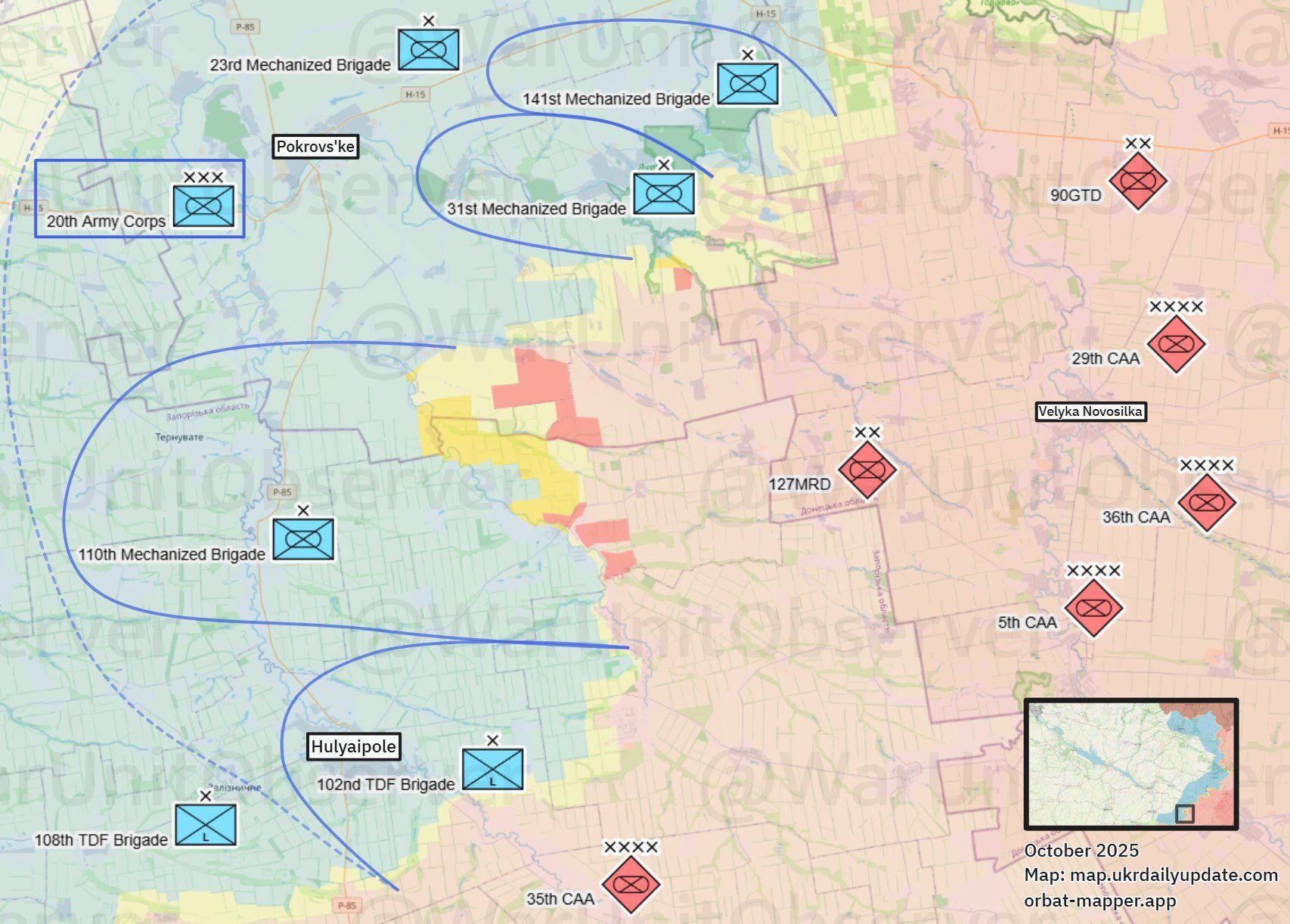
Great Map and information by UnitObservor on X
Rifle Battalion, 125th Heavy Mechanised Brigade (with possible elements from the 2nd Mechanised Battalion)
Sources:
News/Journal sources available upon request, not shown to maintain visual integrity of page.
TODAY IN HISTORY
(November 13, 2015): Terrorist attacks in Paris
On this day in 2015, terrorists staged coordinated attacks in Paris and its environs, the deadliest occurring at the Bataclan theatre and concert hall; in all, at least 130 people were killed and more than 350 were wounded.
