- Basedment
- Posts
- Ukraine Peace Plan Released (Part 2)
Ukraine Peace Plan Released (Part 2)
Your daily dose of geopolitical updates and strategic analysis. Unbiased, but not unbased.

Editor-in-Chief
November 22, 2025
THE BRIEFING
Here’s what’s happening in geopolitics today.
From tensions flaring in the West Bank and China ramping up its “wolf warrior” diplomacy, to the Red Cross tightening its belt as donor fatigue hits hard.
Even the Dubai Airshow and COP30 weren’t spared from drama, with a tragic Tejas crash and a fire briefly halting climate negotiations in Brazil.
And for today’s deep dive, now that Trump’s full 28-point peace plan has finally dropped, we’re breaking down what’s actually in it — and what it might mean.
THE LAST 24 HOURS IN GEOPOLITICS
1. Israeli settlers reportedly set fire to cars and garage in West Bank’s Hawara
Israeli settlers reportedly set fire to several cars and a garage in the West Bank town of Huwara (Hawara), according to local Palestinian officials and media sources. The incident is part of a broader escalation in settler violence in the area, including previous attacks that saw vehicles torched and property damaged.
read more
2. Red Cross to shed nearly 3,000 jobs, scale back budget amid donor fatigue
The International Committee of the Red Cross (ICRC) said it will cut 2,900 jobs and reduce its 2026 budget by 17% to 1.8 billion Swiss francs, citing a sharp decline in donor funding. The funding shortfall reflects what ICRC calls a growing “donor fatigue,” as resources are redirected toward defense amid multiple global conflicts. ICRC President Mirjana Spoljaric emphasized that despite these cuts, the organization remains committed to delivering critical humanitarian aid on the front lines in over 90 countries.
read more
3. China unleashes ‘wolf warriors’ in diplomatic duel with Japan
China has revived its aggressive “wolf warrior” diplomacy in a sharp rebuke of Japanese Prime Minister Sanae Takaichi after she suggested that a Chinese attack on Taiwan could threaten Japan’s survival. Chinese diplomats have unleashed nationalistic caricatures and rhetoric accusing Tokyo of militarism and warning of dire consequences if it intervenes in the Taiwan Strait. Beijing has also threatened further countermeasures, having already imposed a travel advisory, suspended Japanese seafood imports, and publicly called into question Japan’s commitment to peaceful development.
read more
4. Indian Tejas fighter jet crashes in a ball of fire at Dubai Airshow, killing pilot
An Indian HAL Tejas fighter jet crashed during a demonstration flight at the Dubai Airshow on 21 November 2025, killing the pilot, according to the Indian Air Force. The aircraft reportedly lost control mid-maneuver, descended rapidly, and exploded into flames near Al Maktoum International Airport, with emergency crews rushing to the scene. The IAF has launched a court of inquiry to determine the cause of the accident.
read more
5. Fire disrupts COP30 climate talks as UN chief urges deal
A fire broke out on 20 November at the COP30 climate summit venue in Belém, Brazil, sparking a full evacuation of the “Blue Zone” where negotiators were meeting. Thirteen people were treated for smoke inhalation, and UN Secretary-General António Guterres used the disruption to renew his call for a deal, urging countries to accelerate the transition away from fossil fuels and boost climate financing. The blaze, believed to have been caused by a small electrical appliance like a microwave, was extinguished in about six minutes, but it added fresh tension as talks approach their deadline.
read more
DAILY DEEP DIVE
The Peace Plan (Part 2)
Continuing From Yesterday
Yesterday we finished off with the other considerations, so we will kick off with them too.
Let’s paint a clearer picture of Ukraine’s current situation, both internal and external. Russian troops are pressing forward across the key axes of Siversk and Kupiansk. We’re also seeing consolidation on the Pokrovsk front and further Russian movement toward Pokrovske in the south. DRG units are being employed extensively around Lyman and Kostyantynivka. And after months of brutal urban fighting, Russia seems to be making renewed progress in Vovchansk. Ukrainian resistance remains firm, there are clashes again inside Chasiv Yar, but overall, the trend is worrying.
The internal political picture isn’t much better which isn’t presenting a good look. With the energy corruption scandal expanding, many expected Zelensky to dismiss his right-hand man, Andriy Yermak. Instead, Zelensky rejected calls from European Solidarity to sack both Yermak and Defence Secretary Rustem Umerov. MP Yaroslav Zheleznyak claims the president’s office is preparing to frame the scandal as having a “Russian trace,” to target investigators, and potentially suppress media coverage—continuing earlier attempts to undermine NABU and SAP. All of this comes as Kyiv faces a budget shortfall and must continue persuading Western partners to finance the war effort.
What do I mean by “not a good look”? Since the start of the war, Zelensky has been on a political mission to achieve two things at once: prove Ukraine can fight and win, while simultaneously showing the world the brutal toll Russia is inflicting on the country. That mission has never been more critical than now, with President Trump positioning himself at the centre of peace-talk discussions.
To add to this, while this has all been happening U.S. Army Secretary Driscoll and a senior military delegation are in Kyiv (the highest-level visit under Trump) on a fact-finding mission to discuss Ukraine’s battlefield situation and potential ceasefire options. However, according to the WSJ the newly released plan was worked on jointly between the U.S. and Ukraine. Other analysts commented on the role that Qatar and Turkey are allegedly having in this peace process, which strengthens notions that peace might happen. This could be true, but there are a foundational issues within the 28-point plan.
Trust Being The Foundation Of Peace…But There's No Trust
We’re not going to break down all 28 points here — that would be an essay in itself, and maybe something for a long-format video (let us know if you’d want that). My early view is that the first framework released (the one we covered yesterday) was either an extremely early draft or a Russian-proposed version. The fact that no one wanted to discuss it publicly may support this; they may have been waiting for the final iteration.
This updated draft is not as blatantly Russia-maximalist as the previous one. There are sensible elements: using frozen Russian assets to fund Ukraine’s reconstruction, shared administration of the nuclear power plant, a full exchange of prisoners and deported children, humanitarian committees, and other confidence-building steps. But the problem is obvious: all of this rests on trust, and right now, there is none.
From Ukraine’s viewpoint, the deal effectively hands the current frontline to Russia on the promise that Moscow won’t attack again. The main enforcement mechanism is that if Russia breaks the agreement, global sanctions would be reinstated and any new territorial gains would be legally invalidated. But how much does that matter? Russia is already under extreme sanctions and is still grinding forward in an attritional war while consolidating occupied regions. And losing the remainder of Donetsk would mean Ukraine forfeiting its largest defensive network, among the strongest in the world.
For Russia, the commitment to remain under a 600,000-troop cap raises questions. Would paramilitary groups count? What about mobilised reservists? Ukraine would also retain a sizeable mobilised force. And meanwhile, drone warfare will only accelerate — in 10–20 years the role of infantry may be radically reduced, if not fundamentally transformed. The 600k number itself is revealing: if that is the cap, what is Ukraine’s actual military size today? As another note, I will mention I don’t think European leaders will be too happy with this agreement for a number of reasons.
Finally, both leaders’ red lines are well known. Putin has repeatedly stated that he wants full control over what Russia claims as its “legal” territory — all of Zaporizhzhia, Kherson, Donetsk, and Luhansk. Zelensky has repeatedly stated he will not surrender any Ukrainian land in negotiations. For this deal to work, both men would need to walk away from their hardline positions — highly unlikely, but if it ends the war, that is the trade-off on the table.
These are just some of the issues, but the underlying problem is the same: everything relies on trust. With the EU excluded from this process and the credibility of the U.S. as a security guarantor being questioned globally, this framework feels shaky at best at this time. However, I would say this is a step toward peace if both sides want to end the war.
And this is fundamentally the question, does Putin want this war to end?
Let us know your thoughts!
Bonus: I’ve also had the sense that this document wasn’t drafted by people deeply embedded in foreign policy — the wording simply isn’t legalistic enough. Tatiana Stanovaya, founder of R.Politik, made a similar observation. Russian diplomatic style typically involves highly detailed, heavily formatted, and exhaustive position papers — none of which is present here. She argues that Moscow may view this proposal as a “big bird in the sky”: something vague, aspirational, and ultimately lacking any real substance because of its weak and imprecise wording.
And this is fundamentally the question, does Putin want this war to end?
Let us know your thoughts!
Sources:
News/Journal sources available upon request, not shown to maintain visual integrity of page.
TODAY IN HISTORY
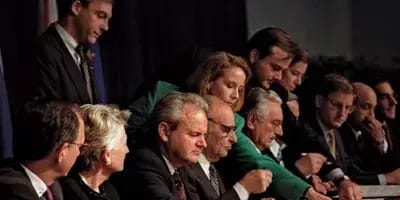
(November 21, 1995): The Dayton Accords
A landmark peace agreement, the Dayton Accords, was signed by the presidents of Bosnia, Croatia, and Serbia, formally ending the Bosnian War and laying the foundation for a new political order in post-war Bosnia and Herzegovina.