- Basedment
- Posts
- Ukraine's Asymmetrical War: Assassinations
Ukraine's Asymmetrical War: Assassinations
Ukraine’s assassination campaign reflects an asymmetrical strategy aimed at degrading Russia’s leadership and elite confidence.

Editor-in-Chief
December 22, 2025
THE BRIEFING
Here’s what’s happening in geopolitics today.
From a deadly car bombing in Moscow to another U.S. oil tanker interception off Venezuela’s coast, today’s headlines span escalating geopolitical pressure points and high-stakes power plays.
We also track a major new trade deal between India and New Zealand, an unexpected political cameo from Nicki Minaj at a conservative conference, and Japan’s move to bring the world’s largest nuclear plant back online nearly 15 years after Fukushima.
In this Deep Dive, we examine how Ukraine’s assassinations function as asymmetrical tools to weaken Russia’s command structure and erode Putin’s credibility.
THE LAST 24 HOURS IN GEOPOLITICS
1. Russian General killed in car bomb in Moscow
Russian Lieutenant General Fanil Sarvarov, head of the General Staff’s Operational Training Directorate, was killed by a car bomb in southern Moscow on Monday morning, after an explosive device planted under his vehicle detonated as he was leaving a parking area on Yasenevaya Street, Russian investigators said. The Russian Investigative Committee has opened a criminal case and said it is examining multiple leads, including the possibility that the attack was orchestrated by Ukrainian intelligence, though Ukrainian authorities have not commented.
read more
2. United States intercepts third oil tanker near Venezuela as tensions escalate
U.S. forces have intercepted a third oil tanker in international waters near Venezuela this weekend as part of Trump’s expanded campaign to enforce sanctions and disrupt what Washington calls illicit oil shipments tied to the Maduro government, according to U.S. officials. The vessel, reported to be part of Venezuela’s so-called “shadow fleet” and sailing under a false flag, was being pursued by the U.S. Coast Guard under a judicial seizure order, though it had not yet been boarded at the time of the report. The move marks the third such interception in less than two weeks, following the seizures of Skipper and Centuries.
read more
3. India, New Zealand finalise free trade agreement
India and New Zealand have finalised a comprehensive Free Trade Agreement aimed at deepening economic ties and expanding market access between the two countries, with formal signing expected in early 2026 after legal reviews. Under the deal, tariffs will be eliminated or reduced on about 95 % of New Zealand’s exports to India, and Indian goods will receive zero-duty or substantially improved access to the New Zealand market, while Wellington has pledged $20 billion in investment into India over the next 15 years.
read more
4. Rapper Nicki Minaj praises Trump in surprise conference appearance
Rapper Nicki Minaj made a surprise appearance at Turning Point USA’s annual AmericaFest in Phoenix on Sunday, joining CEO Erika Kirk on stage for a Q&A session that drew significant attention at the conservative youth organisation’s flagship event. During her appearance, Minaj praised President Trump and Vice President Vance and spoke about issues such as religious freedom, marking a notable public alignment with conservative political figures.
read more
5. Japan prepares to restart world’s biggest nuclear plant, 15 years after Fukushima
Japan is preparing to restart the world’s largest nuclear power plant, Kashiwazaki-Kariwa in Niigata Prefecture, nearly 15 years after the Fukushima disaster shut down much of the country’s nuclear fleet, with local authorities expected to finalise approval to resume operations. The facility, operated by Tokyo Electric Power Company (TEPCO) and boasting an 8.2 GW capacity, is central to Tokyo’s plan to boost energy security, cut reliance on imported fossil fuels and meet climate goals by increasing nuclear’s share of the power mix.
read more
DAILY DEEP DIVE
UKRAINE AND ASSASSINATIONS
Context
A senior Russian general has been killed in Moscow in what authorities describe as a likely Ukrainian intelligence assassination, marking one of the most high-profile attacks inside Russia since the war began. Russia’s Investigative Committee confirmed that Lt Gen Fanil Sarvarov, head of the General Staff’s operational training directorate, died after an explosive device detonated beneath his car on Yaseneva Street early Monday morning. Russian security-linked Telegram channels reported the vehicle travelled several metres before the blast, suggesting a remotely triggered or delayed device. The Investigative Committee of Russia said it is actively examining Ukrainian intelligence involvement. Sarvarov was a veteran of Russia’s post-Soviet wars, having served in both Chechen conflicts and helped organise Moscow’s 2015–16 intervention in Syria. In the current war, he oversaw combat training and force readiness. Russian officials reacted with open threats of retaliation. Duma defence committee member Andrey Kolesnik called for those responsible to be “destroyed on the spot,” framing the attack as terrorism. Ukraine has not claimed responsibility, but Kyiv has previously acknowledged targeting senior Russian officers accused of war crimes.
Never Random
Ukraine’s targets are rarely random. They are typically high-level figures or unusually effective operators within Vladimir Putin’s inner circle—and effective is the critical word. Both Russia and Ukraine suffer from entrenched cronyism, where loyalty often outweighs competence. As a result, genuinely capable generals, security officials, and political operators are scarce. That scarcity makes them highly visible, and strategically invaluable.
When such figures emerge, they tend to accumulate disproportionate influence over command chains, institutional memory, and the functioning of key military and political systems. Removing them does not merely eliminate a rank; it disrupts coordination, slows decision-making, and forces rapid, often clumsy replacements from a shallower talent pool. In highly centralised systems, this effect compounds quickly.
Targeted killings therefore serve a dual purpose: tactical punishment and structural degradation. They impose costs far beyond the individual, exposing fragility inside bureaucracies that rely on a small number of competent actors to compensate for systemic dysfunction. In that sense, Ukraine’s campaign is less about decapitation in the abstract and more about selectively hollowing out the few pillars holding the system together.
The Psychological Effect
Another critical dimension of these assassinations is psychological. Killing members of the top brass generates fear—arguably the most corrosive weapon in a closed system. The most dangerous adversary is not the one you can see on a battlefield, but the one you cannot detect, deter, or defend against. When senior figures are eliminated in supposedly secure environments, it breeds paranoia, distrust, and constant anxiety within elite circles. Over time, those emotions bleed into decision-making, risk tolerance, and operational cohesion.
This fear carries a political cost as well. Vladimir Putin is often referred to as “the boss”—a title that implies not just authority, but protection. Loyalty is the primary currency of advancement in Russia’s system; no one reaches the upper echelons without demonstrating personal allegiance to Putin. In return, the implicit contract is security. When loyal, high-ranking figures are assassinated with apparent ease, that contract is undermined.
Each successful strike chips away at the perception that the system can protect its own. Even if Putin’s formal power remains intact, his credibility as guarantor of elite safety erodes. In highly personalised regimes, perception matters as much as control. Once elites begin to doubt whether proximity to power increases security (or instead paints a target) cohesion fractures. Assassinations, in this sense, are not just acts of violence, but deliberate assaults on trust, authority, and regime confidence itself.
The Broader Picture
These assassinations are part of Ukraine’s broader asymmetrical strategy against a conventionally stronger Russia. Lacking Moscow’s manpower and industrial depth, Kyiv focuses on vulnerabilities that are costly and difficult to defend. Rather than matching Russia force-for-force, Ukraine targets systems: oil tankers, refineries, shipyards, and rear-area infrastructure, forcing Moscow to stretch air defence and security resources far beyond the front. Targeted killings, cyber operations, leaks, and overseas actions against Wagner Group interests follow the same logic—cheap, deniable, and psychologically disruptive. Russia’s size becomes a liability. Every general, tanker, and foreign proxy is another node requiring protection. Ukraine needs only occasional success to impose constant defensive strain.
Sources
News/Journal sources available upon request, not shown to maintain visual integrity of page.
TODAY IN HISTORY
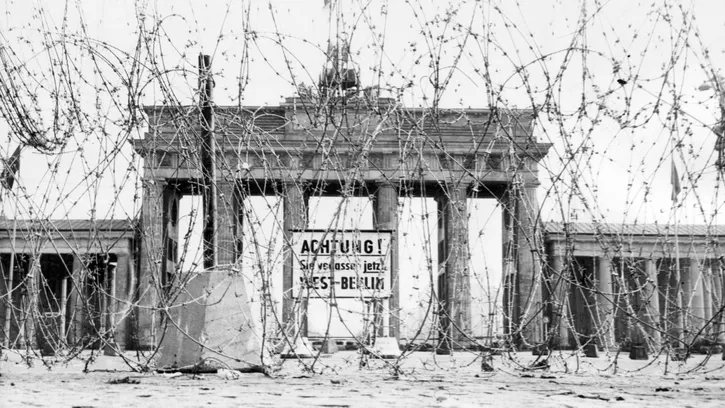
(December 22, 1989): Brandenburg Gate reopened
On this day in 1989, the Brandenburg Gate in Berlin was reopened as East and West Germany continued moving toward reunification. Berliners had been unable to use the gate since 1961, when the newly built Berlin Wall blocked access to it.