- Basedment
- Posts
- Ukraine's Successful Counterattacks Around Pokrovsk
Ukraine's Successful Counterattacks Around Pokrovsk
Your daily dose of geopolitical updates and strategic analysis. Unbiased, but not unbased.

Editor-in-Chief
November 03, 2025
THE BRIEFING
Here’s what’s happening in geopolitics today.
It’s been a busy start to the week, with political turbulence from Belgrade to Dar es Salaam and shifting alliances across the Indo-Pacific.
From new trade frameworks to ongoing conflicts, today’s stories highlight how global power and stability remain in constant negotiation.
In today’s deep dive, we’re going over the recent Ukrainian counterattacks on the Dobropillya salient and Rodynske.
THE LAST 24 HOURS IN GEOPOLITICS
1. Opponents and loyalists of Serbia’s autocratic president clash in Belgrade
Tensions flared in Belgrade as riot police raced in to separate opponents and loyalists of Aleksandar Vučić in a rare face-off after a year of escalating anti-government protests. Demonstrations were triggered by anger over corruption and a fatal train-station collapse in Novi Sad, and now both sides (protesters and pro-Vučić camps) are clashing more openly, raising concerns about Serbia’s democratic path. The confrontation marks a deeper challenge to Vučić’s 13-year hold on power and signals growing unrest in the heart of the Balkans.
read more
2. Nigeria says U.S. help against Islamist insurgents must respect it’s sovereignty
Nigeria has stated that it would welcome U.S. assistance in its fight against Islamist insurgents, but only if its sovereignty and territorial integrity are fully respected. The statement follows a warning from Donald Trump that the Pentagon prepare for possible military action over alleged Christian persecution in Nigeria, a claim rejected by Nigerian officials who emphasised the complexity of the conflict. Nigeria’s response underscores the delicate balance between seeking foreign support and maintaining national autonomy in a country grappling with long-running insurgencies such as Boko Haram and the Islamic State West Africa Province (ISWAP).
read more
3. Australia, Canada sign deal for critical minerals trade, cooperation
Australia and Canada have signed a Joint Declaration of Intent to deepen their cooperation and trade in critical minerals. The agreement focuses on linking upstream production with midstream processing and recycling, encouraging investment, and aligning on environmental, social and governance (ESG) standards. Both countries cited the need to reduce reliance on any single source for essential materials used in clean energy technologies, defence systems and advanced manufacturing.
read more
4. Tanzania’s Hassan sworn into office after deadly election violence
Samia Suluhu Hassan was officially sworn in for her first elected term on November 3 after securing approximately 97.66 % of the vote in the October 29 election. The vote was marred by unrest across the country, fires and arson in major cities, internet blackouts, curfews and credible reports of at least 10 deaths, according to the UN. Critics say the exclusion of her main opposition rivals and the heavy‐handed crackdown heightened fears that the long-ruling Chama Cha Mapinduzi (CCM) may be moving further from democratic norms.
read more
5. Hamas hands over three more hostage bodies
Hamas has handed over the bodies of three more hostages to International Committee of the Red Cross, who transferred the remains to Israel for forensic identification. Israel says the bodies are part of the 11 sets still outstanding under the U.S.-brokered ceasefire deal, and continues to accuse Hamas of dragging its feet. The exchange comes amid persistent cease-fire tensions and ongoing mutual accusation of violations by both sides.
read more
DAILY DEEP DIVE
Ukrainian Counterattacks
Pokrovsk: The Urban Struggle
In Pokrovsk itself, Russian forces have continued to push through the western and central sectors. In the 8th district, the line of contact has moved entirely to Ivana Mazepy Street, while in Dinas the Russian army now controls the brick factory and transport hospital. The fighting has shifted to the high-rise complexes—dense, multi-storey environments that favour defenders but are being relentlessly shelled by Russian artillery. Ukrainian defenders, who once held much of the district, are now confined to small fortified positions as the grey zone steadily contracts around them. South of the city, the Ukrainian withdrawal from the northern half of Lysivka and the adjacent Sukhyi Yar marks a tactical retreat under pressure.
Most of the remaining Ukrainian positions are concentrated on the north-eastern tip of the town, clustered around a group of multi-storey apartment complexes. This small pocket now provides crucial defence for the final two- to three-kilometre gap preventing Russian forces from fully closing the salient (if they wished, but won’t). South and west of these buildings lie suburban housing areas—far easier to bombard and capture—but here, the fighting revolves around dense, five-storey concrete blocks that offer stronger defensive potential and slow the Russian advance.
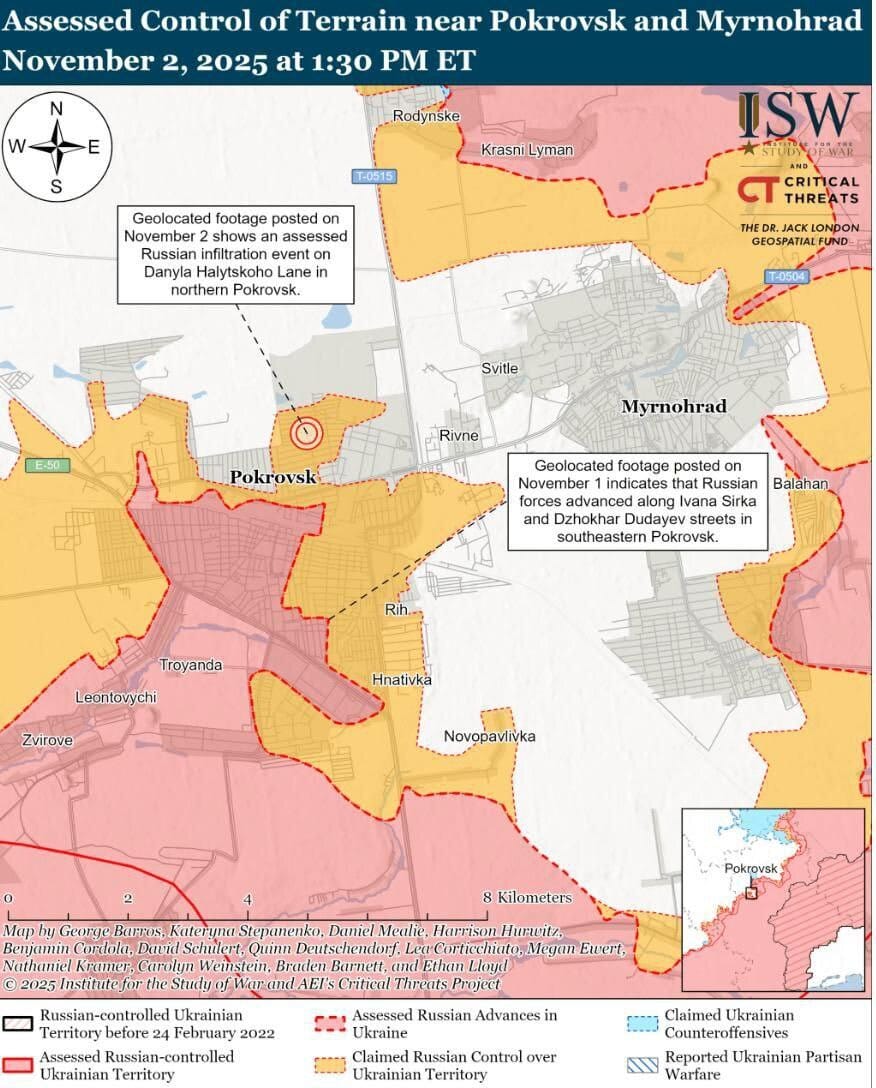
Between Rivne and the marker for the November 2 geolocation north of Pokrovsk is the heavily defensible suburb we are refering to.
Successful Breakthrough in Dobropillya Salient
While the situation in Pokrovsk proper worsens, Ukraine has achieved localized gains to the west and north. Around the former Kucheriv Yar salient near Dobropillya, Ukrainian forces have launched a series of well-coordinated counterattacks. According to AMK, They have retaken several clay quarries, forest belts, and sections of the Velyka Balka Gulley. South of Nove Shakhove, Kyiv’s troops have advanced into Nykanorivka’s outskirts, capturing parts of the Krasnolimanskaya Mine area and pressing toward Boikivka. These manoeuvres aim to destabilise Russian flanks and relieve pressure on Pokrovsk by forcing Moscow’s units to divert reserves.
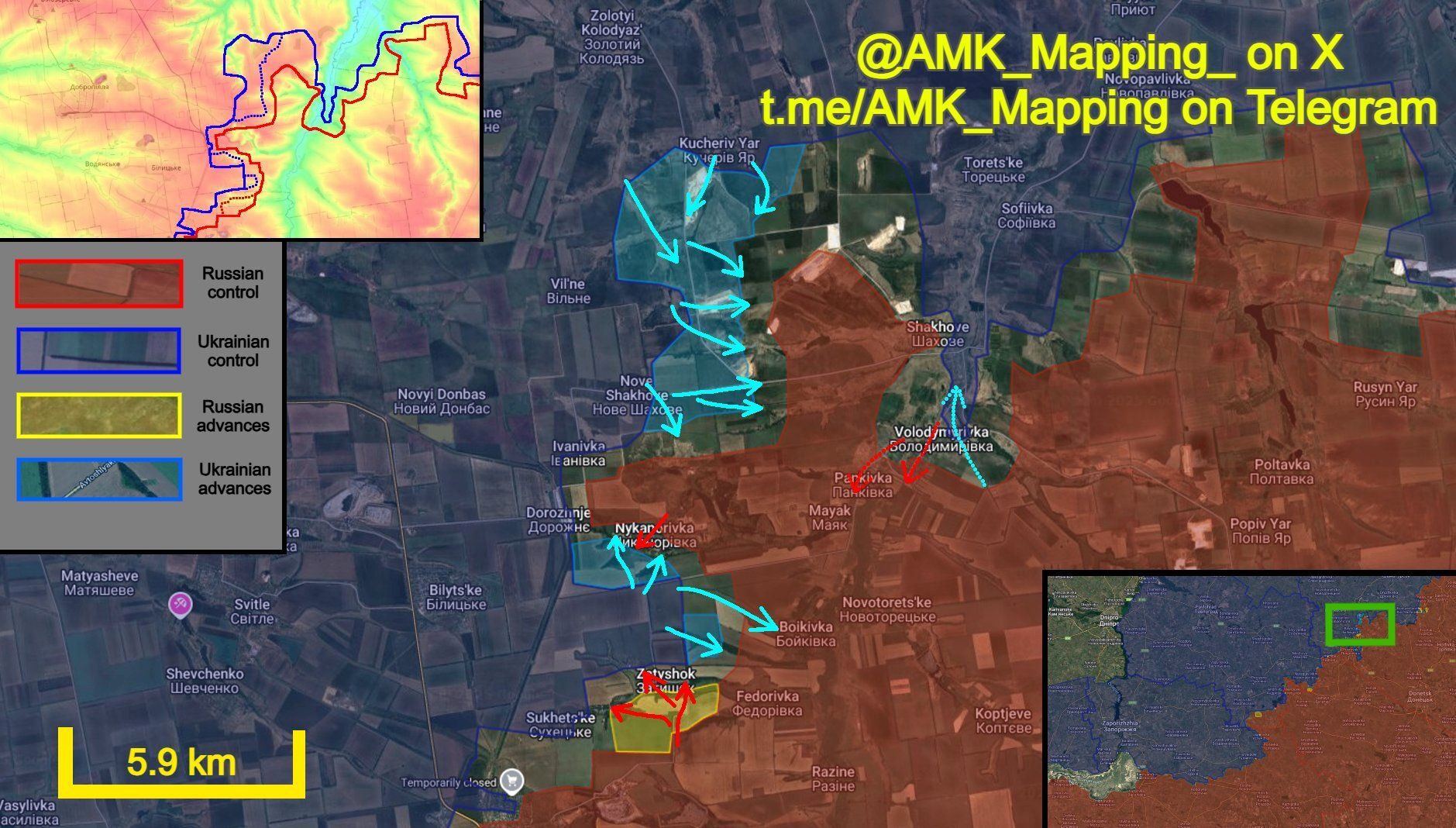
However, Russian counterattacks have already begun. Units advancing from the south have reached the forests near Nykanorivka and crossed the tributaries of the Kazenyi Torets River. The result is a sprawling “grey zone” where territory changes hands daily. For both armies, these engagements are less about immediate breakthroughs and more about endurance—holding ground, inflicting losses, and buying time.
If you’re wondering why the focus seems to be on the salient rather than the city it self — consider the long-term strategy. The chances of Ukraine retaking Pokrovsk are extremely slim, it would make sense for Ukraine to dull the protruding blade which Russia would definitely use as a launching pad deeper into Ukrainian territory.
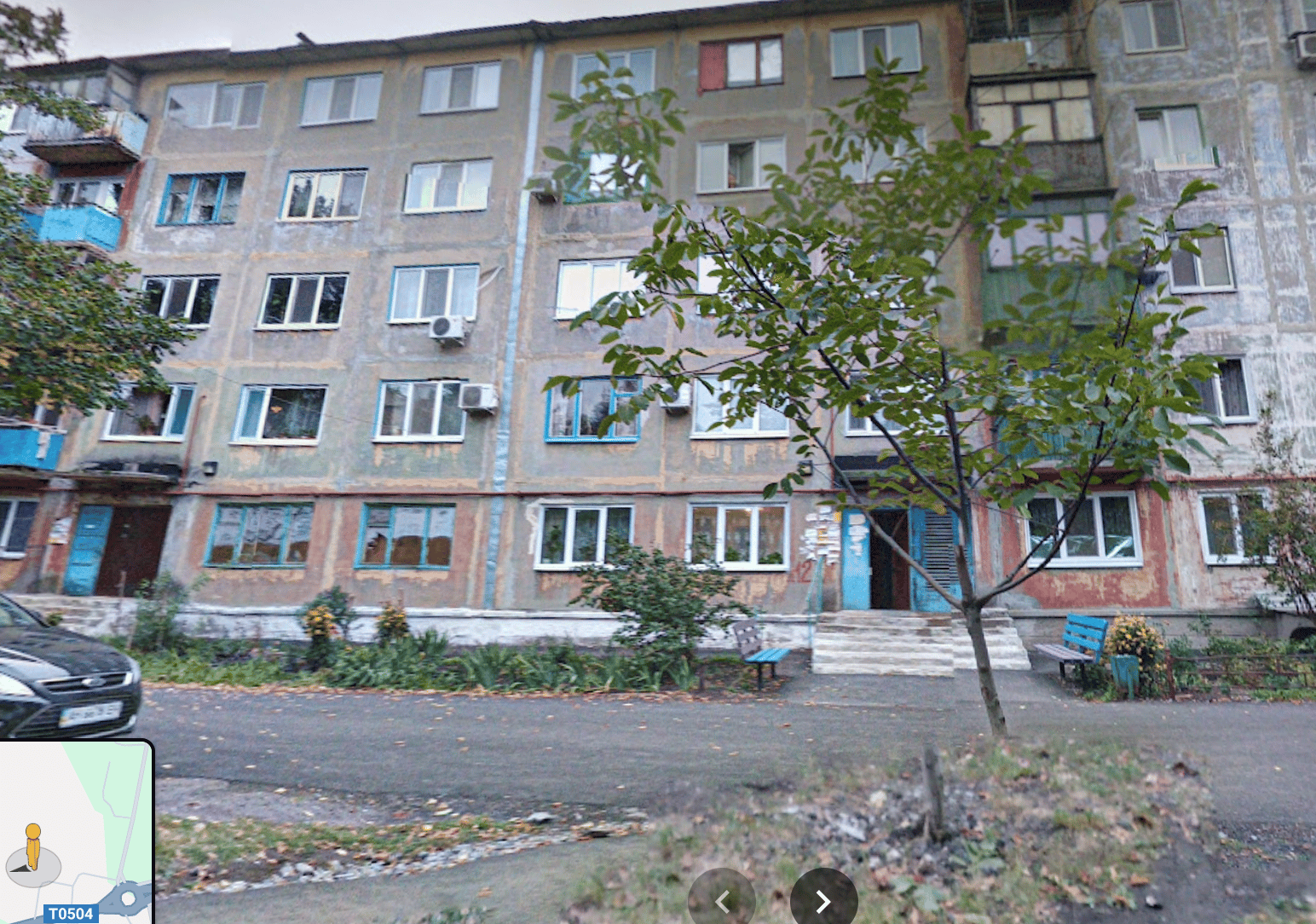
Google streetview of the apartment complex north east of Pokrovsk.
The Flanks Hold
In Rodynske itself, Ukrainian units have infiltrated the town to reinforce those cut off by Russian advances. Some Ukrainian sources have announced the complete recapture of the town, but this seems unlikely. The area around School 35 and Shakhtarska Street has turned into a no-man’s-land under constant bombardment—neither side fully in control, both taking heavy losses, according to Suriyak.Another reason Rodynske has proven such a difficult objective is its urban layout. The town is dominated by apartment blocks surrounded by parks and dense foliage, providing natural cover and defensive depth. This contrasts sharply with many of Pokrovsk’s outer suburbs, which consist mostly of single-storey residential homes that are far easier to bombard and clear.
One sector of the front that receives far less attention is the town of Udachne, located west of Pokrovsk. It has held firm for months and plays a crucial role in preventing a full collapse of the Ukrainian flanks. By “conventional,” we refer to infantry-based advances—because while ground assaults have been contained, Russian drone surveillance has severely restricted Ukraine’s ability to supply and reinforce Pokrovsk.
Sources:
News/Journal sources available upon request, not shown to maintain visual integrity of page.
TWEET OF THE DAY
I think Altman picked a fight with the wrong person 😂
You stole a non-profit
— Elon Musk (@elonmusk)
1:13 PM • Nov 1, 2025
TODAY IN HISTORY
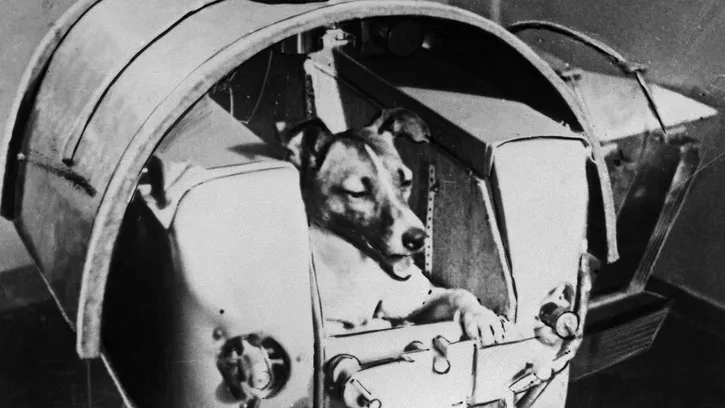
(November 2, 1976): Laika launched into space
On this day in 1957, Laika, a stray dog picked up by the Soviet spaceflight program, became the first living creature to be launched into space and orbit Earth.