- Basedment
- Posts
- Ukraine Strikes Back: Kupiansk
Ukraine Strikes Back: Kupiansk
While Ukraine has had setbacks on most of the frontline, it's position in Kupiansk has significantly increased, today we provide the latest information and analysis.

Editor-in-Chief
December 29, 2025
THE BRIEFING
Here’s what’s happening in geopolitics today.
Today’s headlines span diplomacy, deterrence and disaster relief, with fresh momentum claimed in U.S.-brokered Ukraine peace talks, China turning up the military pressure around Taiwan, and deadly counterterrorism operations unfolding in Turkey.
We’re also watching high-stakes Gaza diplomacy as Netanyahu meets Trump in Florida, alongside Washington’s latest, and notably leaner, humanitarian pledge to the United Nations.
In this Deep Dive, we’re providing an update on the city of Kupiansk as Ukraine continues to press forward in it’s counterattack, while Russian sources argue the front has stabilised.
QUICK WORD FROM TODAY’S SPONSOR
Want to take advantage of the current bull run?
If you want to take advantage of the current bull market but are hesitant about investing, online stock brokers could help take the intimidation out of the process. These platforms offer a simpler, user-friendly way to buy and sell stocks, options and ETFs from the comfort of your home. Check out Money’s list of the Best Online Stock Brokers and start putting your money to work!
THE LAST 24 HOURS IN GEOPOLITICS
1. Trump, Zelenskyy hail progress towards Russia-Ukraine peace deal
Trump said on Sunday after a meeting with Ukrainian President Volodymyr Zelenskyy at Mar-a-Lago that peace negotiations to end the Russia-Ukraine war are “a lot closer” following their discussions and an earlier phone call with Putin, describing the talks as “terrific” and noting significant progress on a U.S.-backed framework. Both leaders highlighted advances on much of a proposed 20-point peace plan, including agreement on security guarantees for Ukraine, but Trump acknowledged that thorny issues remain unresolved, particularly over territorial disputes such as the status of the Donbas region.
read more
2. China launches live-fire war games around Taiwan
China’s has launched large-scale live-fire military exercises around Taiwan under a campaign dubbed “Justice Mission 2025,” deploying army, navy, air force, rocket units and simulating blockades of key ports and joint combat operations in multiple zones surrounding the island. Beijing says the drills are a stern warning against Taiwanese “independence forces” and foreign interference, framing them as necessary to safeguard sovereignty, while Taipei has condemned the manoeuvres as provocative and placed its forces on high alert.
read more
3. 6 Islamic State militants and 3 police officers killed in clash in Northwest Turkey
A terrorism operation in Elmalı district, Yalova province in northwest Turkey on Monday turned deadly after police stormed a house believed to be sheltering Islamic State (IS) militants, resulting in the deaths of six militants and three Turkish police officers, Turkey’s interior minister said. The early-morning raid was part of a broader nationwide counter-terrorism offensive involving more than 100 simultaneous raids against IS suspects, and also left at least eight other officers and a night guard wounded. Special forces from neighbouring Bursa province were dispatched to reinforce the operation, and authorities took precautions by evacuating nearby civilians and restricting access to the area as investigations continue.
read more
4. Netanyahu to meet Trump in Florida for crucial Gaza talks
Netanyahu is meeting Trump at Mar-a-Lago resort in Florida on Monday, as Washington pushes to advance the second phase of a U.S.-brokered Gaza ceasefire plan that has stalled since its initial implementation in October. The talks are expected to focus on ways to move beyond the fragile first phase of the truce and on broader regional concerns such as Iran’s activities and Hezbollah’s threat. While the initial ceasefire reduced large-scale hostilities and saw most hostages released, disagreements remain between Israel, Hamas and Washington over the next steps.
read more
5. U.S. pledges $2 billion in humanitarian support to UN
The U.S. announced it will pledge US $2 billion in humanitarian support to the United Nations amid a broader reduction in U.S. foreign aid under the Trump administration, according to a U.S. State Department official. This funding, significantly lower than Washington’s contributions in previous years, will be channelled into an umbrella fund for U.N. emergency operations and is intended to support crises in countries such as Bangladesh, Congo, Haiti, Syria and Ukraine while also reflecting U.S. demands for reform within the U.N. humanitarian system.
read more
DAILY DEEP DIVE
KUPIANSK: The Battle Rages On
Context
For months, analysts flagged the growing vulnerability of the Kupiansk flank, particularly after Russia’s uneven infiltrations across the area. Key suburbs such as Sobolivka and, more critically, Moskova were never properly consolidated. While Russian DRG activity along the Moskova–Sobolivka axis was frequent, it failed to translate into durable control. Further north near Radkivka, Ukrainian forces initially achieved only limited gains, constrained by dense forests, harsh terrain, and deteriorating weather, which forced Kyiv into a cautious, small-scale approach. Russian command recognised the threat and deployed specialised drone units, including the Rubikon group, transforming approaches north of Radkivka and Kindrashivka into layered kill zones. Over time, however, Ukrainian forces penetrated these zones through speed and coordination, blunting Russia’s drone advantage. After Russian units crossed the Oskil River and seized northern high ground, Ukrainian command under Oleksandr Syrskyi launched a counteroffensive on September 21, led by the Khartiya Corps. Despite Vladimir Putin later declaring Kupiansk captured, corruption and false reporting within Russian ranks likely masked incomplete control, enabling renewed Ukrainian counterattacks.
Now
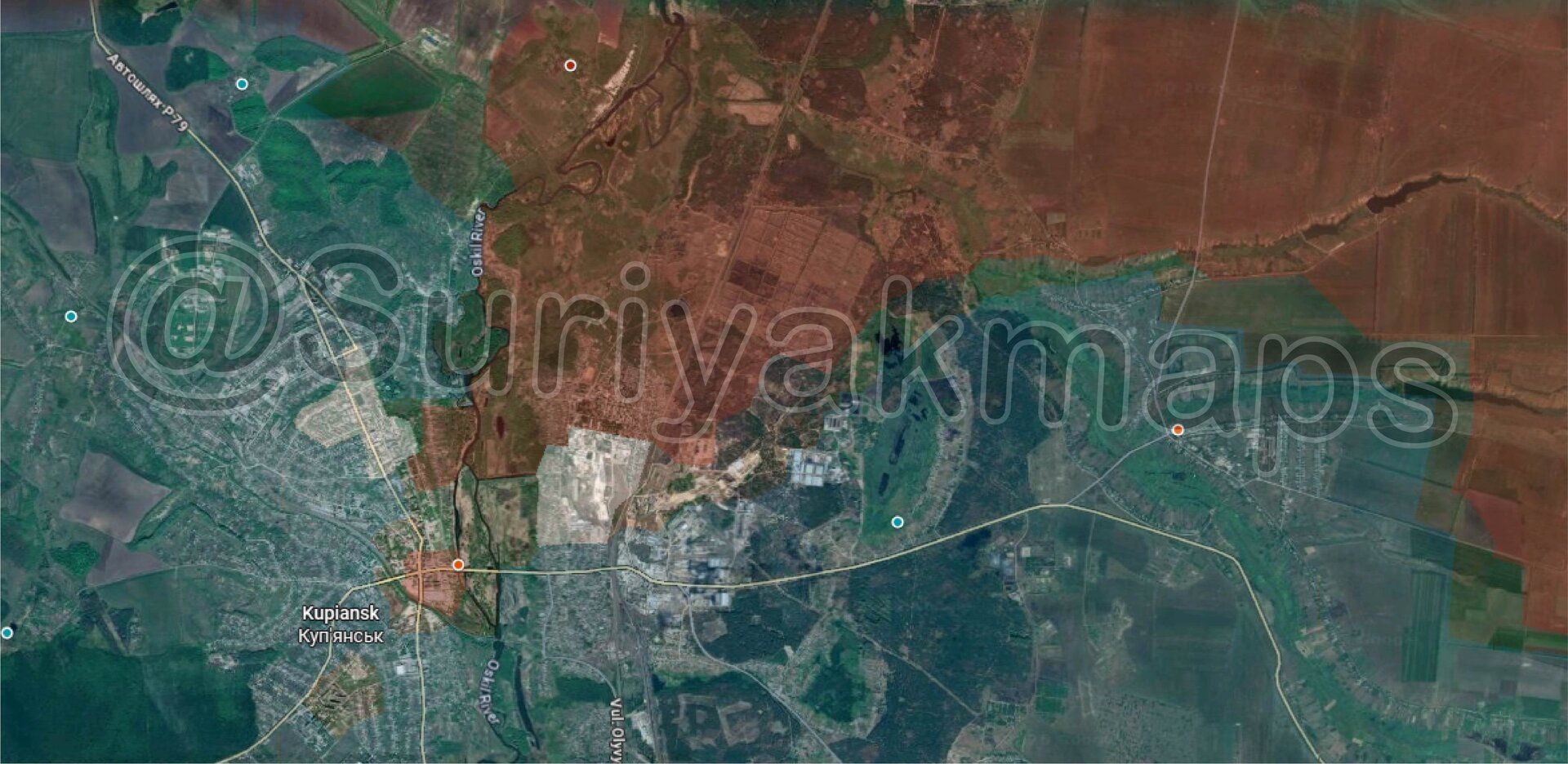
According to Suriyak, the situation around Kupiansk has clarified into two contested “white zones” on both banks of the Oskil River, where Russian and Ukrainian forces are in constant, fluid engagement. Ukraine’s counteroffensive initially succeeded due to a lack of Russian reinforcements. Russia has since intensified bombardment to relieve scattered units inside the city. The dynamic increasingly mirrors Toretsk earlier this year, raising the possibility of a prolonged, back-and-forth battle through summer.
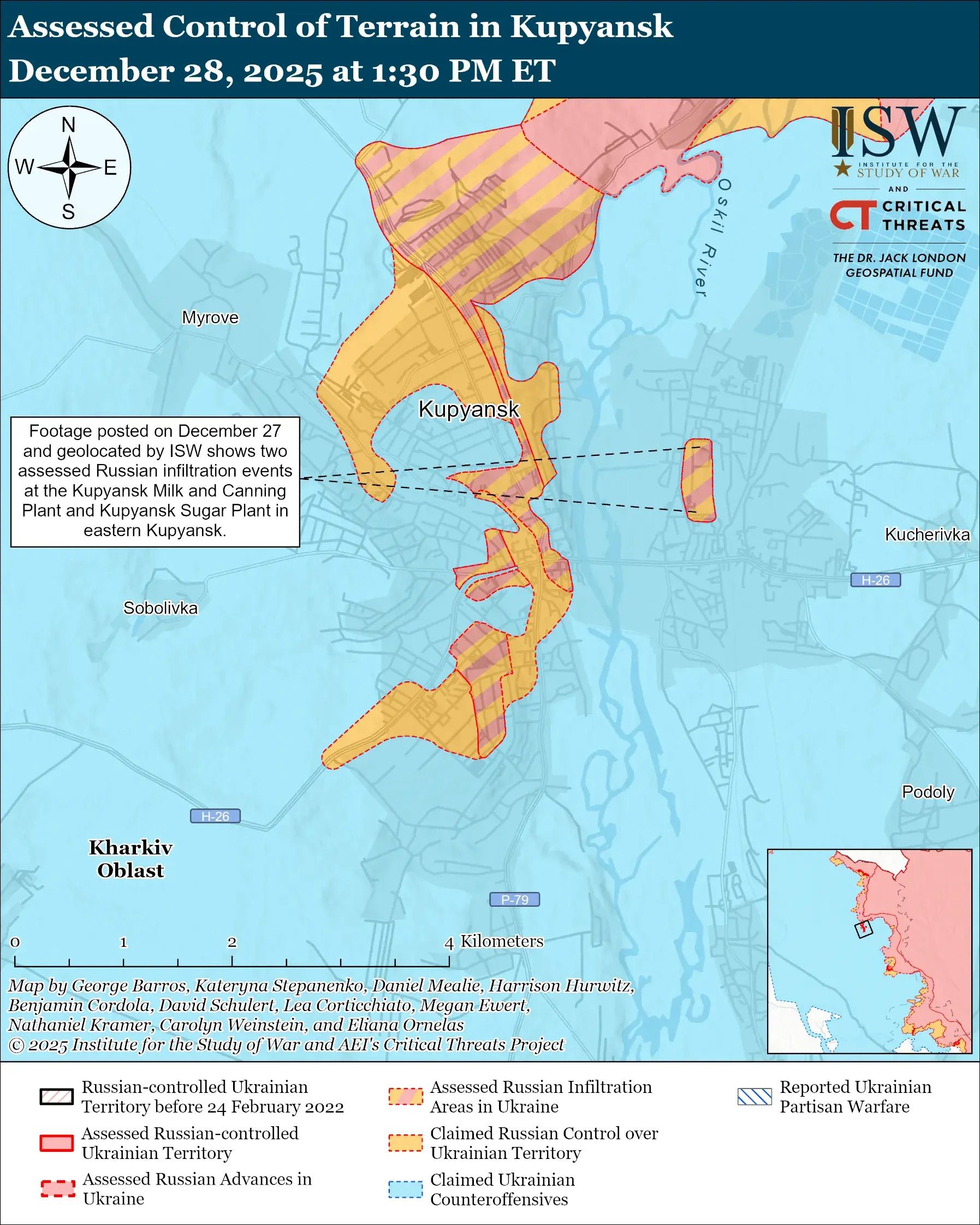
ISW has said: footage published on December 27 and geolocated on December 28 shows Russian forces operating in eastern Kupiansk during infiltration missions that did not alter terrain control or the forward edge of the battle area (FEBA). According to ISW, Russian attacks occurred in and around Kupyansk, including Mala Shapkivka, Petropavlivka, and Pishchane. ISW notes that the Russian Ministry of Defense continues to publish footage and statements claiming advances in the Kupiansk direction, likely to obscure recent operational setbacks amid mounting criticism. A Russian milblogger echoed this assessment, describing Kupyansk as a “sore point” in late December and accusing Russian command of making exaggerated claims for informational and psychological effects that were later disproven.
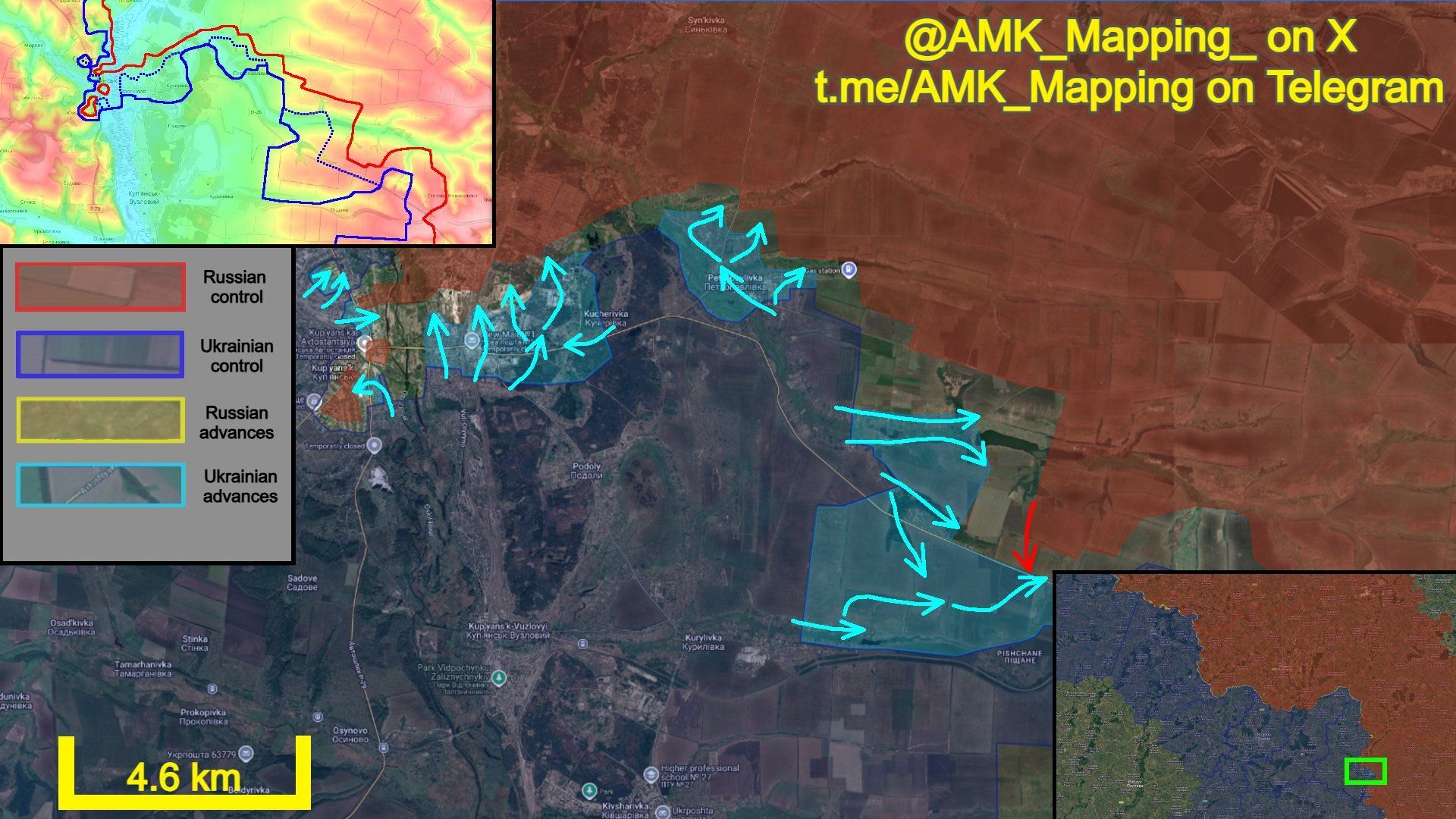
AMK_Mapping is the main source I have found discussing the Ukrainian gains in the further east villages of Kupiansk. Ukrainian units again cleared Russian DRGs from Kurylivka, advancing northeast through treelines and southeast via forested gullies, overrunning poorly consolidated Russian positions and pushing back toward the highway. Ukrainian forces also recaptured the southeastern part of Petropavlivka and secured the forest plantations to its south. Coordinated attacks from Kurylivka enabled Ukrainian assault groups to re-enter the industrial zone east of the railway line, rapidly reclaiming most of it and forcing Russian troops to withdraw from the village and adjacent forests. Russian forces are now attempting counterattacks near the highway as fighting remains fluid across the eastern approaches to Kupyansk.
My Comment
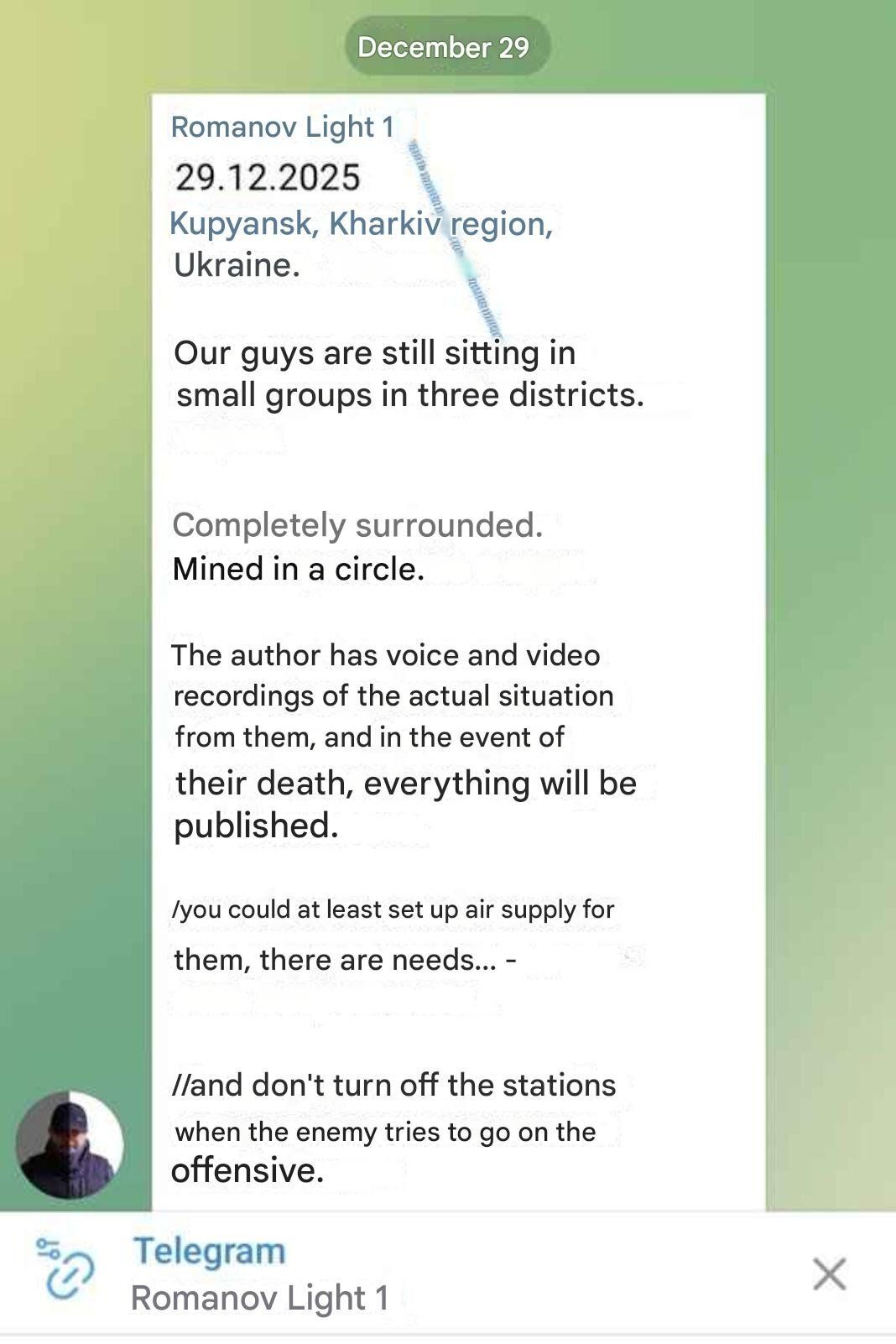
Based on Russian Telegram reporting used to source the image below, there appear to be three isolated pockets of Russian soldiers remaining within the main suburbs of Kupiansk. These forces are likely remnants of units that attempted to retreat across the Oskil River, or late contingents pushed through northern routes in an effort to stabilise the situation. Their apparent isolation suggests fragmented command and limited coordination, with little capacity to influence the broader fight. This reinforces the assessment that Russian positions inside Kupiansk are uneven, contested, and increasingly vulnerable to continued Ukrainian clearing operations.
That said, the reality on the ground is likely far more fluid than maps suggest. During active advances, frontlines blur, and we should expect further Russian infiltration attempts into Ukrainian positions. The key question now is whether Russia will try to stabilise the line or attempt a counterattack toward the city.
Let us know below.
Sources
News/Journal sources available upon request, not shown to maintain visual integrity of page.
TODAY IN HISTORY
(December 29, 1852): Arrested for wearing pants
On this day in 1852, Emma Snodgrass was arraigned in Boston because she was a woman wearing trousers. This was a time when activists were calling for “rational dress” for women, including bloomers and trousers, as an alternative to long, bulky skirts.