- Basedment
- Posts
- Ukrainian Advances Continue On Southern Front
Ukrainian Advances Continue On Southern Front
Today we get more information coming out of the Ukraine-Russia front on this new supposed offensive as others argue it's not really an offensive.

Editor-in-Chief
February 12, 2026
THE BRIEFING
Here’s what’s happening in geopolitics today.
It’s a day that spans summit diplomacy, domestic political survival, and sobering security headlines. Washington deepens ties with Azerbaijan as Turkey reshuffles its cabinet, while Britain’s prime minister fights to steady his leadership amid internal pressure.
Meanwhile, tragedy strikes in Canada and U.S. forces conduct another counternarcotics operation in the Eastern Pacific.
Today we get more information coming out of the Ukraine-Russia front on this new supposed offensive as others argue it's not really an offensive.
WORD FROM TODAY’S SPONSOR
Amazon Prime members: See what you could get, no strings attached

If you spend a good amount on Amazon, do not ignore this. This card could put $100s back every year and gives you the chance to earn cash back on the purchases you already make. You could get approved extremely fast and unlock a massive welcome bonus instantly. Amazon Prime members: See what you could get, no strings attached
THE LAST 24 HOURS IN GEOPOLITICS
1. US and Azerbaijan sign strategic partnership charter during Vance visit
The United States and Azerbaijan signed a “Charter on Strategic Partnership” in Baku on Tuesday during a visit by JD Vance, formalising expanded cooperation across economic, security and technological areas and marking a deepening of bilateral ties. Azerbaijani President Ilham Aliyev and Vance said the agreement will usher in a “new phase” of US–Azerbaijan relations, with commitments to collaborate on defence sales, energy security, counter-terrorism and broader regional connectivity initiatives.
read more
2. Woman kills nine in shootings at School and house in Canada
A mass shooting in the rural town of Tumbler Ridge, British Columbia, left nine people dead on Tuesday, with six victims found at Tumbler Ridge Secondary School and two more at a nearby residence, according to the Royal Canadian Mounted Police. Police said the suspected shooter, described as a female in a dress, was also found dead at the scene from what appeared to be a self-inflicted injury, and authorities believe there is no ongoing threat to the public. In addition to the fatalities, more than 25 people were injured, including several with serious or life-threatening wounds.
read more
3. Two dead, one survivor in latest US strike on suspected narco boat
U.S. military forces struck a suspected drug-trafficking vessel in the eastern Pacific on Monday, killing two people and leaving one survivor, according to U.S. Southern Command, which said the boat was moving along intelligence-identified narco-trafficking routes. The strike, conducted under what the military described as a “lethal kinetic” operation, prompted U.S. Southern Command to notify the U.S. Coast Guard, which activated search-and-rescue efforts for the lone survivor.
read more
4. Turkish President appoints new justice and inferior ministers in cabinet reshuffle
Erdogan has appointed new ministers for both the Justice and Interior portfolios in a cabinet reshuffle published Wednesday in the Official Gazette, signaling changes at the top of Ankara’s government. Istanbul Chief Public Prosecutor Akın Gürlek was named the new Justice Minister, replacing Yılmaz Tunç, while Erzurum Governor Mustafa Çiftçi was appointed Interior Minister, succeeding Ali Yerlikaya. The reshuffle takes effect immediately and reflects Erdogan’s constitutional authority to reassign key cabinet posts, though officials provided no detailed public explanation for the changes.
read more
5. I will never walk away, says PM after facing pressure to quit
British Prime Minister Sir Keir Starmer has publicly vowed he will “never walk away” from his role or mandate after facing mounting pressure to resign from within his own party, including a call from Scottish Labour leader Anas Sarwar to step down amid growing political turmoil. Speaking at a community event in Hertfordshire, Starmer said the infighting and criticism would not deter him from focusing on issues like the cost of living and opportunities for disadvantaged citizens, emphasising his commitment “to the people that I’m charged with fighting for” and “the country that I love.”
read more
DAILY DEEP DIVE
Is This An Offensive or Not? It’s A Growing Debate.
Huliaipole–Pokrovske Direction
Over the past week, Ukrainian forces have retaken Ternuvate, Vovche, Sosnivka, Staroukrainka, and Prydorozhnje along the Zaporizhzhia–Dnipropetrovsk axis. The gains are concentrated around the Haychur River and the base of the Dobropillia salient. According to AMK_Mapping, rather than a deep breakthrough, these appear to be coordinated clearing operations targeting lightly held Russian positions that were not fully consolidated. Limited mechanised activity has been reported near Pryluky–Dobropillia, but advances remain shallow. The focus seems to be restoring defensive integrity, closing local breaches, and exploiting temporary Russian weaknesses in communications and force density rather than launching a theatre-level counteroffensive.
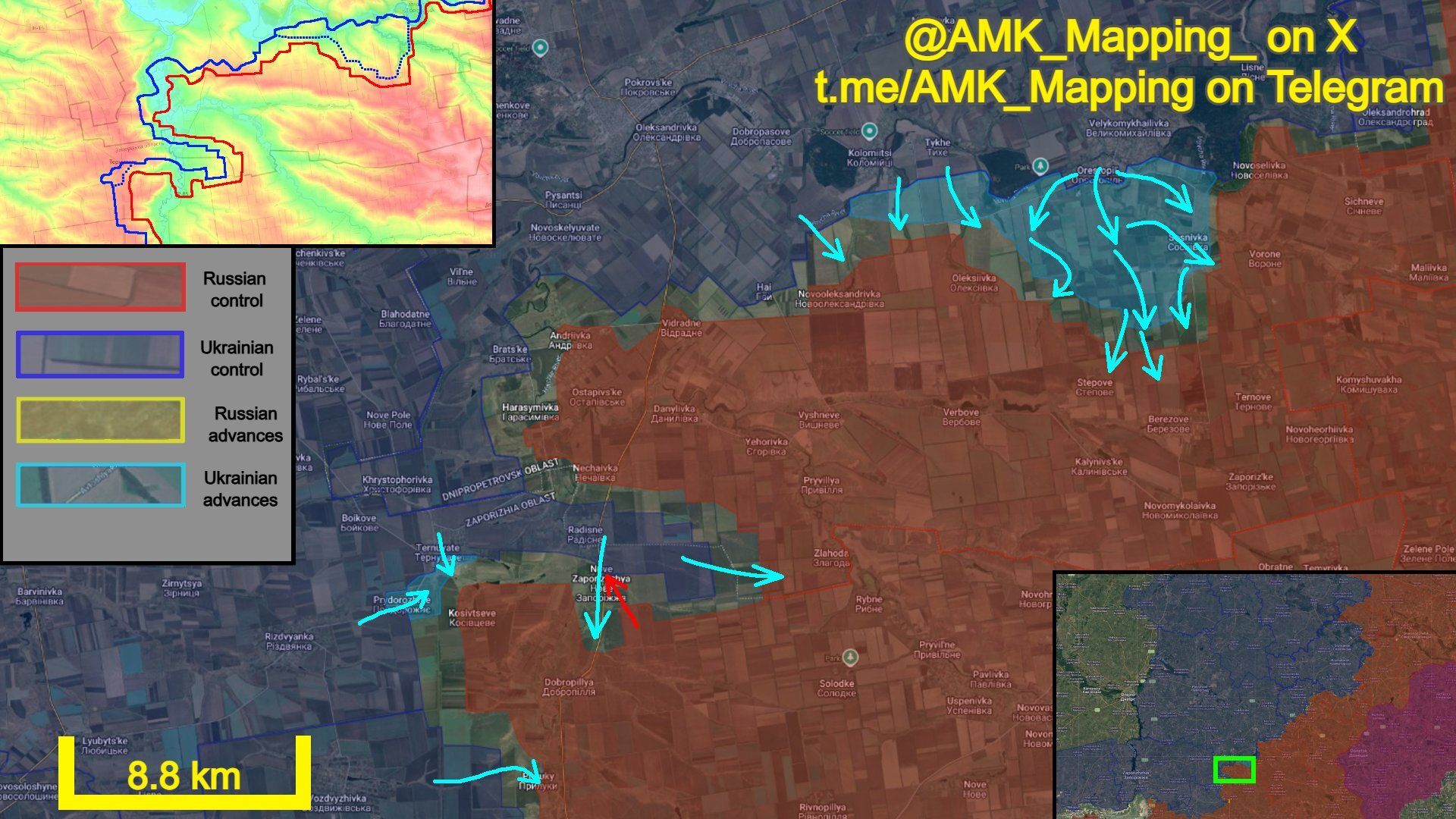
South of Zaporizhzhia City – Vasylivka Front
On the Vasylivka axis, Ukrainian forces have regained positions in northern Prymorske and near Richne after eliminating small Russian forward groups. Novoboikivske and Novoyakovlivka have been secured again, Lukyanivske was recaptured, and fighting resumed in Pavlivka. These actions suggest controlled pushbacks designed to roll back incremental Russian gains and stabilise the defensive line south of Zaporizhzhia city. Instead of sweeping offensives, Ukrainian units appear focused on denying Russia forward positions and tightening local front geometry. The activity reflects disciplined positional recovery, strengthening depth and cohesion while avoiding overextension into fortified defensive belts further south.
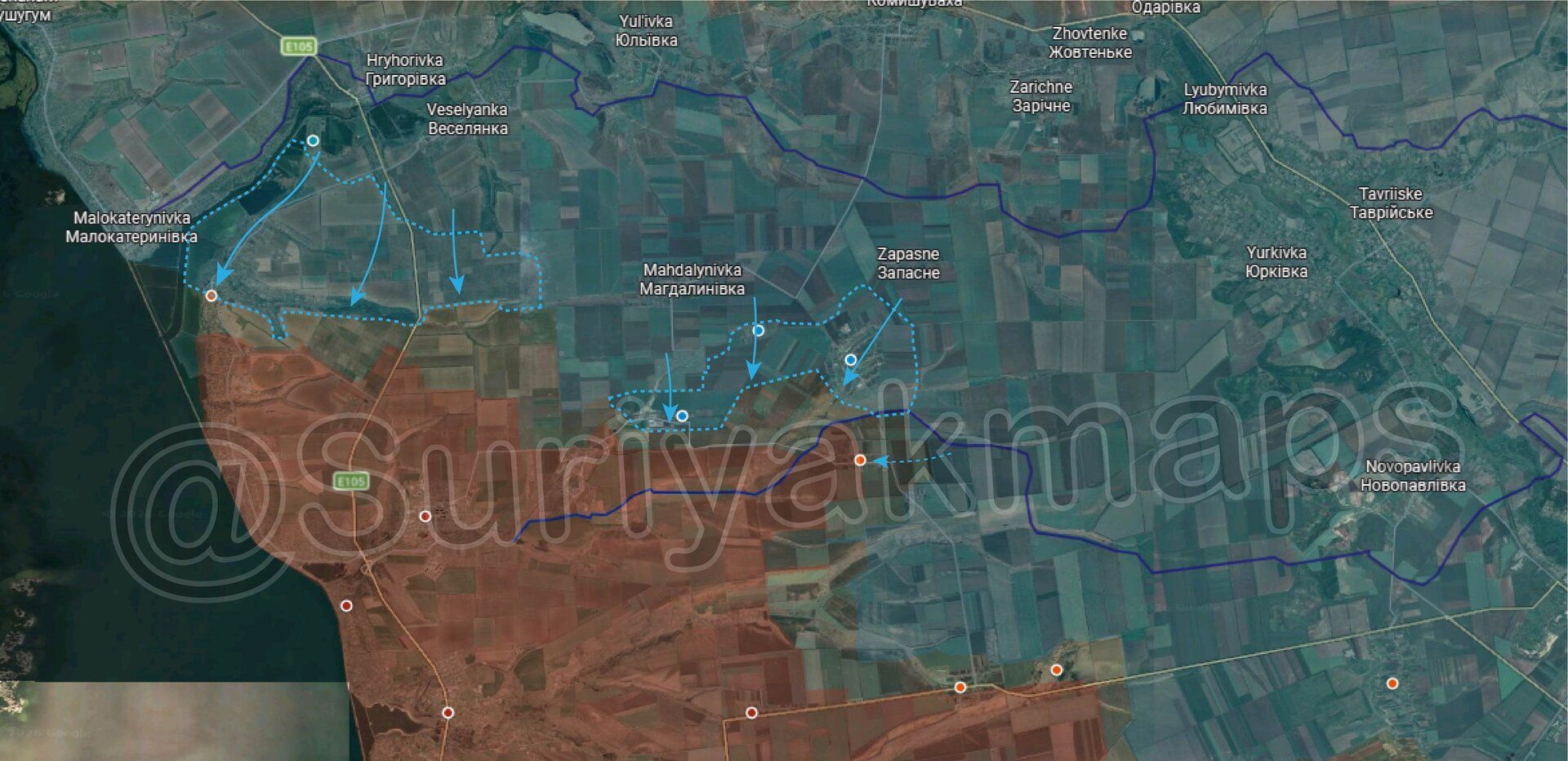
Is This A Counter-Offensive Or Not?
A debate has emerged over whether Ukraine’s recent activity in the Huljajpole–Pokrovske direction constitutes a genuine counteroffensive or merely localized tactical corrections. What’s notable is that, in a rare moment, commentators from opposing political camps appear to be unintentionally aligning. Some pro-Ukrainian analysts, such as Playfra, argue these are large-scale clearing operations rather than a structured operational push. Ironically, certain pro-Russian accounts have made a similar claim—though for entirely different reasons.
Downplaying an offensive serves morale on both sides. Ukrainian counteroffensives have previously been controversial and, at times, costly, making expectations management important. Meanwhile, for some Russian supporters, denying the existence of an offensive helps avoid acknowledging territorial losses. To be clear, this observation refers specifically to the more irrational or extremely biased voices on both sides—not all supporters or analysts.
We’ve linked a great exchange between two analysts – Playfra and Thorkill – who debate whether this is an offensive or not: Playfra argues the gains—such as in Prydorozhnie, Ternuvate, and Staroukrainka—reflect coordinated clearing operations against lightly consolidated Russian positions, exploiting temporary weaknesses like communications disruptions and operational pauses. He compares the situation to the September 2025 Dobropillia actions, framing it as limited battlefield shaping rather than a theatre-level push. Advancing toward hubs like Uspenivka, he contends, would require costly river crossings and assaults on fortified belts. Thorkill disagrees, pointing to redeployments of the 475th Assault Regiment and 82nd Air Assault Brigade as indicators of structured intent. He argues that multiple axes of attack, even in early phases focused on closing breaches near the Haychur River, fit the pattern of a phased counteroffensive. Ultimately, the disagreement hinges on definition: tactical exploitation versus operational buildup.
My View
In my view, this represents a localised offensive rather than a simple clean-up of weakly defended positions. As noted recently, Ukraine appears to be wagering that the Pokrovsk and Kupiansk fronts are sufficiently stabilised to allow the redeployment of reinforcements to this sector. Thorkill makes a similar argument, pointing to the transfer of battle-hardened formations. The reported destruction of an Abrams tank near Huliaipole also suggests the presence of elements from the 47th Mechanised Brigade and the 425th Separate Assault Regiment. High-value Western armour is unlikely to be committed purely for minor clearing operations, indicating a more deliberate operational intent.
At the same time, the disruption of Russian Starlink access appears to have had a net negative impact on Russian forces. Localised Ukrainian counterattacks are occurring across several sectors, and Russian DRG units reportedly face growing difficulties in communication and coordination following the cutoff.
Sources
News/Journal sources available upon request, not shown to maintain visual integrity of page.
TODAY IN HISTORY
(February 11, 1858): St. Bernadette's first visions of Mary at Lourdes
On this day in 1858 in Lourdes, France, 14-year-old Bernadette Soubirous, a miller's daughter, first had visions of the Virgin Mary that were authenticated by Pope Pius IX in 1862, initiating the cult of Our Lady of Lourdes.