- Basedment
- Posts
- Underwater Drones In Ukraine, And Is The U.S. Prepared?
Underwater Drones In Ukraine, And Is The U.S. Prepared?
Ukraine’s drone strike on a Russian submarine highlights how modern naval warfare is being reshaped by cheap, asymmetric technologies that even major powers are struggling to counter.

Editor-in-Chief
December 17, 2025
THE BRIEFING
Here’s what’s happening in geopolitics today.
From explosions in eastern Syria and a dramatic escalation in U.S. pressure on Venezuela’s oil trade, to major criminal cases unfolding in Los Angeles and Sydney, today’s headlines span conflict, coercion and accountability.
Europe also takes a significant legal step against Russia by launching a new international commission to assess war damages in Ukraine, underscoring how the long tail of the conflict is moving from the battlefield to the courtroom.
In today’s Deep Dive we go over Ukraine’s recent attack on a Russian submarine using drones and we assess how exposed U.S. bases and fleets are to similar attacks.
A MESSAGE FROM OUR PARTNER
THE LAST 24 HOURS IN GEOPOLITICS
1. Car loaded with ammunition exploded in Al-Bukamal, Syria
An explosion rocked the city of Al-Bukamal in eastern Deir ez-Zor province on Tuesday when a car loaded with ammunition belonging to the Syrian Transitional Government’s Ministry of Defense detonated, according to local eyewitnesses. The blast sent flames and smoke billowing from what appeared to be a military pickup truck, and activists reported casualties and injuries while a security alert was declared in the area. No official government statement has yet been released clarifying the cause of the explosion or the number of victims.
read more
2. Trump blockades sanctioned oil tankers from Venezuela
Trump announced a “total and complete blockade” of all oil tankers designated under U.S. sanctions entering or leaving Venezuela, sharply escalating pressure on President Nicolás Maduro’s government and its oil-dependent economy. The move follows the seizure of a large sanctioned oil tanker off Venezuela’s coast by U.S. forces, an unprecedented maritime enforcement action that sent global oil prices higher and drew condemnation from Caracas as an illegal act. Trump framed the blockade as part of a broader campaign targeting illicit trafficking and state support for “narco-terrorism,” while critics and legal experts have raised concerns about its legality and potential to further destabilise regional energy markets.
read more
3. Nick Reiner charged with murder of his parents Rob and Michele Reiner
Nick Reiner, 32, has been formally charged with two counts of first-degree murder in the stabbing deaths of his parents, acclaimed Hollywood filmmaker Rob Reiner and photographer-producer Michele Singer Reiner, inside their Brentwood, Los Angeles home. Los Angeles County District Attorney Nathan Hochman announced the charges include special circumstances which could make the case eligible for life imprisonment without parole or the death penalty if convicted.
read more
4. Accused gunman charged with 59 offences including 15 counts of murder
The 24-year-old man accused of carrying out the deadly Bondi Beach shooting has been formally charged with 59 offences, including 15 counts of murder, after waking from a coma in a Sydney hospital where he remains under police guard. Police allege the charges also include one count of committing a terrorist act, 40 counts of wounding with intent to murder, and multiple firearm-related offences linked to the attack on a Hanukkah celebration that killed 15 people and wounded dozens more. The joint counter-terrorism team from New South Wales Police, the Australian Federal Police, and national intelligence agencies laid the charges following extensive inquiries under Operation Arques into the incident.
read more
5. Europe launches international commission for Ukraine war damages
European leaders, joined by Zelenskyy and representatives from over 30 countries, have formally launched an International Claims Commission in The Hague to assess and validate compensation claims for war-related damages caused by Russia’s invasion of Ukraine. The commission will work from a Register of Damage that has already received tens of thousands of submissions and is charged with reviewing claims for infrastructure destruction, personal injuries, and other losses, though mechanisms for financing eventual payments have yet to be finalised. Establishing the commission under a treaty framework backed by the Council of Europe and dozens of states marks a significant step in international efforts to hold Russia accountable for the humanitarian and economic costs of the war.
read more
DAILY DEEP DIVE
A New Age In Naval Warfare
What Happened?
On the 16th of December, the SBU released footage of what appeared to be a hacked security camera panning to the moment of underwater detonation next to a Kilo-class submarine. Early reporting was quick to suggest the submarine was either destroyed or beyond repair. However,sSatellite imagery following Ukraine’s strike on the submarine in Novorossiysk shows visible damage to the pier, indicating the use of a substantial explosive charge. While the full extent of damage to the submarine remains unclear, imagery suggests the vessel’s bow may have been affected. Russian state media did release their own photos, however, not from the side of where the explosion happened. Repair options are limited: Russia’s main submarine repair hub in Sevastopol has already been hit by Ukrainian strikes, previously destroying the Rostov-on-Don.
It is still unclear which submarine was damaged. Russia’s Kalibr-capable Black Sea fleet includes B-265 Krasnodar, B-268 Veliky Novgorod, and B-271 Kolpino — all Project 636 “Varshavyanka” (Kilo-class) submarines. These diesel-electric boats typically carry crews of 52, operate up to 45 days, dive to 300 meters, and are prized for their low acoustic signature, earning the nickname “Black Hole.” Each submarine is valued at roughly $400–500 million. Whether repairs are feasible, and how long they would take, remains unknown.
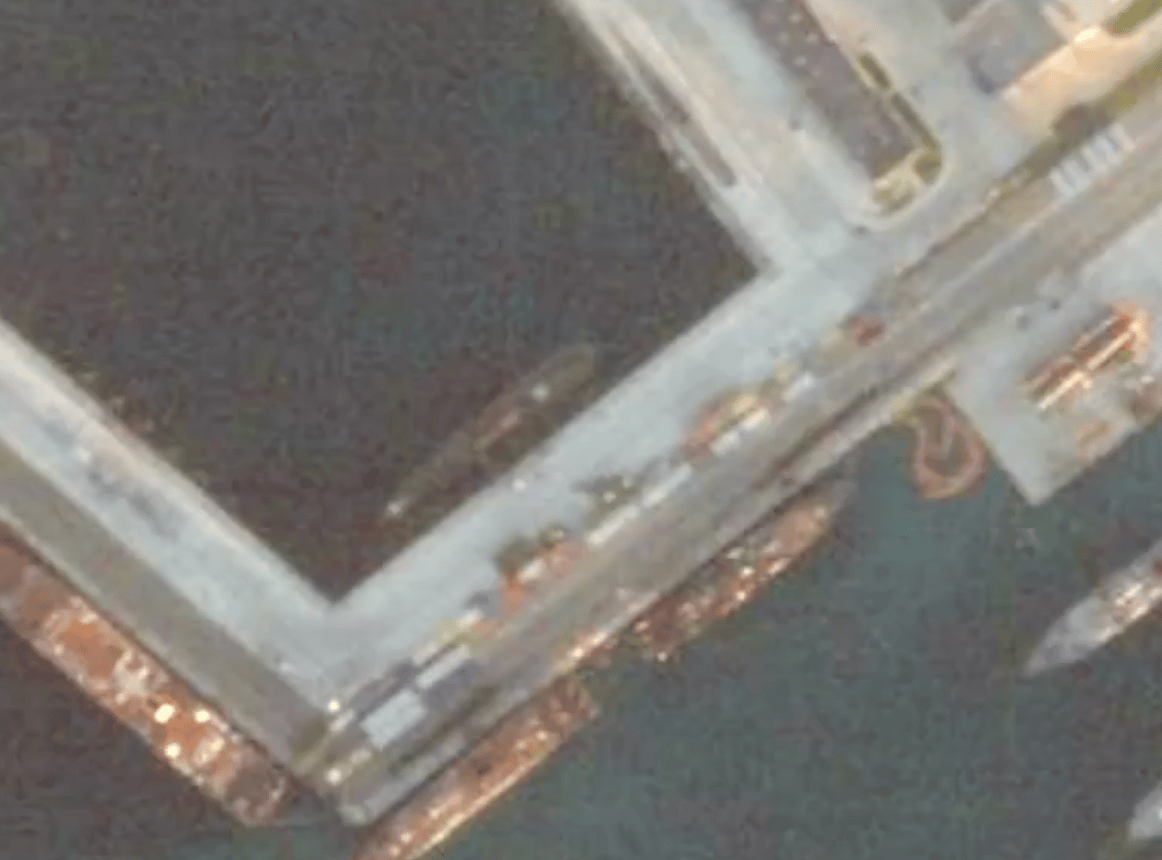
Satellite imagery before the attack.
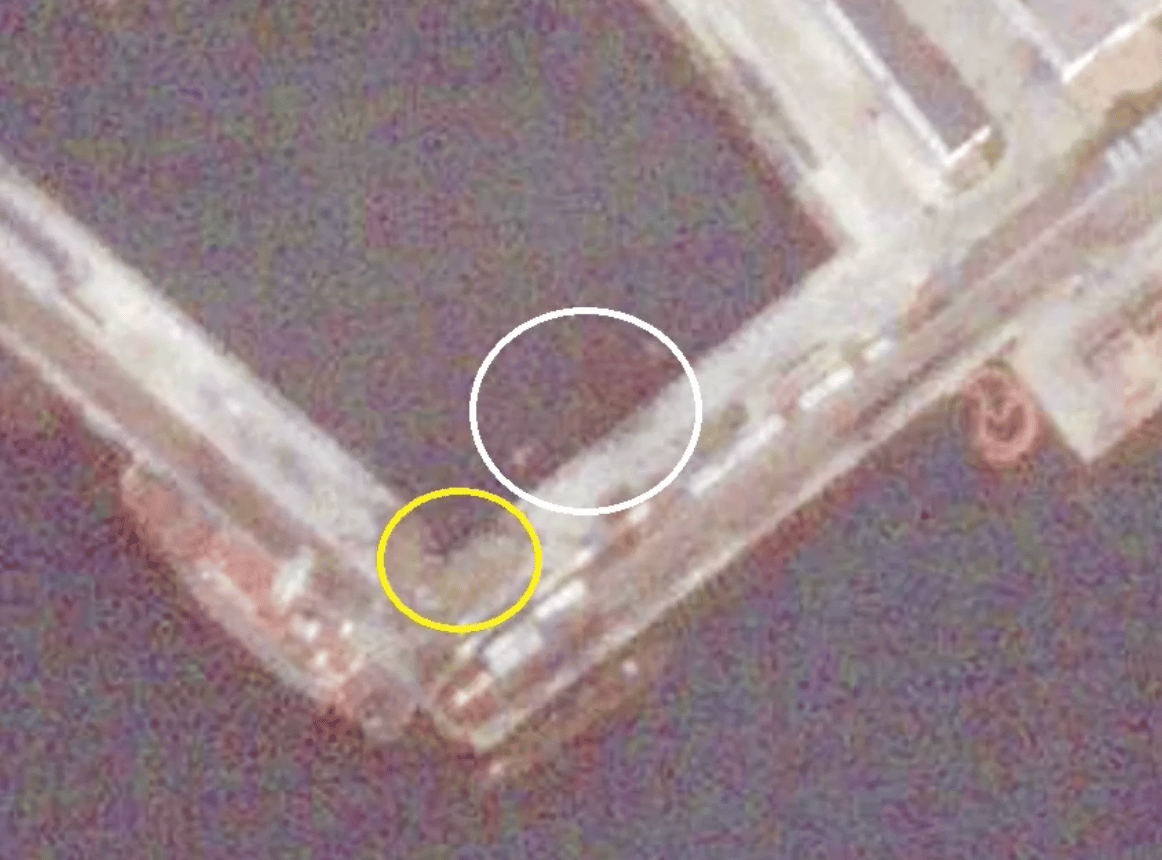
Yellow is the damage to the pier, the sub is circled in white.
Which Drone Was Used?
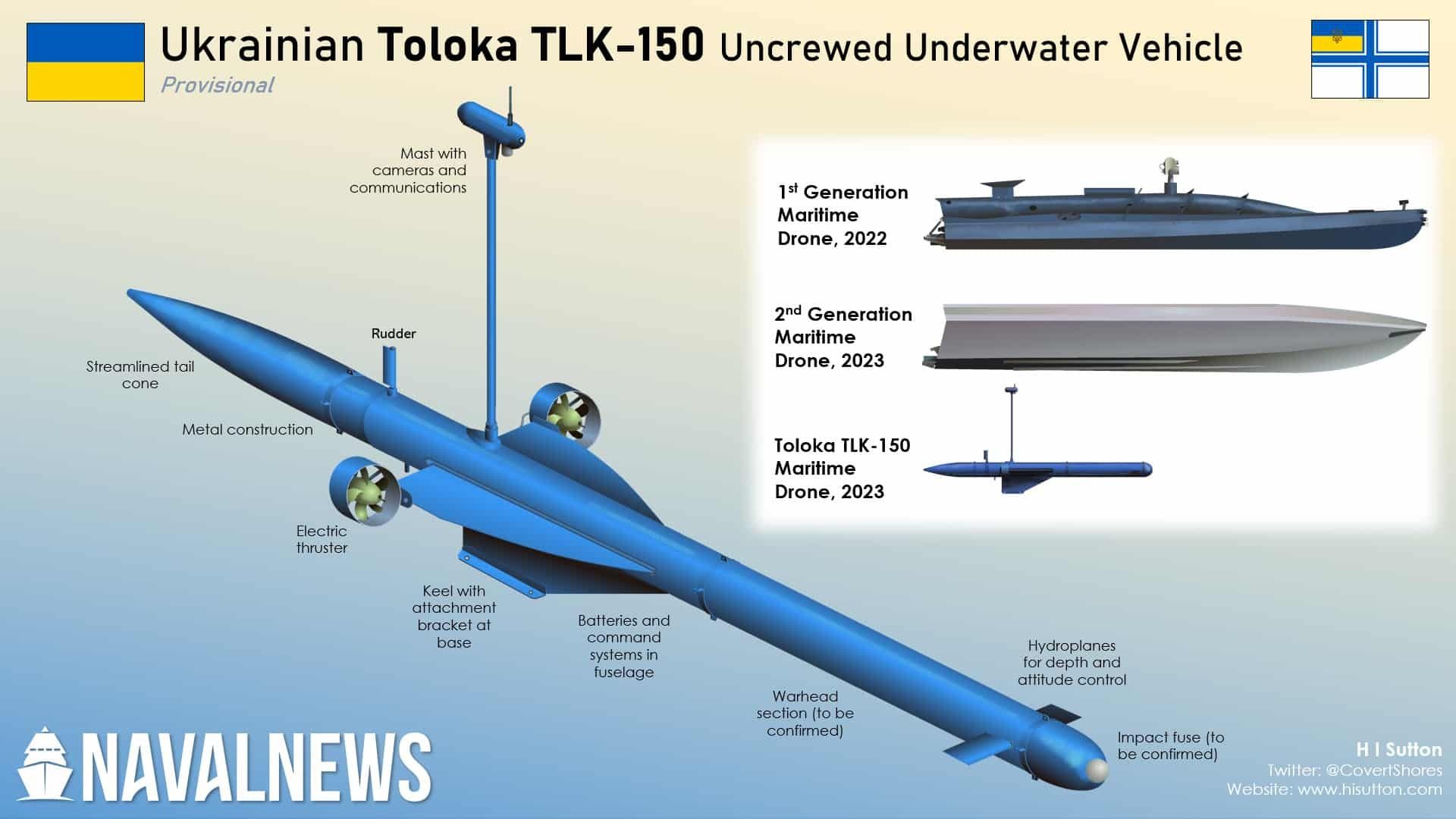
Ruslan Leviev (founder of CITeam) notes that details about Ukraine’s reported “Sub Sea Baby” underwater drone remain unclear, but suggests it likely resembles earlier systems like Toloka. Rather than a true deep-running torpedo-style drone, it is probably a submersible operating near the surface, using a mast for GPS and Starlink communications. Fully underwater control would require far more complex inertial navigation. Such mast-based designs are easier to detect than true underwater drones.
Is The U.S Prepared For This New Type of War?
Ukraine’s ability to target and dismantle Russia’s Black Sea Fleet without possessing a traditional navy will be studied for decades. We are watching a real-time case study unfold, with few historical precedents for this form of naval warfare. While opponents of Russia may mock what are, objectively, embarrassing failures, this assessment comes from a non-biased perspective. These are not isolated incidents, but repeated successful strikes on submarines and surface vessels inside heavily protected zones using drones.
Russia has adapted tactically, but it has not yet absorbed the full strategic lesson. More importantly, the Western world is no better prepared for this new era of naval warfare. U.S. naval bases lack anti-drone netting, hardened underwater defenses, or effective countermeasures against an “Operation Spider Web”-style attack on critical ports.
At the same time, underwater drones in the United States are advancing rapidly across both military and commercial roles. Programs like DARPA’s Manta Ray, the Navy’s Orca XLUUV, and REMUS focus on long-endurance autonomous missions such as seabed mapping, mine countermeasures, and intelligence collection, while commercial systems like Terradepth and Kongsberg’s HUGIN expand deep-sea surveying and infrastructure inspection. The concern, however, is cost and complexity. The U.S. Marine Corps’ new FPV drone reportedly costs around $70,000 per unit, compared to Ukrainian FPVs that cost a few hundred to roughly $1,000. The Military Industrial Complex loves to throw big price tags on these items, but inevitably this will prove a major kink in the armour.
There is some hope. South Korea’s Hanwha has partnered with U.S. startup Vatn Systems to develop low-cost autonomous underwater drones for the U.S. Navy, aiming to scale undersea surveillance and strike capabilities amid growing competition with China.
Sources:
News/Journal sources available upon request, not shown to maintain visual integrity of page.
TODAY IN HISTORY
(December 17, 2014: The United States and Cuba reestablished diplomatic relations that had been suspended for more than 50 years.