- Basedment
- Posts
- Who Are The Countries In Trump's Peace Stabilisation Force?
Who Are The Countries In Trump's Peace Stabilisation Force?
Today we focus on five countries who are committing to Trump's Gaza plan, what their roles will be and what their history with Israel and the U.S. is.

Editor-in-Chief
February 21, 2026
THE BRIEFING
Here’s what’s happening in geopolitics today.
Today’s global news cycle runs the gamut from big dollars and big diplomacy to defence and foreign policy realignments: Donald Trump unveiled a headline-grabbing $10 billion contribution to his Board of Peace for Gaza reconstruction, while Yvette Cooper heads to Washington to meet Marco Rubio amid tensions over a key joint air base.
Meanwhile, Europe’s biggest militaries agreed to jointly develop low-cost air defences, Spain urged the European Union to lift sanctions on Venezuela, and Iran signalled a potential counterproposal in nuclear talks could be ready within days.
In today’s deep dive, we focus on five countries who are committing to Trump's Gaza plan, what their roles will be and what their history with Israel and the U.S. is.
WORD FROM TODAY’S SPONSOR
Smarter news. Fewer yawns

Business news takes itself way too seriously.
Morning Brew doesn’t.
Morning Brew delivers a smart, skimmable email newsletter on the day’s must-know business news — plus games that make sticking around a little more fun. Think crosswords, quizzes, and quick breaks that turn staying informed into something you actually look forward to.
Join over 4 million professionals reading Morning Brew for free. And walk away knowing more than you did five minutes ago.
THE LAST 24 HOURS IN GEOPOLITICS
1. Trump announces $10B donation to Board of Peace
Trump announced that the United States will contribute $10 billion to the newly established Board of Peace at its inaugural meeting in Washington, pledging the largest single funding commitment to the initiative aimed at facilitating reconstruction and stabilization in Gaza Strip. Trump made the announcement alongside news that nine other member countries have pledged roughly $7 billion for Gaza relief and reconstruction, although overall funding needs are estimated far higher. While framed as a major step for global peacebuilding, questions remain about how the funds will be allocated and the role the board will play relative to existing international institutions.
read more
2. UK Foreign Minister Yvette Cooper to meet Marco Rubio
Britain’s Foreign Secretary Yvette Cooper is scheduled to meet U.S. Secretary of State Marco Rubio in Washington on Friday amid rising tensions with the U.S. over a sovereignty deal for the Chagos Islands, home to the strategically important joint U.K.–U.S. military base on Diego Garcia. The meeting follows renewed criticism by Donald Trump of London’s transfer of sovereignty of the islands to Mauritius while retaining a long-term lease for the base, which the U.S. sees as vital for operations in the Middle East. Cooper and Rubio are expected to discuss broader defence and security cooperation, including fallout from Trump’s toughened rhetoric on Iran and allied military coordination.
read more
3. Top European Military Powers to work on low-cost air defense
Europe’s five largest military spenders have launched a collaborative initiative called Low-Cost Effectors and Autonomous Platforms (LEAP) to develop affordable air-defence systems, including autonomous drones and missiles, with the first systems expected by 2027. The move, agreed at a defence ministers’ meeting in Krakow, is driven by lessons from the Ukraine conflict, where low-cost interceptor drones proved effective against costly missile threats, and aims to bolster European airspace defence amid concerns about future security challenges.
read more
4. Spain urges EU to lift sanctions on Venezuela
Spain’s Foreign Minister José Manuel Albares announced that Madrid will formally ask the European Union to lift sanctions against Venezuela’s interim president Delcy Rodríguez, arguing that recent political steps signal progress toward dialogue and democratic transition. Albares said sanctions “are never an end in themselves” and that the EU should send a positive signal if Venezuela is moving in the right direction, though Brussels has so far been cautious in responding.
read more
5. Tehran counterproposal could be ready in days, Iran’s foreign minister says
Iran’s Foreign Minister Abbas Araghchi said Tehran could have a draft counterproposal ready within the next few days to present to U.S. negotiators as indirect nuclear talks continue, with aims to advance discussions on limiting Iran’s nuclear programme. Araghchi also clarified that the United States did not press for a complete suspension of uranium enrichment during the latest talks in Geneva, and Iran likewise has not offered to halt enrichment, focusing instead on how to ensure its programme remains peaceful.
read more
DAILY DEEP DIVE
The Gaza Stabilisation Force Participants And Their Roles / Relationships
Wider Context
Five countries have now pledged troops to a proposed Gaza “International Stabilisation Force” unveiled during US President Donald Trump’s Board of Peace meeting in Washington.
Indonesia, Morocco, Kazakhstan, Kosovo and Albania all signalled participation, with Egypt and Jordan committing to train Palestinian police units rather than deploy combat forces.
The initiative, announced under Trump’s newly formed Board of Peace, positions US Army General Jasper Jeffers as commander of the force. Indonesia has reportedly accepted the deputy commander role and could contribute up to 8,000 personnel. President Prabowo Subianto framed the move as necessary “to make this peace work” in Gaza.
Jakarta has been careful to draw red lines. Its foreign ministry stressed Indonesian troops would not conduct combat operations or engage in direct confrontation with armed groups. The mandate, officials say, will focus on civilian protection, humanitarian assistance, reconstruction and police training.
That distinction matters.
Unlike UN missions such as United Nations Interim Force in Lebanon (UNIFIL), this stabilisation force is not formally under a multilateral UN mandate. It emerges from a US-led political framework at a time when Israeli forces continue expanding buffer zones and restricting aid flows during what is nominally a ceasefire.
Critics argue the structure risks entrenching Israeli control rather than facilitating Palestinian sovereignty. Amnesty International Indonesia has warned that participation could expose Jakarta to legal and reputational risks if the force operates in ways that contravene international humanitarian law.
Morocco
Morocco and Israel have significantly deepened ties since normalising relations under the Abraham Accords in 2020. Defence cooperation has become a central pillar, including intelligence sharing, joint military training, and major Israeli arms exports to Rabat such as drones, air defence systems, and surveillance technology. Israeli defence firms have reportedly helped modernise Moroccan capabilities, while both sides conduct high-level security visits.
Indonesia
Indonesia does not formally recognise Israel and has long positioned itself as a vocal supporter of Palestinian statehood. At the same time, President Prabowo Subianto has sought to balance principled rhetoric with pragmatic diplomacy, particularly in maintaining constructive ties with Donald Trump’s administration.
By contributing to the proposed Gaza stabilisation force, Jakarta strengthens its relationship with Washington without formally shifting its stance on Israel. The deployment is framed as humanitarian and non-combat, allowing Indonesia to argue it is protecting civilians and upholding international law rather than endorsing Israeli military policy.
Strategically, the move enhances Indonesia’s profile as a major Muslim-majority power capable of shaping outcomes beyond Southeast Asia. It also positions Jakarta as a credible interlocutor between Western governments and the Palestinian leadership, increasing diplomatic leverage while preserving domestic legitimacy.
The optics are equally significant. Indonesia is one of the largest Muslim-majority countries and a long-standing supporter of Palestinian statehood. Its involvement lends political legitimacy to a plan many Palestinians view with suspicion.
Kazakhstan
Kazakhstan’s pledge to join the Gaza stabilisation force and its recent entry into the Abraham Accords reflect calculated alignment with Donald Trump’s diplomatic architecture. President Kassym-Jomart Tokayev is leveraging symbolic participation in the Gaza peace framework to deepen ties with Washington, attract US investment, and reinforce Kazakhstan’s multi-vector strategy. With longstanding relations with Israel already in place, this move is less about Gaza itself and more about securing strategic goodwill in the United States.
Albania and Kosovo
Kosovo and Albania’s willingness to participate in a US-backed Gaza stabilisation framework is consistent with their established pro-Western foreign policy trajectories.
Kosovo normalised relations with Israel under the 2020 Washington Agreement and, in 2021, became the first Muslim-majority country to open an embassy in Jerusalem. That move was a clear signal of alignment with US and Israeli diplomatic priorities. Kosovo also hosts NATO’s KFOR mission and consistently frames its foreign policy around deepening integration with Euro-Atlantic institutions, including eventual NATO membership.
Albania, a NATO member since 2009, has long positioned itself as one of Washington’s most reliable partners in the Balkans. It regularly hosts US and NATO exercises, upgraded the Kuçova air base into a NATO facility, and has strengthened political and security ties with Israel. During its 2022–2023 UN Security Council tenure, Tirana frequently aligned with US positions.
Sources
News/Journal sources available upon request, not shown to maintain visual integrity of page.
TWEET OF THE DAY
TODAY IN HISTORY
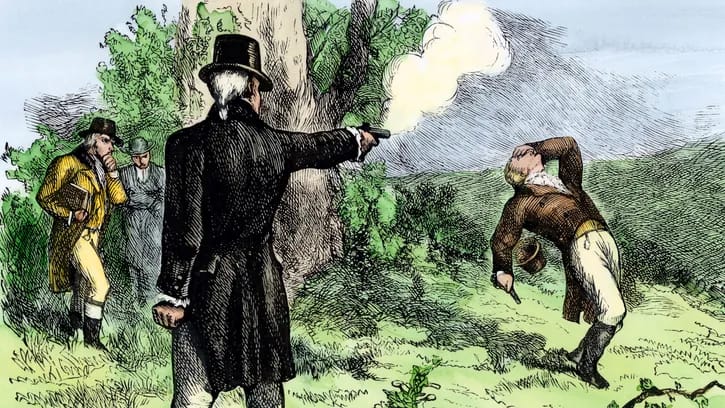
(February 20, 1839): Congress bans dueling in Washington, D.C.
On this day in 1839, U.S. Congress made dueling in Washington, D.C., a felony punishable by up to 10 years of hard labor. The tipping point for the bill had come in 1838: Kentucky Rep. William Graves and Maine Rep. Jonathan Cilley had dueled, which had led to Cilley's death by Grave's hand.