- Basedment
- Posts
- Why is Trump in the UK for a second time?
Why is Trump in the UK for a second time?
Your daily dose of geopolitical updates and strategic analysis. Unbiased, but not unbased.

Editor-in-Chief
September 18, 2025
THE BRIEFING
Here’s what’s happening in geopolitics today.
Welcome back to your daily briefing. Here’s a quick run-through of the biggest geopolitical developments making headlines.
From deadly Russian strikes in Ukraine and a drone scare in Warsaw, to a second U.S. strike on a Venezuelan boat and Denmark’s big investment in Greenland, it’s been an eventful 24 hours. We’re also watching Thailand’s new prime minister roll out his cabinet as he looks to steady the country’s politics.
And in today’s deep dive we explore why President Trump has arrived in the UK for a second time.
THE LAST 24 HOURS IN GEOPOLITICS
1. Charlie Kirk shooting suspect charged as prosecutor seeks death penalty
Prosecutors in Utah have formally charged 22-year-old Tyler Robinson with aggravated murder and related offenses in the killing of conservative activist Charlie Kirk, and on Tuesday announced they will seek the death penalty should he be convicted. They allege Robinson fired a single rifle shot from a rooftop during a public event at Utah Valley University, then attempted to cover up his involvement by directing his roommate to delete messages and stay silent. Authorities say the case is being treated as politically-motivated, citing text messages in which Robinson confessed and expressed resentment toward Kirk's views.
read more
2. Trump arrives in Britain for second state visit
Trump has arrived in the UK for his historic second state visit, from September 17-19, hosted by King Charles III at Windsor Castle, a rare honour not normally granted to American leaders on a second term. he visit’s agenda mixes royal pomp with serious diplomacy: there’s a £31 billion “Tech Prosperity Deal” with the UK focused on AI, quantum computing, and nuclear energy, along with discussions on trade, steel tariffs, and geopolitics.
read more
3. Four arrested after Trump, Epstein images projected onto Windsor Castle
Late Tuesday, four people were arrested after images of Donald Trump alongside convicted sex offender Jeffrey Epstein were projected onto Windsor Castle as part of a protest timed with Trump’s second state visit to the UK. The projection included a controversial birthday letter allegedly written by Trump to Epstein (which the White House denies), along with images of Epstein’s victims and related news clips.
read more
4. Korea-US trade talks remain in deadlock after raid fuels tension
South Korea and the U.S. remain deadlocked over key details of their $350 billion investment fund, part of a trade deal agreed in July, particularly over how much of the money should be direct investment versus guarantees and its effects on Korea’s foreign exchange market. The tension deepened after an aggressive U.S. immigration raid at a Hyundai-LG battery plant in Georgia, which Seoul says is fuelling concerns among Korean companies considering investment in the U.S. under the deal.
read more
5. Under US pressure, Syria and Israel inch toward security deal
Under U.S. pressure, Syria and Israel are fast-tracking talks on a security pact that Damascus hopes will roll back recent Israeli land seizures, though those involved say the deal would stop well short of a full peace treaty. The proposals include restoring the 1974 demilitarised buffer zone, ending Israeli airstrikes and ground incursions, and removing Israeli troops from newly seized territory. Key sticking points remain, especially over the Golan Heights, which neither side has agreed to address yet, showing how fragile and limited any agreement is likely to be.
read more
DAILY DEEP DIVE
WHY IS TRUMP IN THE UK FOR A SECOND TIME?
Donald Trump has arrived in the United Kingdom for his second state visit. The trip comes at a politically sensitive moment for Prime Minister Keir Starmer, who is navigating internal Labour Party discontent, reputational fallout from the Epstein scandal involving former ambassador Peter Mandelson, and a broader narrative of national decline. For the UK, the visit is framed as a high-stakes opportunity to showcase the “special relationship” and attract investment, while for Trump it represents both prestige and a platform to project his America-First vision abroad.
The Schedule and Ceremonial Highlights
The visit is structured around two main pillars: royal pageantry and diplomatic engagement. Trump and the First Lady are staying at Windsor Castle, with King Charles and Queen Camilla leading the ceremonial aspects. The itinerary features a royal salute, a carriage procession, guard of honour, and a potential flypast of British and American fighter jets. A state banquet and tours of royal collections further emphasize the grandeur. Beyond ceremony, Trump will attend bilateral meetings with Starmer at Chequers, engage business leaders in technology and energy sectors, and deliver a press conference aimed at projecting transatlantic solidarity.
The choice of Windsor Castle rather than central London is not incidental. It reduces exposure to protests and highlights the monarchy’s role in anchoring continuity and tradition. The UK is deliberately deploying pomp and ritual to both flatter Trump and remind audiences of its soft power assets.
Key Policy Issues and Strategic Stakes
Trade and investment are top of the agenda. London is seeking commitments in advanced technologies such as AI, quantum computing, and data centers, as well as cooperation on nuclear energy through small modular reactor agreements. These initiatives are designed to speed deployment and create bilateral industrial synergies. Tariffs, particularly on steel and aluminium, remain unresolved and symbolize the structural friction in the relationship.
Foreign policy adds another layer of complexity. Both sides are expected to reaffirm support for Ukraine, though differences in approach remain. Trump has called Russia “the aggressor” in recent months, and the UK will try to lock this stance into concrete commitments. Gaza presents a sharper divergence: Britain is preparing to recognise Palestinian statehood at the United Nations, a position that sits uncomfortably alongside Trump’s pro-Israel rhetoric.
Migration and free speech are further pressure points. UK officials fear that Trump could wade into domestic debates in ways that stoke far-right narratives or undermine Starmer’s government. The shadow of the Epstein scandal lingers as well, with concerns that Trump’s own past associations, along with Prince Andrew’s, could overshadow the carefully choreographed schedule.
Royal and Soft Power Dimensions
The UK is leaning heavily on symbolism. Carriage rides, royal banquets, military pageantry, and ritualised ceremony are intended not just to impress Trump but to broadcast Britain’s continued relevance on the global stage. For Trump, who is known to enjoy grand displays, the spectacle reinforces his self-image of being treated as a world-shaping figure. For Britain, the monarchy acts as a diplomatic tool, giving weight to an otherwise transactional agenda.
Public Sentiment and Risks
Trump remains deeply unpopular with wide segments of the British public. Protests are expected in Windsor and London, with campaigners already staging dissent such as projecting Epstein-related images onto Windsor Castle. For Starmer, the optics are precarious. Hosting Trump risks accusations of deference, but any perceived misstep could also fuel criticism of incompetence or weakness. Managing these tensions is as important as any formal agreement.
Our Assessment
This state visit is less about sweeping breakthroughs than about symbolism, relationship management, and political theatre. Incremental agreements in trade, nuclear energy, and technology may be announced, but they are unlikely to transform the economic landscape. The true value lies in optics: Britain presenting itself as diplomatically relevant, and Trump reinforcing his stature as a global power broker. For the UK, the risk is that the visit becomes remembered less for policy gains and more for controversy, whether through Trump’s remarks, protest movements, or resurfacing scandals. If it goes smoothly, London can claim renewed transatlantic alignment at a moment of uncertainty. If not, it could deepen perceptions of political fragility and diplomatic overreach.
Sources:
Sources available on request, reduced to maintain visual integrity of page.
TWEET OF THE DAY
Not what I was expecting…
Twitter is a bubble
Coding - 4%
— Dennis (@dkardonsky_)
9:11 PM • Sep 16, 2025
TODAY IN HISTORY
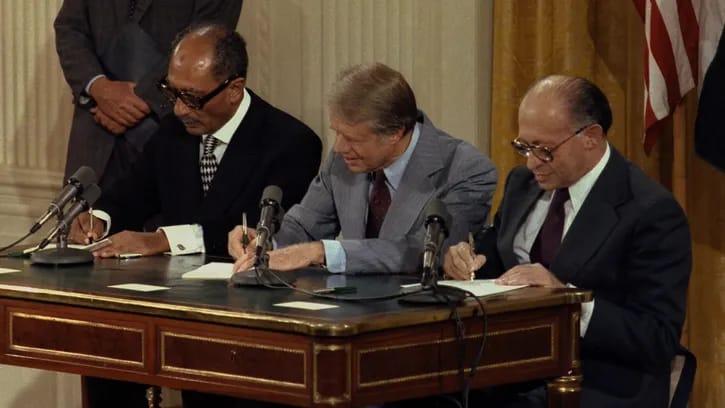
(September 17, 1978): Camp David Accords concluded
The Camp David Accords, negotiated by U.S. President Jimmy Carter, were completed this day in 1978, leading to a peace treaty between Egypt and Israel and a broader framework for pursuing peace in the Middle East.