- Basedment
- Posts
- Will War Reach The Euphrates Again?
Will War Reach The Euphrates Again?
Twelve months after Assad’s fall, Syria’s post-war landscape remains fraught with political tension, Kurdish–Turkish friction, and signs that the fragile new order could be slipping toward renewed instability.

Editor-in-Chief
December 08, 2025
THE BRIEFING
Here’s what’s happening in geopolitics today.
Border clashes, critical infrastructure strikes and a regional coup scare dominate today’s headlines, with Thailand launching air strikes on Cambodia and Russia targeting a key dam in Ukraine’s Kharkiv region.
Nigeria has deployed jets and troops to help dislodge coup plotters in neighbouring Benin, while South Korea hands down a prison sentence in the high-profile blackmail case involving football star Son Heung-Min. Syria also marks one year since Assad’s fall with a symbolic gift from MBS.
In today’s Deep Dive, we examine why Syria’s first year without Assad is showing cracks — from U.S. signalling on decentralisation to rising Kurdish–Turkish tensions and military posturing across the north.
THE LAST 24 HOURS IN GEOPOLITICS
1. Thailand launches air strikes at Cambodia as border tensions reignite
The military of Thailand announced it launched air-strikes early Monday along the disputed border with Cambodia, after Bangkok said Cambodian troops opened fire. The strike reportedly killed one Thai soldier, wounded four others, and struck several Cambodian military positions. Cambodia’s defence ministry confirmed its forces were targeted and denied initiating the earlier fire, rejecting claims it provoked the attack and urging immediate de-escalation. The new strikes raise serious doubts about the stability of the ceasefire brokered in October, triggering mass evacuations of border-region civilians.
read more
2. Russia strikes key Pechenihy Reservoir dam in Kharkiv region
Russian forces struck the Pechenihy Reservoir Dam in Ukraine’s Kharkiv region, prompting authorities to shut all traffic across the structure as emergency crews assess the damage. The dam supplies water and supports logistics for nearby communities, raising concerns that the attack could disrupt water supply, civilian services, and critical transport routes. Local officials warned residents to stay away from the site while damage assessments continue, and Ukraine’s 16th Army Corps said contingency plans are ready in case the strike causes “critical damage.”
read more
3. Nigeria says it deployed jets, troops to Benin to ‘dislodge coup plotters’
Nigeria says it deployed Air Force jets and ground troops into the neighbouring Benin Republic this week to help “dislodge coup plotters” after mutinous soldiers seized the national TV station and announced the overthrow of the government. Acting on a formal request from Benin’s government, Nigerian forces intervened under regional protocols, helping restore control and prevent the coup from gaining hold.
read more
4. Woman who blackmailed South Korean football star Son Heung-Min jailed for 4 years
A South Korean court has sentenced a woman to four years in prison for blackmailing Son Heung-min by falsely claiming she was pregnant with his child and extorting 300 million won (roughly US $200,000) from him. The woman, surnamed Yang, was joined by an accomplice who received a two-year sentence for attempted blackmail; both had been detained since May. The verdict followed evidence that Yang sent a foetal ultrasound image to Son in 2024 and threatened to go public unless he paid, concluding a high-profile case that drew major media and public attention in South Korea.
read more
5. Syria’s Al-Sharaa reveals MBS gift on first anniversary of toppling Al-Assad
Ahmed Al‑Sharaa revealed that Mohammed bin Salman (MBS) gave a piece of the Kaaba’s cloth to be placed in the Umayyad Mosque as a symbolic gift, on the first anniversary of the overthrow of Bashar Al‑Assad’s regime. The gesture was announced as part of nationwide celebrations marking one year since the collapse of the Assad government and Syria’s shift in foreign alignment toward Gulf Arab states under Al-Sharaa’s leadership.
read more
DAILY DEEP DIVE
AS DAMASCUS CELEBRATES, THE EUPHRATES REMAINS SILENT
Context
As Syrians mark one year since the rebels toppled the Assad regime in a lightning offensive no one predicted, serious tensions continue to simmer beneath the celebrations. We’ve covered parts of this before, but new developments are adding fresh pressure to an already fragile post-war landscape. Military parades are happening in major cities across Syria, with just as many celebrations for the one year anniversary, but the eastern Syrians have been banned from celebrating under new orders from the SDF — which has caused a nationwide and online uproar.
Tom Barrack Opens A Can Of Worms
On 6 December, US Envoy Tom Barrack was asked about decentralisation in Syria. His answer was blunt: “Decentralization has never really worked anywhere in this region… you look at what happened in the Balkans… it’s a mess.” He added that the future system of governance should be decided by regions, tribes and cultures, but didn’t endorse autonomy outright. Unsurprisingly, this triggered backlash online — particularly from pro-Kurdish voices who saw it as undermining long-sought autonomy in the northeast. The reality is deeply geopolitical. The U.S. has long backed the Kurds, from their pivotal role leading the anti-ISIS campaign to hosting U.S. bases and training alongside SOF. But strategically, they remain cornered. Trump is pushing hard for a Middle East peace deal, building ties with al-Sharaa while strengthening relations with Erdogan — and both men view Kurdish autonomy as a national and regional threat. As Kissinger famously said,”it may be dangerous to be America's enemy, but to be America's friend is fatal.” The Kurds are putting their faith into their well trained armies, but more so that their U.S. relationship will protect them – as that is the only obstacle holding back Erdogan.
Kurd’s Shoot themselves In The Foot
Over recent weeks, tensions have escalated sharply. We’ve reported on everything from theft of Kurdish farmland in Afrin to full-blown skirmishes along the Euphrates. Small flashpoints are appearing with increasing frequency. Turkish military vehicles have now crossed into northern Syria, prompting some analysts to warn of an approaching catalyst for open conflict, with Turkey at the forefront. Others argue it’s a calibrated show of force, especially after the SDF banned all public gatherings on 8 December, the anniversary of Assad’s fall. While the SDF governs large swathes of territory, many inhabitants are Arab, and the leadership fears celebrations could morph into anti-Kurdish riots. However, this has simply blowback in their faces and has caused an uproar online, but more importantly has undermined Kurdish credibility in the region.
Meanwhile, Turkey has initiated significant military shipments into northern Syria, with notable deployments toward Afrin, Serikaniye and Aleppo. Afrin remains a Kurdish-majority enclave, and Aleppo’s Sheikh Maqsoud district is another Kurdish stronghold. Separate footage appears to show Syrian government convoys moving through Deir Ezzor — adding to the sense of posturing, if not preparation for something larger. A more benign interpretation is that these deployments may simply be for upcoming military parades. But taken together, the signals are increasingly hard to ignore: the post-Assad order is volatile, crowded with competing interests, and dangerously close to tipping into a new phase of conflict.
Overall, we’re not trying to be pessimistic. There are real signs of progress in Syria — full days of electricity are slowly becoming normal, the Caesar Act is set to be repealed, and new investment will eventually follow. But alongside these gains, cracks still linger, and in some areas they’re beginning to widen.
Sources:
News/Journal sources available upon request, not shown to maintain visual integrity of page.
TWEET OF THE DAY
Yet it still feels like every asset class is near all time highs… Interesting!
TODAY IN HISTORY
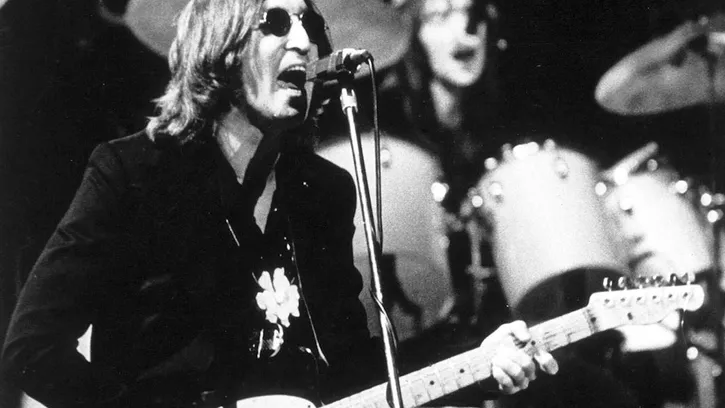
(December 8, 1980): John Lennon fatally shot
On this day in 1980, British musician John Lennon—who rose to fame with the Beatles and had a successful solo career—was fatally shot by Mark David Chapman in New York City, causing a global outpouring of grief.