- Basedment
- Posts
- Zelensky Associates Caught In Corruption Scandal
Zelensky Associates Caught In Corruption Scandal
Your daily dose of geopolitical updates and strategic analysis. Unbiased, but not unbased.

Editor-in-Chief
November 12, 2025
THE BRIEFING
Here’s what’s happening in geopolitics today.
From renewed instability in Pakistan to high-stakes diplomacy in the Indo-Pacific, the week is shaping up to be one of shifting alliances and simmering unrest.
Australia and Indonesia inked a landmark defence pact, while tragedy struck Turkey’s military aviation program after a fatal crash near the Georgian border. Meanwhile, climate tensions flared in Brazil as protests briefly disrupted the COP30 summit.
And in today’s deep dive we’re going over the newly unearthed corruption within Ukraines’s energy sector.
THE LAST 24 HOURS IN GEOPOLITICS
1. Turkish military cargo plane crashes near Georgia and Azerbaijan border
A Turkish military C-130 cargo plane crashed in Georgia near the Azerbaijan border after departing from Azerbaijan en route back to Turkey, with 20 personnel reported on board. Turkish and Georgian authorities launched joint search and rescue operations, and Turkey’s President referred to those aboard as “martyrs,” The mishap raises fresh questions about aircraft age and safety protocols in the region’s militaries, as the 57-year-old aircraft reportedly disintegrated mid-air before impact.
read more
2. Tens of thousands fill streets of Poland’s capital for Independence March
Tens of thousands of people packed the streets of Warsaw for Poland’s annual Independence March, marking November 11 with a display of national pride under heavy police supervision. The gathering featured white-and-red flags, family groups, football ultras and far-right nationalists, with attendees voicing concerns about sovereignty, migration and the country’s direction. While the event passed without major incident this year, the size and composition of the crowd highlight the enduring potency of nationalism in Poland and underline the continuing tensions between traditional patriotic movements and the liberal government.
read more
3. Australia and Indonesia strike landmark security treat
Australia and Indonesia announced a landmark security treaty that commits both nations to consult regularly at leader and ministerial levels in the event either faces a threat, a move Australian Prime Minister Anthony Albanese called a “watershed moment.” While the pact stops short of a full mutual defence obligation, it significantly deepens the strategic partnership between these neighbours amid shifting Indo-Pacific dynamics. The agreement builds on previous cooperation and is designed to strengthen shared regional security interests.
read more
4. Suicide bombing in Pakistan capital kills 12, raises regional tension
A suicide bomber struck outside the Islamabad district courts on Tuesday, killing at least 12 people and injuring 27 others in the deadliest attack in the Pakistani capital in nearly a decade. The blast, which targeted a police vehicle after the attacker failed to enter the court, was claimed by the Tehrik‑e‑Taliban Pakistan (TTP) and signals a sharp escalation of violence within Pakistan’s heartland. The incident has raised serious regional tensions, with Pakistani officials warning that Kabul may face military repercussions unless it cracks down on militants operating from Afghan soil.
read more
5. Protesters force their way into COP30 Summit Venue, clash with security
Dozens of protesters forced their way into the COP30 climate summit venue in Belém, Brazil, on Tuesday, clashing with UN and Brazilian security guards at the main entrance. Protesters, including Indigenous leaders, chanted slogans like “Our land is not for sale” and demanded stronger action on forest protection and climate justice. The altercation left two security personnel with minor injuries, triggered a temporary evacuation of delegates, and underscored how activism is increasingly converging with high-level diplomatic negotiations.
read more
DAILY DEEP DIVE
IS ZELENSKY IN THE CROSSFIRE?
NABU with the help of SAP, is back in the spotlight but this time, it’s not under attack; it’s leading the charge. Yes, the very same anti-corruption agency that the Zelensky government tried to rein in through legal manoeuvres in July is now taking aim at the country’s power elite.
In a sweeping crackdown, Ukraine’s anti-corruption agency, the National Anti‑Corruption Bureau of Ukraine (NABU), has exposed what it describes as a “high-level criminal organisation” that allegedly commandeered control of the state-owned nuclear energy company Energoatom and extracted bribes of 10-15% of every major contract. NABU says the scheme spanned 15 months of wire-taps and 1,000 hours of surveillance, culminating in 70 raids. The annual revenue of Energoatom is around €4 billion (Hr 200 billion) according to NABU.
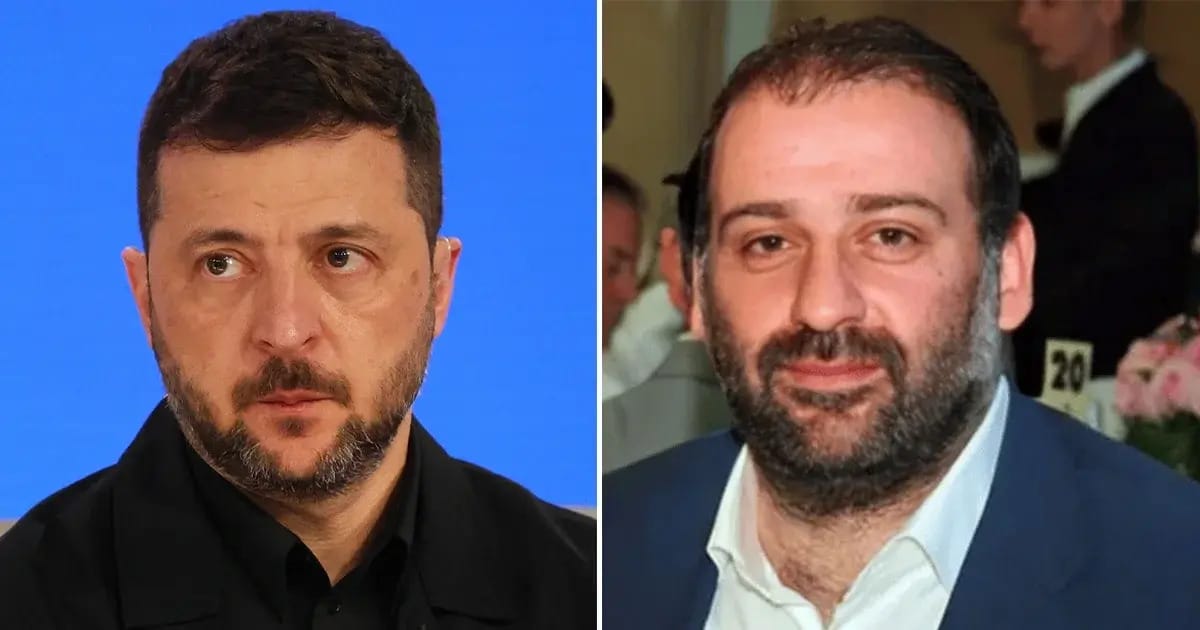
Key suspects include Timur Mindich, a producer and former business partner to President Volodymyr Zelenskyy—who allegedly acted as the ringleader. Zelensky had even hosted his own birthday at the apartment of Mindich in 2021, just to give you a reference for how close the relationship was or is.
According to the Kyiv Independent, Mindich used the alias “Karlsson” in taped conversations and is suspected of orchestrating kickbacks through associates. Others implicated include former advisor Ihor Myroniuk (alias “Rocket”) and ex-prosecutor/security-head Dmytro Basov (alias “Tenor”), both said to have exerted influence inside Energoatom’s procurement processes. Deputy PM Oleksiy Chernyshov (alias “Che Guevara”) and current Justice Minister/ ex-Energy Minister Herman Halushchenko (alias “Professor”) are also named.
Tapes reportedly show the group threatening contractors: “It’ll be total … chaos for the whole line of companies … you’ll just end up on the blacklist,” Myroniuk allegedly said. The scheme also reportedly avoided construction of protective installations for energy sites – even as they discussed funneling money into a company they controlled. NABU and the Specialised Anti‑Corruption Prosecutor’s Office (SAPO) say they are working with the government to ensure punishment. Taped conversations allegedly show Myroniuk threatening to revoke certifications, cancel technical specs, blacklist firms, and even have their employees conscripted. And just to add, this was not a small operation, NABU have recorded over 1000 hours of wiretapping audio which will be released.
Zelenskyy has publicly backed the investigation, stating that “integrity within the company is a priority” and that “everyone who has been involved in corruption schemes must face clear legal consequences.” Yet questions are already being asked as to how Mindich was tipped off just hours before the raids began.
So What Does This Mean?
When a major crackdown like this happens in a democratic country, it should be seen as a positive sign, proof that the system still works. NABU is doing exactly what it was created to do: tackling corruption at the highest levels, and doing so effectively. This is just one of many high-profile operations the agency has carried out, and its persistence is a reminder that accountability is essential, even during wartime. Those who downplay or ignore these actions for fear of damaging Ukraine’s or Zelensky’s image are missing the bigger picture. Corruption is a cancer that eats away at a nation from within, and confronting it head-on is vital for Ukraine’s long-term stability. Hiding or softening these stories would only weaken the country’s democratic credibility. At the same time, Zelensky faces a difficult dilemma — NABU’s independence is both a political risk and a necessity. He can’t afford to alienate the agency, especially since it has strong backing from Western partners whose support remains critical for Ukraine’s war effort.

Sources:
News/Journal sources available upon request, not shown to maintain visual integrity of page.
TODAY IN HISTORY
(November 12, 1990): Akihito enthroned
Japanese Emperor Akihito—according to tradition, the 125th direct descendant of Jimmu, Japan's legendary first emperor—was formally enthroned on this day in 1990, nearly two years after the death of his father, Hirohito.
