- Basedment
- Posts
- Zelensky at the White House: What To Expect
Zelensky at the White House: What To Expect
Your daily dose of geopolitical updates and strategic analysis. Unbiased, but not unbased.

Editor-in-Chief
August 18, 2025
THE BRIEFING
Here’s what’s happening in geopolitics today.
Today’s briefing brings together a mix of stories shaping global headlines, from the ongoing war in Ukraine to diplomacy in the Middle East.
In Kharkiv, another deadly drone strike underscores the human cost of Russia’s campaign, while in Gaza, mediators press for a fragile ceasefire. Bolivia is entering uncharted political territory after voters broke with two decades of socialist rule, and Iran signals it’s still open to talks with the IAEA despite strained relations.
We wrap up with mass protests across Israel and then turn to our deep dive, where European leaders prepare to join Ukraine’s Zelenskyy for a White House meeting with Donald Trump. We’ll dive into what to expect.
THE LAST 24 HOURS IN GEOPOLITICS
1. Russian drone attack kills seven in Kharkiv, including two children
Kharkiv was hit hard overnight in a brutal drone strike that set an apartment building ablaze. Ukrainian officials confirmed at least three people were killed and 17 injured, many of them children, with rescuers still pulling people from the rubble as medics tended to the wounded. Witnesses described widespread destruction include shattered windows, charred walls, and chaos in the streets as emergency crews worked through the aftermath.
read more
2. Qatar PM travelling to Egypt for new Gaza talks
Qatar’s Prime Minister is set to travel to Egypt as mediators, alongside the U.S. to redouble efforts to broker a renewed 60-day ceasefire in Gaza, one that includes phased hostage releases and unfettered humanitarian access. The trip comes amid mounting pressure to break a recent stalemate and prevent a possible Israeli military escalation in Gaza City. Both Cairo and Doha underscored their continued commitment to meaningful negotiations, even as key sticking points remain unresolved.
read more
3. Voters end two decades of Socialist Party rule in Bolivia
In a surprise turn of events, Bolivian voters delivered a major blow to two decades of socialist rule. None of the top left-wing figures even made it past the first round, setting the stage for a runoff between moderate Rodrigo Paz and conservative ex-president Jorge Quiroga. Rodrigo Paz, once polling at just 3%, surged to the front with over 30% of the vote, while the socialist Movement Toward Socialism (MAS) saw its support collapse amid economic turmoil and internal division. The runoff, due in October, marks a political sea change for Bolivia.
read more
4. Iran says it will continue talks with IAEA after curbing access
Iran’s Foreign Ministry spokesman, Esmaeil Baghaei, announced on Monday that talks with the U.N. nuclear watchdog (IAEA) are ongoing, and that both sides are aiming for another round of negotiations in the coming days. Despite suspending cooperation earlier this summer, Tehran continues dialogue, even as inspections remain stalled and access to crucial sites curtailed. This marks a cautious diplomatic step forward amid heightened tensions over Iran’s nuclear activity and growing international calls for renewed transparency.
read more
5. Israelis stage nationwide protests to demand end to war and release of hostages
Nationwide protests and a sweeping general strike erupted across Israel as thousands demanded an end to the war and the safe return of those still captive, with demonstrations shutting down cities like Tel Aviv and Haifa and bringing daily life to a halt. Released hostages, Holocaust survivors, and ordinary citizens marched with yellow flags and photos of loved ones, warning that continued military escalation threatens the remaining hostages’ lives while adding pressure on Prime Minister Netanyahu to negotiate a ceasefire.
read more
DAILY DEEP DIVE
THE SCRAMBLE TO WASHINGTON
The Alaska Summit: Reading Between the Lines
The Alaska summit was billed as historic, yet from the outset it raised more questions than answers. Putin and Trump’s face-to-face lasted just two and a half hours, short of the expected five to six hours. Lunch was skipped, and reporters from MSNBC noted Witkoff and the U.S. Treasurer appearing anxious during breaks. Vice President J.D. Vance was not present inside the meeting room, despite expectations he would play a role. All of these signs point to the possibility that something significant happened behind closed doors, something neither side is yet willing to show publicly.
At the same time, Moscow released short, carefully staged footage of Putin and Trump smiling and in good spirits. The release itself was strategic, it projects calm, unity, and control, even if behind the scenes the situation may have been anything but.
Prior to Washington
Initially, Zelensky was expected to attend alone. Yet within hours, Ursula von der Leyen, Mark Rutte, Emmanuel Macron, Giorgia Meloni, and even (a last minute addition) Keir Starmer were en route. Some commentators have suggested the urgency suggests they were tipped off, likely by someone in Trump’s orbit, that Putin had gained more ground in his private exchanges with Trump than anyone anticipated. If this had been a routine discussion, Zelensky would have arrived solo as planned. Instead, the Europeans mobilized in force, creating the image of a united bloc unwilling to let Trump and Putin dictate terms without them.
Trump’s Shift In Diplomatic Tone
To back some of claims, we immediately saw Trump change some of his stances. Prior to Alaska, his central objective was a ceasefire, backed by threats of new sanctions if Putin refused to yield. Now, Trump is abandoning that approach and focusing entirely on securing a peace deal. Which would favour Putin, as it gives more time for Russia to gain leverage on the battlefield. The change in posture is significant, Trump appears to believe progress is being made with Putin and no longer wants to risk derailing it with fresh sanctions.
Just a couple hours ago, Trump posted on Truth Social that Ukraine should formally give up Crimea and commit to never joining NATO. These are maximal concessions to Russia. He will also likely tout the idea of Zelensky giving up the remaining fortress-like Donetsk. The logic is clear: Trump sees territorial concessions as the price of “peace.” The Europeans, however, see this differently. For them, legitimising Crimea’s annexation and removing NATO as an option would amount to rewarding Russian aggression.

Note: Critics often argue Trump is impressionable, quick to change course after a single conversation. Yet he also deploys unpredictability as a negotiation tool. The result is on display here: he meets Putin, sides with him publicly, and suddenly world leaders scramble to Washington. The same could be said with Putin, it was only recently that Trump took a sharp turn and promised more support to Ukraine due to Russia’s indiscriminate bombings, which he stated he learned of from his wife. But this tactic does leave vulnerability for manipulation.
The European Dimension
The sudden involvement of Europe has two possible explanations. First, that they were reacting to whispers from within Trump’s team that the U.S. president was leaning dangerously close to Putin’s terms. Second, that they wanted to demonstrate unity and ensure their voice was heard in a negotiation that directly affects their continent.
This is where the real problem lies: neither Trump nor the EU sees themselves as a global power. Trump prefers bilateralism, grand deals struck leader-to-leader, often dismissing multilateral structures as slow and ineffective. The EU, meanwhile, struggles with fragmentation and indecision. This fragmentation only reinforces Trump’s belief that the EU is incapable of acting as a coherent geopolitical actor.
By arriving en masse, the Europeans are signalling two things: first, that they are united behind Zelensky and unwilling to see him sidelined; second, that Trump must recognise their relevance in shaping any European security architecture. It is a reminder that Washington cannot dictate terms alone on the European continent. They are also looking to avoid the infamous last meeting that Zelensky had with Trump and his top aides.
We should also consider Zelenskys recent public statements: Ukraine’s constitution forbids giving up land, and Zelensky says any territorial talks must involve Ukraine, Russia, and the U.S., together. And suggests if Russia does not cooperate, the West should apply more pressure through isolation and sanctions. He also today made a post today, calling for ‘lasting peace’ in Europe. Suggesting that there needs to be backed security guarantees with substance if Ukraine meets with Russia for peace.

European leaders attending the meeting.
The Optics of Power
Trump’s behaviour adds another layer. He puts on a spectacle for Putin because he views Russia as an “old world power”, an empire with history, grandeur, and weight. Many in the West viewed this as a disgrace given Putin’s opposition to the West. But Trump is a deal maker, he wants to make the man, who he sees as stronger hand, feel welcomed - its only natural in deal making and diplomacy.
The EU, in contrast, he views as economically strong but politically paralysed—lagging behind the U.S. and China in innovation and unable to project geopolitical weight. Furthermore, Trump see’s Putin as an equal adversary on top of the fact for his dislike of multilateral thinking. This contrast matters: Putin commands his respect, while the EU remains a group of leaders he has often clashed with both publicly and privately.
That dynamic makes Alaska all the more precarious. If Trump respects Moscow more than Brussels, and the EU lacks the capacity to project power, the Europeans may find themselves spectators to a U.S.-Russia bargain. Their sudden dash to Alaska shows they understand this risk, and are desperate to prevent it.
Sources:
References available upon request. A full citation list has been omitted to preserve the visual integrity of the page.
TWEET OF THE DAY
Legendary meme from the Newsom Press Office…
A highly anticipated “showdown”
— Governor Newsom Press Office (@GovPressOffice)
12:57 AM • Aug 18, 2025
TODAY IN HISTORY
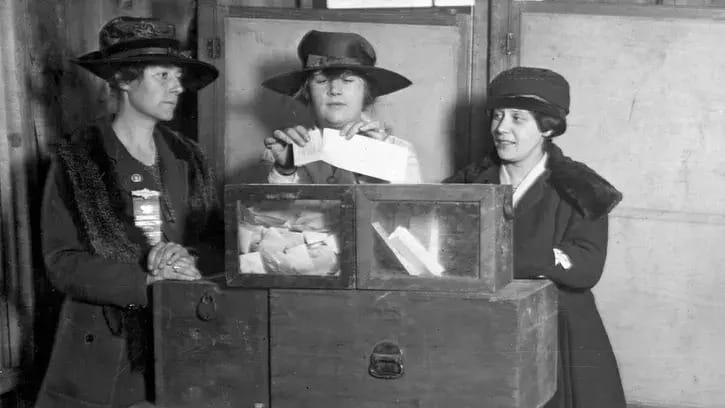
(August 18, 1920): Women’s right to vote in the USA
On this day in 1920, the Nineteenth Amendment was ratified after Tennessee, by a single vote, became the 36th state to approve it, concluding a 72-year struggle to secure women’s right to vote in the United States.