- Basedment
- Posts
- Zelensky's Middle East Tour, U.S. Unprepared For Modern War?
Zelensky's Middle East Tour, U.S. Unprepared For Modern War?
Today we tackle Zelensky’s visit to the Middle East. A monumental symbol of the changing order of the geopolitical world, as the U.S. lose an important air asset to a new form of warfare

Editor-in-Chief
March 30, 2026
THE BRIEFING
Here’s what’s happening in geopolitics today.
Today’s headlines stretch from the streets to the seas, with protests erupting across the U.S. against Trump, while Zelensky is signing new air-defence deals in the Gulf as Ukraine deepens its security ties.
At the same time, China and the Philippines are back at the negotiating table over South China Sea tensions, regional powers are heading to Pakistan to discuss ending the Iran war, and two humanitarian aid boats have safely made it to Havana after being located by the Mexican Navy.
In today’s deep dive, we tackle Zelensky’s visit to the Middle East. A monumental symbol of the changing order of the geopolitical world, as the U.S. lose an important air asset to a new form of warfare - to quote Zelensky “you will feel it soon”.
SUPPORT OUR PODCAST!
We just released our first duo-pod, this is a great one to crack open a beer to — more of a relaxed vibe and just a chat about what’s going on in the world.
In the podcast we discussed: Iran, Russia-Ukraine, the potential ground invasion and whether Bibi is alive or not!
Click Here To Listen (And Sub!) - Youtube
We’re Also on Spotify CHA
THE LAST 24 HOURS IN GEOPOLITICS
1. No Kings protesters across the US rally against Donald Trump
Thousands of protesters marched through cities across the U.S. as part of the nationwide “No Kings” demonstrations, calling out Donald Trump over issues including the Iran war and U.S. immigration enforcement policies. The rallies included more than 3,000 coordinated protests held across the United States, drawing large crowds in major cities as opposition to the administration’s actions intensified. Organisers and participants said the demonstrations were aimed at challenging what they view as government overreach and expressing concern about the expanding conflict with Iran.
read more
2. Ukraine’s Zelensky signs air defence deals with UAE, Qatar on Gulf tour
Ukrainian President Volodymyr Zelensky has signed air-defence cooperation agreements with the United Arab Emirates and Qatar during a diplomatic tour of the Gulf aimed at expanding Kyiv’s security partnerships. The deals focus on sharing expertise and technology to counter missile and drone threats, drawing on Ukraine’s experience defending against large-scale aerial attacks during its war with Russia. The agreements come as Gulf states face increased regional security risks and as Ukraine seeks broader international support and cooperation.
read more
3. Philippines, China resume talks, tackle South China Sea tensions
The Philippines and China have resumed high-level talks aimed at easing tensions in the disputed South China Sea, marking the first round of discussions under their bilateral consultation mechanism since early 2025. The meetings covered maritime issues, protection of fishermen and personnel, and potential cooperation on oil and gas development and energy security. Both sides said they would continue dialogue and consultations as they try to manage disputes and prevent further escalation in the strategic waterway.
read more
4. Regional powers to meet in Pakistan to discuss efforts to end Iran war
Regional powers are gathering in Pakistan for high-level talks aimed at finding diplomatic pathways to end the ongoing Iran war. Foreign ministers from countries including Saudi Arabia, Turkey, and Egypt are meeting in Islamabad to discuss de-escalation efforts and explore possible mediation between Washington and Tehran. The talks come as the conflict continues to expand across the region, with Pakistan positioning itself as a potential venue for broader negotiations.
read more
5. Two humanitarian aid boats safely reach Havana, Cuba
Two humanitarian aid sailboats that had gone missing en route from Mexico were located by the Mexican Navy and have now safely reached Havana, Cuba. The vessels were part of an international aid convoy carrying supplies such as food, medicine, and other essential goods to the island amid ongoing shortages. Officials said the boats had been delayed by bad weather but confirmed that all crew members were safe and the mission was able to continue as planned.
read more
RECEIVE A COPY OF OUR 2026 RUSSIA-UKRAINE WAR PREDICTIONS E-BOOK
In this E-Book you will receive all major frontline updates from Sumy to Kherson, hundreds of kilometres analysed to give you the best predictions of where 2026 will go.
Maps, Units, Analysis, Situation Reports.
Refer five like-minded friends to receive the book!
GLOBAL CONFLICT TRACKER
Russia-Ukraine
On the Orikhiv axis, Russian forces launched two mechanised pushes this morning from Robotyne and Inzhenerne, advancing toward Novodanylivka and Mala Tokmachka. The assaults used fog for concealment but were intercepted and halted by Ukrainian units, which are now preparing for a likely follow-up wave. Several vehicles were destroyed during the engagement, while dismounted infantry came under sustained fire. The scale and probing nature of the attacks suggest this was less a full breakthrough attempt and more a reconnaissance-in-force operation, aimed at testing defensive lines, identifying weak points, and setting conditions for potential future assaults with reinforced elements.
Three BM-30 Smerch/Tornado-S MLRS systems, along with a transport-loader vehicle, were destroyed in Ukrainian strikes on a Russian rocket artillery base in Crimea overnight on March 29. This is a notable hit. It took nearly four years of high-intensity war for Russia to record confirmed losses of three BM-30 systems via Oryx. A single strike potentially matching that figure highlights a sharp increase in impact. Beyond the equipment loss, this points to improving Ukrainian medium-range strike capabilities, with the ability to locate and hit high-value artillery assets deep behind the front line. While the Russians prioritise striking the logistics routes of Ukrainian frontlines (which has had devastating effects), the Ukrainians continue to focus on disabling AA and long-range systems.
Source
Before getting into this, a quick note for new subscribers — everything we cover is approached from a neutral, analytical standpoint. Volodymyr Zelenskyy has spent the weekend touring the Middle East, standing out as one of the only Western leaders engaging the region amid ongoing conflict. This presents a significant opening for Ukraine to project itself as an emerging middle power, even while fighting the largest land war in Europe since World War II. Two key points stand out. First, Ukraine’s adaptability throughout the war has been notable. Much like Russia, it has been forced to evolve rapidly, absorbing battlefield pressure while simultaneously shaping modern warfare practices. Second, both Ukraine and Russia have contributed to the evolution of modern warfare, particularly in areas like drones and distributed operations. The difference lies in positioning. Russia remains constrained by widespread political isolation, limiting its ability to export that experience. Ukraine, by contrast, has far greater freedom to engage internationally. That creates space to export training, technology, and operational lessons to partners in regions like the Gulf, something now becoming increasingly visible.
Iran-Israel-USA
I’m genuinely not sure what we’re seeing from Western militaries right now, whether it’s complacency, slow adaptation, or a failure to internalise the lessons already written in Ukraine.
The warning signs have been there. During NATO’s Exercise Hedgehog in Latvia, a small Ukrainian drone unit reportedly degraded two battalions within a day. That should have been a wake-up call. Years of real-world iteration in Ukraine, built through constant trial, error, and attrition, have fundamentally reshaped the battlefield. Yet large parts of NATO still appear structured for a previous era.
We’re now seeing similar vulnerabilities emerge in U.S. operations. On paper, strike efficiency remains high. But the gap lies in defending against what is now an “abstract” battlespace, one defined by low-cost, decentralized threats. A fiber-optic drone operating near Baghdad’s Green Zone, FPV drones striking rotary assets like Black Hawks, and the recent Iranian strike damaging KC-135 refueling aircraft all point to the same issue: exposure at depth.
The reported loss of an E-3 Sentry is particularly significant. These are not expendable platforms. The E-3 serves as an airborne command-and-control hub, providing real-time battlefield awareness, tracking airspace, coordinating assets, and effectively acting as the nervous system of air operations. They are rare, high-value assets, with limited numbers in service and long replacement timelines. Losing one is not just a material hit, it directly degrades command, coordination, and situational awareness across an entire theatre.
The Western social media space was quick to mock Russia for failing to protect its strategic air assets, pointing to the lack of even basic measures like hardened shelters or reinforced bunkers. Not long after, similar vulnerabilities are now being exposed on the U.S. side. It seems that Zelensky’s now-famous “you will feel it in the future.” comment during his shouting match with Trump has proved eerily accurate – and much sooner than anyone anticipated.
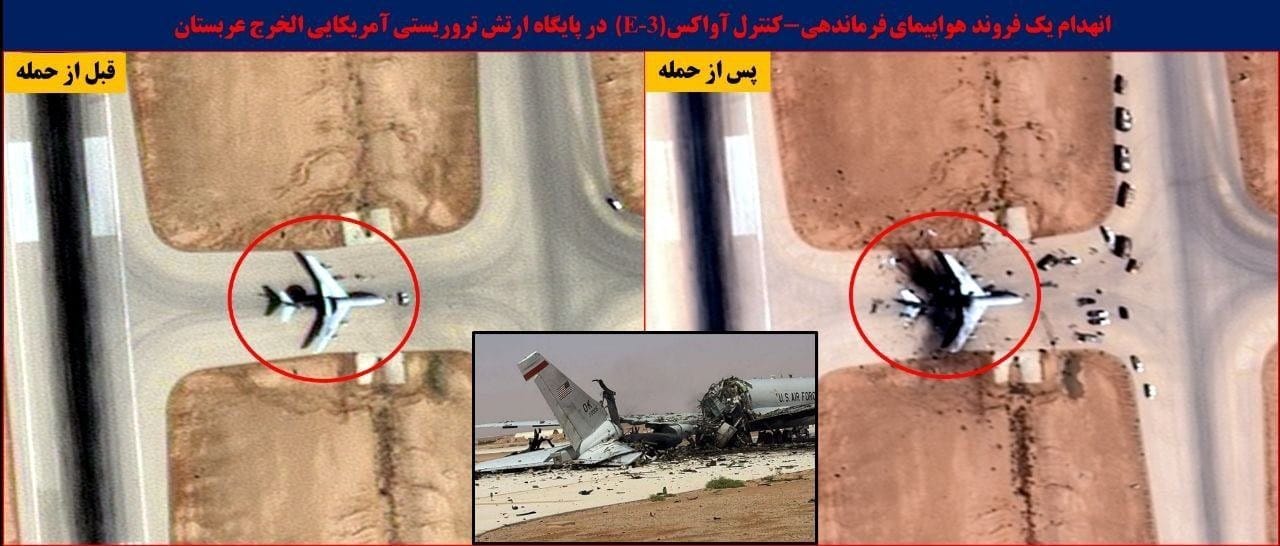
Sources available upon request
Will The U.S. Begin Ground Operations This Weekend? |
TODAY IN HISTORY
(March 29, 1973): American troops evacuated Saigon (Ho Chi Minh City) as the United States ended its involvement in the Vietnam War.