- Basedment
- Posts
- Zelensky's Right-Hand Man Removed - What's Next?
Zelensky's Right-Hand Man Removed - What's Next?
Your daily dose of geopolitical updates and strategic analysis. Unbiased, but not unbased.

Editor-in-Chief
November 30, 2025
THE BRIEFING
Here’s what’s happening in geopolitics today.
Today’s headlines span high-stakes politics, quiet personal milestones, and conflict spreading across land and sea.
Ukraine sees political upheaval at the top and fresh drone strikes aimed at Russia’s oil lifelines, while China flexes its muscles in contested South China Sea waters and Nigeria grapples with another deadly kidnapping.
There’s also a lighter note out of Canberra while in today’s deep dive, we take a closer look at Andriy Yermak’s resignation and what it could mean for Ukraine next.
THE LAST 24 HOURS IN GEOPOLITICS
1. Zelensky’s chief of staff Andriy Yermak resigns after anti-corruption raid
Andriy Yermak, the chief of staff to Volodymyr Zelenskyy and Ukraine’s lead negotiator in U.S.-backed peace talks, has resigned following a raid by anti-corruption investigators on his home and office. The searches were part of an expanding investigation tied to alleged graft at the state nuclear company, though Yermak has not been formally named a suspect; he said he is fully cooperating with investigators. Zelenskyy announced a “reset” of his presidential office, saying the resignation is meant to avoid distraction during wartime and maintain public trust.
read more
2. China’s military, coast guard conduct patrols around Scarborough Shoal
People's Liberation Army Navy (PLA) and the China Coast Guard conducted patrols around Scarborough Shoal, a move Beijing says is intended to “resolutely safeguard” its sovereignty and maritime rights. The patrol report from China’s state-run media offered no detail on the size or scope of the operation, but comes amid a broader pattern of increased Chinese maritime and air activity in the disputed South China Sea waters.
read more
3. Australian PM Albanese marries partner in private ceremony
Anthony Albanese has married his partner Jodie Haydon in a private ceremony held at the official Prime Minister’s residence in Canberra becoming the first Australian prime minister to marry while in office. The intimate event was attended by close family and friends, including their dog “Toto” as ring-bearer and Haydon’s five-year-old niece as flower girl, and the couple said they were “absolutely delighted” to share their commitment in front of loved ones.
read more
4. Abductors kill priest in Nigeria after a month in captivity, church leader says
An Anglican priest, Edwin Achi, who had been kidnapped on October 28 along with his wife and daughter in Kaduna state, Nigeria, has been found murdered after roughly a month in captivity, the killing was confirmed by the national church leadership. At the time of his abduction, the kidnappers had demanded a ransom of 600 million naira (later reduced to 200 million) for his release; his wife and daughter remain missing. Church authorities condemned the killing and called on security forces to identify “the sponsors, financiers, and enablers” behind the wave of kidnappings.
read more
5. Ukrainian naval drones behind ‘successful’ strike on 2 Russian shadow fleet tankers
Security Service of Ukraine (SBU) and the Ukrainian navy say they used sea-drones to strike two oil tankers belonging to Russia’s so-called “shadow fleet” in the Black Sea. According to the official, both vessels were empty en route to Russia’s Novorossiysk port and were critically damaged, effectively taken out of service. Ukrainian authorities say the strikes are part of a broader effort to disrupt Russia’s oil-transport network that helps Moscow evade Western sanctions.
read more
DAILY DEEP DIVE
Yermak Is Gone, But Who Is Next?
Context
Volodymyr Zelenskyy has accepted the resignation of his closest and most influential adviser, Andriy Yermak — the man widely viewed in Kyiv and Western capitals as the second-most powerful figure in Ukraine. His exit comes hours after Ukraine’s anti-corruption agencies raided his home and offices in a pre-dawn operation inside Kyiv’s secure government district.
Yermak wasn’t just Zelenskyy’s chief of staff. Since 2020, he effectively operated as Ukraine’s shadow prime minister and chief diplomat, shaping peace
proposals, handpicking ministers, directing foreign policy, and even involving himself in military decision-making. One Western ambassador described his role bluntly: “He’s the president, the prime minister, the foreign minister… all the ministers put together.”
But Yermak’s downfall was accelerated by a major corruption investigation: Operation Midas. NABU (National Anti-Corruption Bureau) and SAPO (Specialised Anti-Corruption Prosecutor’s Office) — the two independent bodies at the centre of Ukraine’s anti-graft reforms — accused Yermak of orchestrating an attempt to strip their independence earlier this year. He allegedly pushed Zelenskyy to place both institutions under the control of the president’s loyal prosecutor-general. This ended up causing the largest protests since the before the start of the war. We covered this in detail and we considered it one of the decisions that Zelensky could have done as it had substantial negative effects domestically and in the circles of his European allies. The EU is heavily invested in NABO and SAPO and maintains strong connections to the groups. Friday’s raid appears to be part of a broader sweep tied to “Operation Midas”, which has already toppled several top officials and led to an arrest warrant for Zelenskyy’s former business partner, now reportedly abroad.
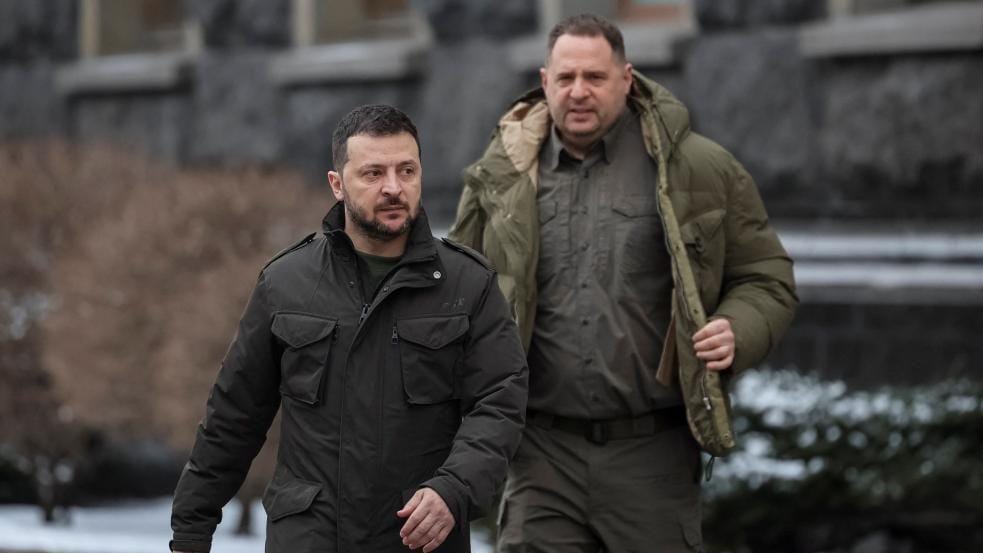
Zelensky (left) Yermak (right)
Dying On The Wrong Hill Has Consequences
Will this affect the peace negotiations? The simple answer is yes. The timing is extremely poor for Zelensky, but he had no choice. Yermak was central to the ongoing peace talks with both the U.S. and Russia, and was scheduled to travel to Miami this weekend to meet Donald Trump’s team. That meeting is now cancelled.
Zelensky has moved quickly to replace him with a new delegation led by Rustem Umerov (NSDC), Chief of General Staff Andriy Hnatov, and representatives from the MFA and intelligence services. While this is ultimately a good outcome for the Ukrainian public, it is not a win for Zelensky. This move should have happened months ago, when the first protests erupted over Yermak’s actions. Instead, Zelensky doubled down and refused to dismiss his right-hand man. There were even rumours Yermak would be removed during the energy sector scandal — yet again, Zelensky held the line. All the while, Yermak was still being used in high-level negotiations with the U.S., which was a clear misreading of the political climate. Only once the raids began did he finally resign. By that point, the damage was already done.
Who’s Next As Zelensky Promises Changes?
One popular name being floated is the current Commander-in-Chief, Oleksandr Syrskyi. He has long had a controversial reputation inside the Ukrainian military. Among frontline troops he is widely disliked, often described as a commander shaped by a Soviet-era mindset and notorious for heavy micromanagement. During the Battle of Bakhmut he was even dubbed the “Butcher of Bakhmut,” accused of ordering repeated counterattacks that cost high numbers of Ukrainian lives with questionable tactical value. Insider accounts also describe him as a chronic micromanager, which many believe has damaged cohesion and slowed Ukraine’s ability to respond effectively to Russian advances.
The backlash is already visible: Bohdan Krotevych, former Azov Chief of Staff, publicly hinted Syrskyi should be next to go, posting “Next up” alongside a snow leopard — Syrskyi’s callsign.
See Bohdan’s tweet
So why would Zelensky put him in this position? Ukraine already had a highly respected and capable commander-in-chief in Valerii Zaluzhnyi. But Zaluzhnyi and the political leadership in Kyiv frequently clashed. Kyiv has often prioritised political symbolism – defending Bakhmut, Avdiivka or Pokrovsk long after it made military sense — while Zaluzhnyi pushed for an attritional approach based on phased withdrawals to stronger defensive lines.
There were also concerns about Zaluzhnyi’s connections to far-right groups that hold social, military and political influence. Ultimately, Zelensky moved him out of the military command structure without provoking backlash against the presidency, appointing him Ambassador to the United Kingdom, a role that preserves Zaluzhnyi’s prestige while removing him from the centre of military decision-making.
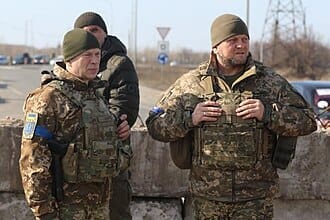
Syrskyi (left) and Zaluzhnyi (right)
Sources:
News/Journal sources available upon request, not shown to maintain visual integrity of page.
TODAY IN HISTORY
(November 29, 1947): United Nations approves resolution for the partition of Palestine
On this day in 1947, the United Nations General Assembly passed Resolution 181, which called for the partition of Palestine into Arab and Jewish states and for placing the city of Jerusalem under a special international regime.